Haegum Performer No Eun-ah's First Solo Recital at New York Carnegie Hall
A New Challenge for Haegum Globalization... Premiere of Original Works by 5 Foreign Composers
"We Will Perform Our Subtle and Deep Sound for the World to Experience Directly"
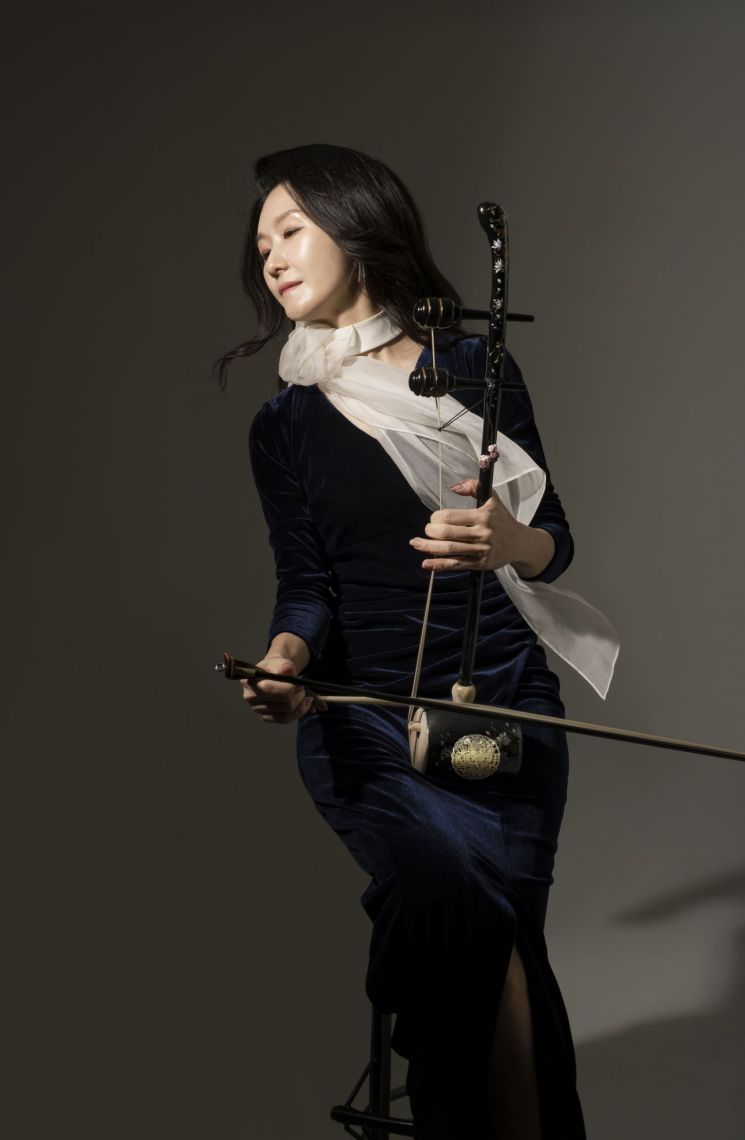 Haegum performer No Eun-ah, a professor in the Department of Korean Music at Seoul National University, said that since the haegum was a widely loved popular instrument during the Goryeo Dynasty, she wants to widely promote its charm so that it can become an instrument loved by people all over the world today.
[Asia Economy Reporter Kim Heeyoon] “The melody that comes from the bow placed between the two silk strings can touch the heartstrings and also stir the spirit. The haegeum, which entered Korea during the Goryeo Dynasty and was loved as a popular instrument with a wide range, I want to widely share this melody so that today's haegeum can become an instrument loved by people all over the world.”
Haegeum player No Eun-ah will hold a solo recital with sanjo and original compositions on April 18 (local time) at Carnegie Hall in the United States. Since the late haegeum master Ji Young-hee performed as a soloist with masters Sung Geum-ryeon and Kim So-hee in 1972, this is the first solo haegeum recital stage. No Eun-ah, a professor in the Department of Korean Traditional Music at Seoul National University College of Music, is a leading haegeum player in Korea known for her powerful melodies that captivate audiences. Having played the haegeum for 30 years this year, she expressed in an interview with Asia Economy on the 29th, “Through the Carnegie Hall performance, I want to suggest the direction the haegeum should take.”
The haegeum has been widely used in the royal court and among the people since the Goryeo Dynasty and was a popular instrument that anyone could easily play. Professor No said, “These days, musicians play guitar on the street, but in the Goryeo era, when people enjoyed leisure in the folk community, the haegeum was an indispensable instrument. The haegeum, which expanded its domain from a traditional instrument to a popular hobby instrument for many, is now advancing further to be widely played by people worldwide.”

To globalize the haegeum, she is taking on a new challenge with this Carnegie Hall performance. She commissioned five new pieces for the haegeum from five foreign composers active in the United States, the United Kingdom, and Switzerland, and plans to premiere these five works before the New York audience. Professor No said, “Four out of the five composers were writing haegeum pieces for the first time, so there were difficulties, but we exchanged various ideas about the pieces daily through video conferences. Later, when I listened to the completed pieces, the works by foreign composers actually gave the feeling of traditional haegeum music, which made me reflect on why we had tried to imitate foreign string instruments like the violin.”
Professor No added, “Especially ‘Homage to the Eight Sounds (Pal-eum) of the Haegeum,’ completed by Dana Kaufman, a composition professor at California State University, accurately captures the essence and characteristics of the haegeum. It focused on producing sounds that Korean performers had not attempted before, which was astonishing.” She will present this piece along with four other original compositions and the Ji Young-hee style haegeum sanjo at the performance.
Despite her busy schedule as a performer and educator, Professor No said she spends a lot of time collecting historical materials and transcribing scores related to the haegeum. She explained, “For the global dissemination of the haegeum, I thought detailed and specific materials on the history and information of the haegeum were necessary. After the New York performance, I plan to publish a specialized book introducing the haegeum, titled ‘The Haegeum: A Comprehensive Guidebook for Composers and Performers,’ in English and distribute it to universities, libraries, and art institutions worldwide.”

He joined the Little Angels Dance Group at the age of eight, dreaming of becoming a ballerina, but naturally started playing the haegeum after quitting dance due to a leg injury in middle school. Professor No said, “I had to change my major to graduate from Sunhwa Arts Middle School, and as soon as I picked up the haegeum, I naturally started playing it. I think it was because I remembered the haegeum melodies I had constantly heard during traditional dance performances.” She smiled and added, “After that, I became deeply immersed in the haegeum, continued my studies at the Korean Traditional Music High School and Seoul National University’s Department of Korean Traditional Music, and I think my leg injury was a fateful encounter with the haegeum.”
Having rediscovered the value of the haegeum as a performer by seeing audiences worldwide focus on the haegeum during foreign performances, she shared her unique aspiration: “I want people around the world to be enchanted by the subtlety and profound beauty of our unique sounds conveyed through the haegeum, to seek out and play the haegeum themselves, and to feel the philosophy and thoughts of the Korean people.”
© The Asia Business Daily(www.asiae.co.kr). All rights reserved.
!["I'd Rather Live as a Glamorous Fake Than as a Poor Real Me"...A Grotesque Success Story Shaking the Korean Psyche [Slate]](https://cwcontent.asiae.co.kr/asiaresize/183/2026021902243444107_1771435474.jpg)


















