Criticism of Lee Jun-seok for Questioning Disabled Groups' Protest Methods as 'Hate Politics'
Ultimately, Disabled Individuals, Families, and Politicians Lead Problem Solving
Unexpected Academic Background Controversy... Yoon Transition Team Filled with 'Seo-O-Nam', Park Ji-hyun Faces 'Academic Attacks'
"Political Sphere Must Lower Barriers for Minorities... More Diversity Needed"
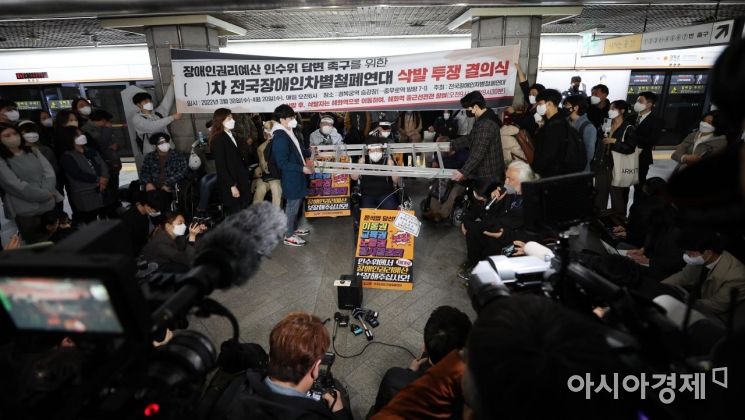 On the 30th, at the Gyeongbokgung Station on Subway Line 3 in Jongno-gu, Seoul, Lee Hyung-sook, Chairperson of the Seoul Disabled Independent Living Center Council, is speaking before shaving her head at the head-shaving protest resolution ceremony held by the National Solidarity for the Elimination of Discrimination against Persons with Disabilities, urging the transition team to respond to demands for disability rights budget and related law amendments. Photo by Kim Hyun-min kimhyun81@
[Asia Economy Reporter Park Hyun-joo] Political circles have been embroiled in a series of controversies over the subway protests organized by disability groups. Amid this, the efforts of lawmakers who are either persons with disabilities or have family members with disabilities to take the lead in resolving the issues regardless of their party affiliation stand out, leading to interpretations that greater diversity is needed in politics.
Lee, who has been criticized for "hate politics," insists that he only raised legitimate concerns about the protest methods. On the 31st, he appeared on MBC Radio's "Kim Jong-bae's Focus" and expressed sympathy for the purpose and claims of the disability groups' protests but emphasized that they should not cause inconvenience to the majority.
On the 29th, he also announced his intention to build a policy cooperation relationship with the Korea Disabled People's Association (KDPA), not the National Solidarity Against Disability Discrimination (NSADD), which organized the subway protests. The KDPA has labeled NSADD's protest methods as "illegal protests" and appealed to "stop protests that the public cannot understand."
However, as the next ruling party leader, Lee could not avoid criticism that his use of terms such as "underdogma," "citizens as hostages," and "arrogance" in response to the mobility rights demands of transportation-vulnerable groups was inappropriate. There are concerns that such remarks might foster prejudice against minorities and deepen hatred. Notably, at the highest-level meeting on the 24th, Lee also stated that he would not apply a minority quota system in the upcoming June 1 local elections nominations, drawing criticism that this system, designed to enhance diversity in the National Assembly, would make it harder for minorities to enter the legislature.
◆ Choi Hye-young, Jang Hye-young, Kim Ye-ji Lead Regardless of Party... Persons with Disabilities or Their Families
In this situation, the first to condemn Lee's remarks were politicians who are either persons with disabilities or have family members with disabilities. Choi Hye-young, a spinal cord injury lawmaker from the Democratic Party, and Jang Hye-young, a Justice Party lawmaker with a sibling who has severe developmental disabilities, held a joint press conference with NSADD on the 25th. Rep. Choi pointed out, "The inconvenience and conflicts caused by disability group protests are not issues for political exploitation but tasks to be resolved," adding, "Seeing the demands for mobility rights being labeled as hostage-taking, coercion, and absurdity, and even requesting action from the Seoul Metropolitan Police Agency, I feel a deep fear of the new government."
Rep. Jang also criticized, "If the next ruling party leader has even minimal awareness, now is not the time to make reckless and dangerous remarks calling for the suppression of transportation-vulnerable groups by public authority," and added, "The zero empathy and arrogance of the next ruling party leader, who boldly makes excessive claims to suppress the voices of the weak by mobilizing public authority, is truly worrisome."
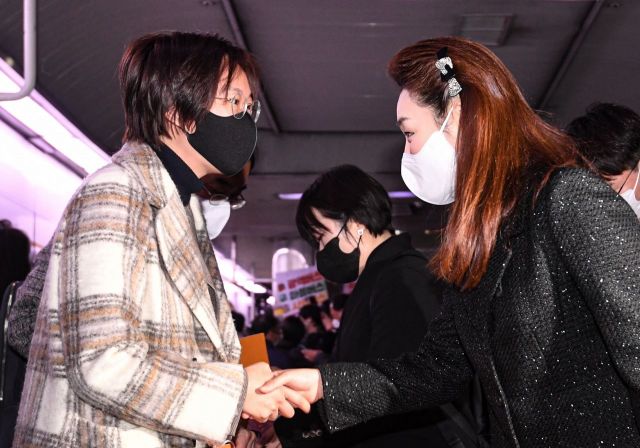
There was bipartisan sympathy for the difficulties faced by transportation-vulnerable groups. Kim Ye-ji, a lawmaker from the same party as Lee, visited the NSADD protest site on the 28th. When she knelt down and apologized on behalf of Lee's remarks, sighs erupted at the scene. Since Rep. Kim is both a member of the National Assembly and a person with a disability, it was interpreted that she chose to apologize directly and urge resolution rather than defend the party leader's remarks. Visually impaired, Rep. Kim was the first to enter the National Assembly accompanied by a guide dog in 2020.
Former lawmaker Na Kyung-won, who has a daughter with Down syndrome, also lent her support. On the 28th, she pointed out on Facebook that while NSADD's protests cause inconvenience to citizens, they should not be mocked or criticized. Na said, "Raising a child with a disability, I have experienced countless frustrations and confrontations with reality, and what I realized is that if laws and systems are inadequate, one has no choice but to rely on protests," adding, "While NSADD's 'It varies each time' protest attitude is problematic, belittlement and mockery are not signs of mature politics."
◆ Unexpected 'Academic Background Controversy'... Park Ji-hyun Emphasizes Diversity in Politics, Saying "Ability Should Not Be Judged by Academic Background"
In addition, an unexpected "academic background controversy" arose in political circles. The presidential transition committee of President-elect Yoon Suk-yeol was criticized for being composed mainly of so-called "Seo-O-Nam" (Seoul National University graduates, in their 50s, male), lacking diversity in gender, generation, academic background, and region.
Meanwhile, Park Ji-hyun, co-chair of the Democratic Party's Emergency Response Committee, faced "academic background attacks" because she is not a graduate of a prestigious university. This occurred after she confused the Cheonan ship sinking incident with the Second Battle of Yeonpyeong in a memorial post for the West Sea Defense Day.
Park responded to the criticism by stating that ability cannot be judged solely by academic background and that more diversity is needed in politics. On the 26th, in a live broadcast on the YouTube channel "SisaIN," she said, "So-called SKY (Seoul National University, Korea University, Yonsei University) graduates have been doing politics until now, so shouldn't politics be perfect? I think my presence in the Democratic Party really shows diversity. Anyone should be able to engage in politics regardless of academic background, and capable people should come. The criterion for evaluating ability should never be academic background alone."
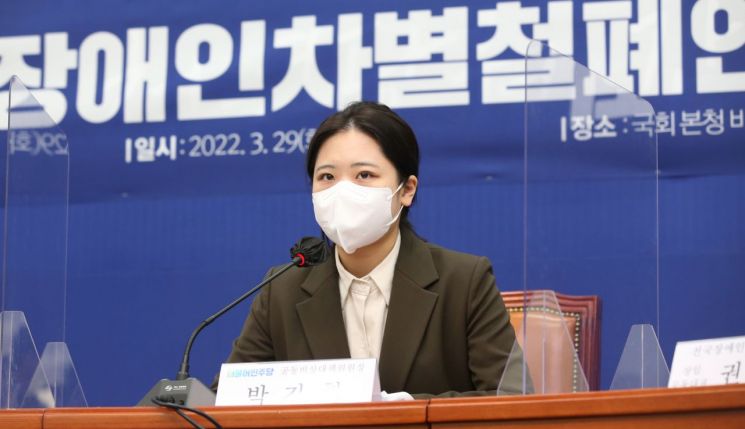 Park Ji-hyun, Co-Chair of the Emergency Response Committee of the Democratic Party of Korea, is speaking at a meeting between the Democratic Party of Korea and the National Solidarity for the Elimination of Disability Discrimination held at the National Assembly in Yeouido, Seoul, on the morning of the 29th.
 [Image source=Yonhap News]
Experts emphasized the need to increase diversity within political circles. Kim Ji-hak, director of the Korea Diversity Research Institute, said, "As seen in the academic background controversy, our society regards accumulating more capital as ability. There needs to be a discussion about what should be defined as ability," adding, "It is not that minorities such as women and persons with disabilities lack ability and thus find it difficult to enter politics."
He also pointed out that the National Assembly must secure proportional representation of our society. Kim explained, "To reflect society as it is, the National Assembly must secure more proportionality. Registered persons with disabilities account for over 5%, and including unregistered persons with disabilities, the number is much higher. How will they be represented? This issue can also be considered in terms of how to reflect the actual proportions of women, youth, and various professionals in the National Assembly."
Furthermore, he stressed the need for political reform to secure proportionality. Kim said, "Politics that protect vested interests are no longer desired by the public and are bound to fail," emphasizing, "As soon as possible, starting with the upcoming June 1 local elections, more active and advanced diversity guarantee systems such as mixed-member proportional representation should be introduced. Also, efforts to secure proportionality through multi-party systems are the hallmark of an advanced legislature and the path to establishing political democracy."
© The Asia Business Daily(www.asiae.co.kr). All rights reserved.



















