Azov Regiment Defending Mariupol
Started as Militia in 2014
Initially Criticized for 'Far-Right' Views
Experts: "Had Far-Right Tendencies in the Past"
"Now Following a De-Ideologized Path"
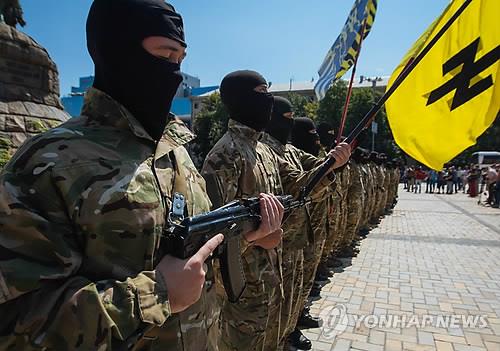 Azov Regiment soldiers belonging to the Ukrainian regular army and their insignia / Photo by Yonhap News
[Asia Economy Reporter Lim Juhyung] The 'Azov Regiment' played a significant role in defending Mariupol, a southeastern Ukrainian port city and strategic stronghold. However, criticism persists from some quarters accusing those fiercely resisting to protect the city of 'following Nazism.'
Since Russia launched a large-scale invasion of Ukraine on the 24th of last month (local time), Russian forces have been making every effort to seize control of Mariupol. It is reported that about 6,000 Russian troops have been deployed to the area since the outbreak of the war.
Reports have emerged that Mariupol was on the verge of falling to Russian forces. On the 29th, Vadym Boychenko, mayor of Mariupol, told the U.S. media outlet CNN, "There have been numerous casualties due to Russian shelling," adding, "We do not have full authority. Unfortunately, we are in the hands of the occupying forces," describing the situation.
According to information released by the Ukrainian military, about 90% of residential buildings in Mariupol have been damaged, with 40% completely destroyed. Additionally, 140 facilities including hospitals, schools, kindergartens, factories, and ports have been destroyed by Russian bombardment.
Amid this, the core force continuing the resistance in Mariupol so far is the Azov Regiment. Composed of approximately 1,500 soldiers, they are reportedly still engaged in combat despite being in an overwhelmingly disadvantageous situation with almost no expectation of support from allied forces.
However, criticism of the Azov Regiment is growing in some circles. It is claimed that the unit’s roots lie in white supremacist and Nazi-following groups.
In this regard, CNN also explained on the 29th that "the core force resisting Russian troops in Mariupol is the Azov Regiment," adding, "It has far-right tendencies and is associated with neo-Nazi elements, which makes Western countries uncomfortable."
The Azov Regiment was formed in 2014. At that time, hundreds of militia members voluntarily established it to fight against pro-Russian separatist rebels in the Donbas region, who had sparked a civil war by demanding independence from Ukraine. Initially a small armed group called the 'Azov Battalion,' it grew in size and became known as the 'Azov Regiment.'
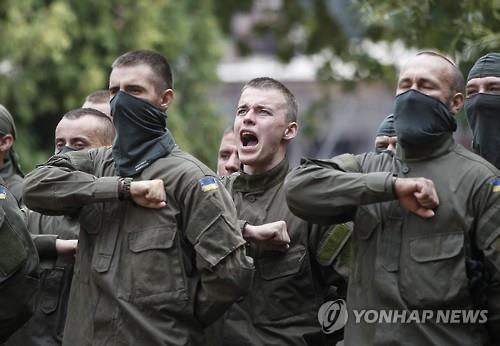 New recruits of the Ajoou Regiment. In 2015, a spokesperson for the regiment claimed that 10-20% of the new recruits were Nazi followers, sparking controversy. / Photo by Yonhap News
The Azov Regiment is currently incorporated into the National Guard under the Ukrainian Ministry of Internal Affairs, gaining regular military status. After the Russian invasion of Ukraine, it was deployed to major cities including Mariupol to defend the front lines.
However, some members of the Azov Regiment have been criticized for far-right tendencies. According to the British media outlet The Times, Andriy Biletsky, a founding figure and the first commander of the Azov Regiment, stated in 2010 that "Ukraine’s mission is to lead the worldwide white race in a final crusade against the inferior races led by Jews."
Additionally, in 2015, a spokesperson for the Azov Regiment claimed that 10-20% of newly recruited soldiers were Nazi followers. The unit’s emblem, the 'Wolf’s Hook' flag, also resembles the Nazi 'Hakenkreuz' (swastika).
Russia has actively exploited these controversies. Initially, Russian President Vladimir Putin cited 'denazification' as a reason for the invasion of Ukraine. In particular, Putin set the elimination of the Azov Regiment as a key objective within the 'denazification' effort.
However, some experts argue that labeling the Azov Regiment as a 'far-right group' is unfair. They point out that its ideological character has diminished compared to its early days.
Andreas Umland, a researcher at the Stockholm Center for Eastern European Studies, told the French AFP news agency in an interview that "while the Azov Regiment clearly had far-right roots at its inception, it has since taken a path of 'de-ideologization,'" adding, "It is now a general combat unit."
Regarding claims that a significant portion of recruits are neo-Nazis, he countered, "The large number of applicants is due not to ideology but to the image of a strong fighting force."
© The Asia Business Daily(www.asiae.co.kr). All rights reserved.


















