Spring Flowers Blooming in Disarray Contrary to 'Chunseo'
Global Average Temperature Rise Advances Blooming Period
From 2.9°C in the 1980s to 4.2°C in the Last Decade
Earlier 'Accumulated Temperature' Reaches Cause Forsythia, Azalea, and Cherry Blossoms to Bloom Simultaneously
Pollinator Insect Activity Disrupted, Threatening Ecosystem Order... Leading to 'Honeybee Disappearance'
Honeybees Aid Pollination... Their Loss Could Drastically Reduce Crops, Posing a Crisis for Humans
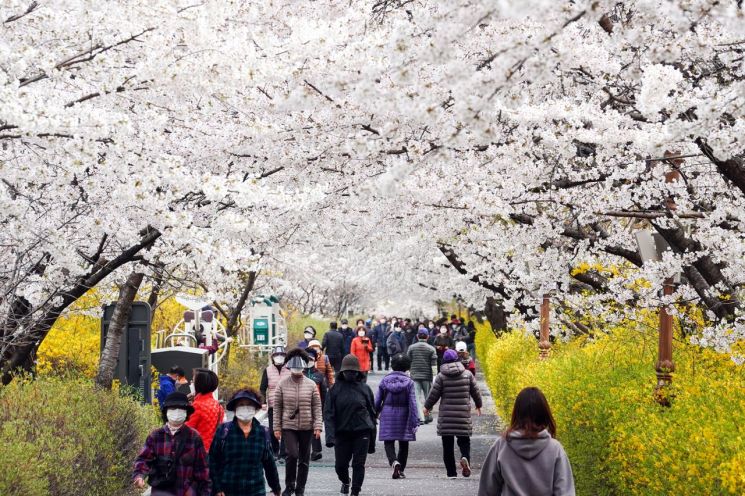
[Asia Economy Reporter Yoon Seul-gi] Climate change has even mixed up the order in which spring flowers bloom. As the term 'Chunseo' (春序) suggests, spring flowers have bloomed in a specific sequence with regular intervals for hundreds of years, representing the natural order. However, due to abnormal high temperatures, it has long been observed that spring flowers are blooming simultaneously in multiple locations.
'Chunseo' refers to the blooming order of spring flowers. The sequence of spring flower blooming starts with camellias and plum blossoms, followed by cornelian cherries, forsythias, azaleas, cherry blossoms, and rhododendrons. But in recent years, due to climate change, camellias, forsythias, azaleas, plum blossoms, and cherry blossoms have begun to bloom fully around the same time. This is because the average global temperature has risen, advancing the blooming period of spring flowers.
According to the Korea Meteorological Administration's report on 'Trends in Spring Flower Blooming Times' released last year, the blooming dates of plum blossoms, forsythias, azaleas, and cherry trees have advanced by as little as 6 days and as much as 21 days in the recent 30 years (1991?2020) compared to 1981?1990.
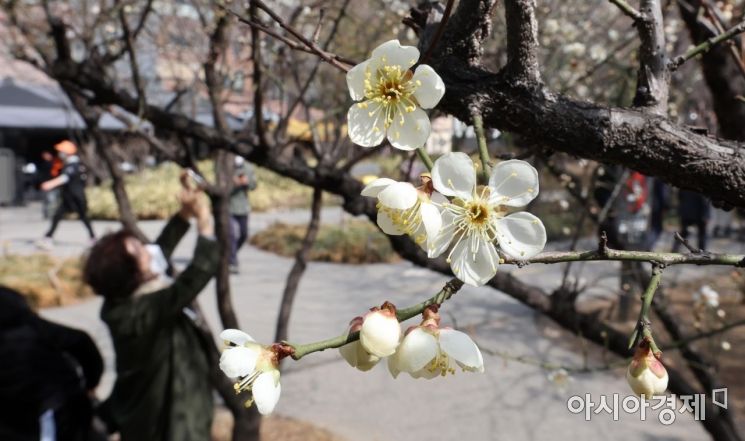 On the 16th, with warm spring weather, plum trees are bursting into bloom at Gyeongui Line Forest Park in Mapo-gu, Seoul. Photo by Hyunmin Kim kimhyun81@
In the 1980s, the nationwide average blooming date for plum blossoms was April 2, but it has shifted to March 12; for forsythias, from March 28 to March 24; for azaleas, from March 31 to March 26; and for cherry trees, from April 8 to April 2. This means plum blossoms have advanced by 21 days, forsythias by 4 days, azaleas by 5 days, and cherry trees by 6 days. The Korea Meteorological Administration explained that this is due to the average temperature in February and March, which affects spring flower blooming, rising from 2.9°C in the 1980s to 4.2°C in the past decade.
Typically, the blooming periods of forsythias, azaleas, and cherry blossoms differ by more than ten days, but as the average temperatures rise, simultaneous blooming of spring flowers is also occurring. Each plant requires a certain accumulated temperature to trigger blooming, but abnormal high winter temperatures have caused a mismatch in the blooming times of spring flowers.
The problem is that the earlier blooming of spring flowers could disrupt the entire ecosystem. If flowers bloom and wither early, the activity periods of pollinating insects also change, potentially threatening the ecological order. It can also affect the pollination activities of honeybees, which transfer pollen to pistils to produce fruit.
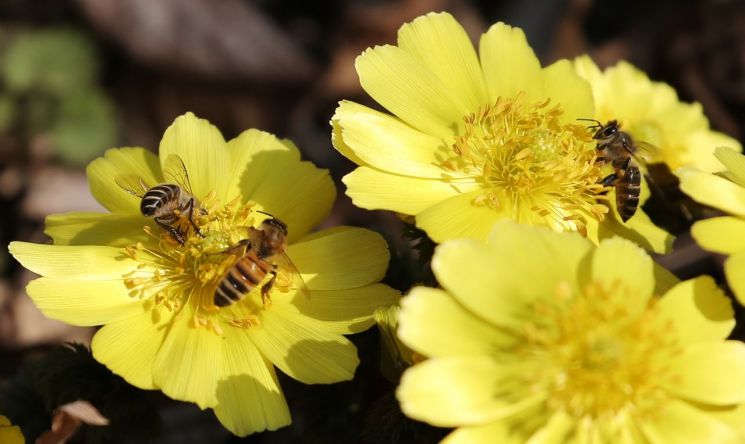 A bee found a winter aconite. The photo is not related to any specific expression in the article. [Image source=Yonhap News]
Recently, the 'disappearance of honeybees' incident is closely related to abnormal weather. According to a joint investigation on winter bee damage announced by the Rural Development Administration on the 13th, the main causes of this honeybee disappearance were the honeybee mite pest and its predator, the hornet, but abnormal weather also played a role. Higher temperatures in November and December caused flowers to bloom early, leading worker bees to exhaust themselves while collecting pollen and fail to return to their hives.
According to the United Nations Food and Agriculture Organization (FAO), 71% of the world's top 100 crops are pollinated by honeybees. Without honeybees, the growth of fruits and vegetables would be severely impacted, and reduced production would greatly affect human life. The abnormal high temperatures caused by humans advance blooming times, which affect honeybees, and the disappearance of honeybees leads to damaged livelihoods, ultimately becoming a crisis for humanity.
Meanwhile, there is a global consensus that carbon emissions from various human activities are causing the climate crisis. Accordingly, over 140 countries worldwide have declared or supported carbon neutrality, aiming for net-zero greenhouse gas emissions by 2050.
South Korea has also set the goal of becoming a '2050 Carbon Neutral Nation' and is promoting related policies. Since the 25th, the 'Carbon Neutrality and Green Growth Basic Act,' which specifies a mid- to long-term national greenhouse gas reduction target (NDC) of 40% compared to 2018, has been in effect. With the enforcement of this law, South Korea became the 14th country to legally establish a 2050 carbon neutrality vision.
The Ministry of Environment and the 2050 Carbon Neutrality Committee announced plans to prioritize support for projects that maximize greenhouse gas reduction effects and to continuously expand investments in green finance and technology development projects, establishing and developing these as representative financial programs supporting carbon neutrality.
© The Asia Business Daily(www.asiae.co.kr). All rights reserved.



















