Hankyung Research Institute, Report on 'Economic Effects of Moving the Presidential Office to Yongsan'
Domestic and International Tourists Expected to Reach 16.7 Million... Tourism Revenue Estimated at 1.8 Trillion KRW Annually
GDP Growth Effects Also Estimated Between 1.2 to 3.3 Trillion KRW
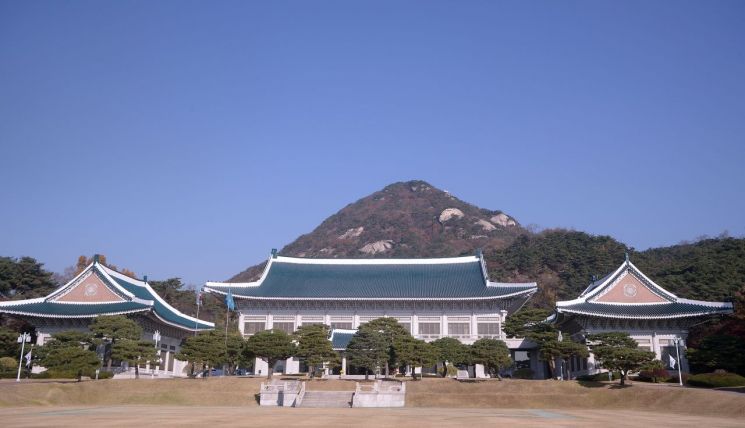
[Asia Economy Reporter Jin-ho Kim] The Korea Economic Research Institute (KERI), affiliated with the Federation of Korean Industries (FKI), released a report stating that the economic benefits of relocating the presidential office from the current Blue House to the Yongsan Ministry of National Defense building would be enormous. This means that the gains from moving the Blue House far outweigh the losses.
The report analyzed that the annual tourism revenue would be about 1.8 trillion KRW, and the GDP increase effect could reach up to 3.3 trillion KRW. This is an economic benefit 25 times greater than the 200 billion KRW economic effect estimated earlier by the Korea Tourism Research Institute, an agency under the Ministry of Culture, Sports and Tourism.
It is interpreted that this reflects active support for the new Yoon Seok-yeol administration’s plan to relocate the presidential office from the current Blue House to the Yongsan Ministry of National Defense building ahead of its inauguration. There is also an interpretation that the FKI, which was thoroughly sidelined during the Moon Jae-in administration, has begun a full-fledged move to restore its status.
On the 30th, KERI released a report titled "Economic Effect Analysis of Relocating the Presidential Office to the Yongsan Ministry of National Defense Building," which was commissioned to Professor Hyun-seok Kim of Pusan National University.
The report estimated that opening the Blue House fully to the public would generate annual tourism revenue of about 1.8 trillion KRW. This assumes that the effect of attracting domestic and foreign tourists would reach the level of visitors after the restoration of Cheonggyecheon in Seoul. The report analyzed that opening the Blue House fully could attract 16.19 million domestic tourists and 510,000 foreign tourists annually.
Of the 1.8 trillion KRW tourism revenue, domestic and foreign tourist revenues were each estimated to be around 900 billion KRW. Regarding the estimation of tourism revenue effects, Professor Kim explained, "We estimated the net increase effect of fully opening the Blue House by using the annual visitors to Cheonggyecheon (17.4 million) as a baseline and subtracting the existing annual visitors to the Blue House (690,000)."
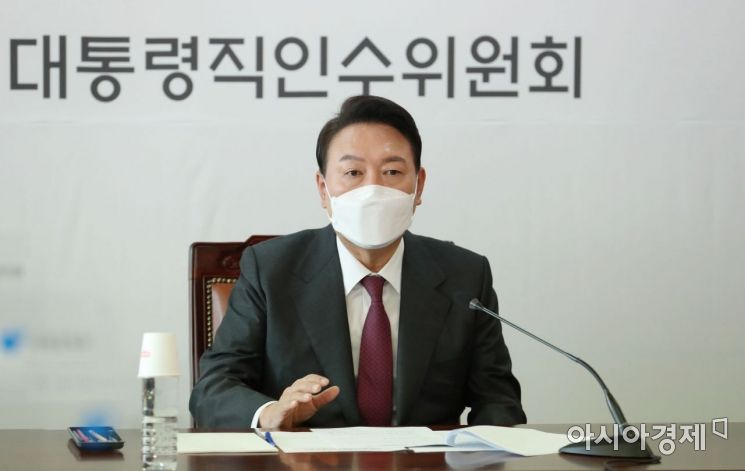 President-elect Yoon Suk-yeol attends the 2nd Secretariat Meeting of the Presidential Transition Committee at the Transition Committee office in Tongui-dong, Seoul, on the 29th, stating that there will be no opening remarks. Photo by Transition Committee Photographers Group
In particular, Professor Kim highly valued the Blue House’s beautiful scenery and its special value as the workplace of past presidents. He evaluated that full opening would also open hiking trails from Gyeongbokgung Palace and the Blue House to Bukaksan Mountain, which would generate significant tourism demand. He said that if a tourism product connecting the Blue House and the Yongsan office were developed, foreign tourists’ demand would be high because they could see the workplaces of both current and former presidents at once.
Additionally, the report estimated that the economic effect from increased institutional trust among citizens due to the presidential office relocation, which would promote economic actors’ activities, would range from 1.2 trillion KRW to 3.3 trillion KRW based on 2020 GDP.
Social capital is defined as tangible and intangible capital that promotes cooperation within the community, such as cooperation among social members and trust in national policies and institutions. The report argued that when social capital increases, government trust rises, leading to public support for policy implementation, improving policy effectiveness, promoting information exchange, and contributing to economic growth. Specifically, it analyzed that if the new Yoon Seok-yeol administration relocates the presidential office to Yongsan and expands communication between the government and citizens, it would activate mutual information exchange, create an opportunity to increase institutional trust, and thereby enhance government policy efficiency.
Professor Kim stated, "The relocation of the presidential office should be viewed not as a cost but as an investment," and added, "I hope it will be an opportunity to improve national efficiency and enhance public welfare in the long term."
In the business community, the report’s topic is considered unusual given that the FKI represents companies. There is also an interpretation that the FKI, which was thoroughly 'passed over' during the Moon Jae-in administration, has begun efforts to regain its status by actively supporting Yoon Seok-yeol’s campaign promises. This means that the FKI has taken an active supporting role in the public opinion battle over the presidential office relocation, which Yoon Seok-yeol is actively pursuing.
However, controversy is expected as well, since the report analyzes a much larger economic effect compared to the 200 billion KRW forecast by the Ministry of Culture, Sports and Tourism’s affiliated agency, which had already drawn criticism from the ruling party and others as a 'poor policy.'
© The Asia Business Daily(www.asiae.co.kr). All rights reserved.


















