<Planning Series - The Ageless Human is Coming>
Social Influencers Shine Brightly
Debuting as Singers with Consecutive Exclusive Contracts
Active Collaborations with Luxury Brands Overseas
Virtual Humans Earning 14 Billion KRW Annually Also Appear
[Asia Economy Reporter Seungjin Lee] According to Bloomberg News, the virtual human influencer market size in 2020 was estimated to be only 2.4 trillion KRW. However, by 2025, the virtual human market size is expected to reach 14 trillion KRW, surpassing the human influencer market of 13 trillion KRW.
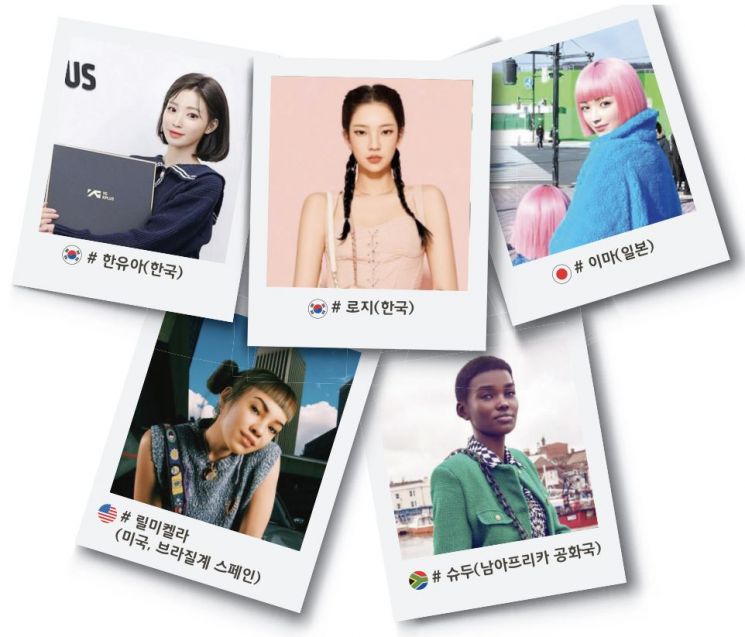
Domestic companies are also moving quickly in response to the activities of virtual humans that surpass real humans. Currently, in Korea, virtual humans such as Rozy, Kim Rae-a, and Han Yoo-ah are active, and several domestic companies plan to debut virtual humans this year.
Debut of Trainee Virtual Humans in Series
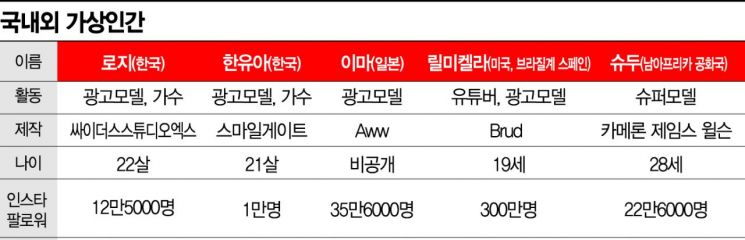
In the domestic virtual influencer scene, since the retirement of the cyber singer 'Adam' who debuted in 1998, Rozy, Han Yoo-ah, and Kim Rae-a have played the role of senior figures. While Rozy has expanded into singing, Kim Rae-a, created by LG Electronics, recently signed a Memorandum of Understanding (MOU) with Mystic Story and is debuting as a singer with an album produced by singer Yoon Jong-shin.
Han Yoo-ah, a virtual human born from the collaboration between Smilegate and Giant Step, recently signed an exclusive contract with YG KPLUS and is preparing to release music. Although the official debut timing is similar to Rozy's, they have not shown remarkable activities yet but plan to debut as singers in the first half of this year and continue active promotions.
There is also a virtual human who joined the agencies of actor Song Kang-ho and singer Rain. 'Lina,' developed by Netmarble's Metaverse Entertainment, signed an exclusive contract with the entertainment agency Sublime. Lina will appear not only as a character in games serviced by Netmarble but also in various metaverse (extended virtual world) contents presented by Kakao Entertainment. Game company Krafton is also producing a virtual human aiming for release around June to July this year.
US Virtual Human Earned 14 Billion KRW Annually
The most famous virtual influencer worldwide is 'Lil Miquela,' a 19-year-old singer, YouTuber, and advertising model living in Los Angeles, USA. Miquela, a Brazilian-American who appeared in 2016, reportedly earned 14 billion KRW in 2019. Last year, the cost for a single Instagram sponsored post was about 10 million KRW, based on around 2 million followers at the time. This year, with followers surpassing 3 million, the advertising rate has doubled.
Miquela's range of activities is extensive. She has modeled for luxury brands such as Chanel, Prada, and Louis Vuitton, and in 2019 participated in Samsung Electronics' Galaxy S10 campaign. On YouTube, she showcases even more diverse activities, uploading videos filmed with real celebrities and sharing stories about her personality and identity.
There is also the first virtual supermodel, 'Shudu.' With 226,000 Instagram followers, she mainly focuses on photoshoots for luxury brands. Shudu's photoshoots are famous for appearing more human-like than actual humans. In Japan, there is a virtual human named 'Ima.' She gained attention by working as a model for the furniture company IKEA and releasing a video of living in the Harajuku IKEA store for three days. Currently, Ima's annual income is reported to be close to 2 billion KRW.
US market research firm Business Insider Intelligence predicted that this year, companies' marketing expenses for influencers will reach $15 billion (approximately 18.19 trillion KRW), nearly doubling compared to 2019, with most of these expenses expected to be handled by virtual influencers.
© The Asia Business Daily(www.asiae.co.kr). All rights reserved.
![Clutching a Stolen Dior Bag, Saying "I Hate Being Poor but Real"... The Grotesque Con of a "Human Knockoff" [Slate]](https://cwcontent.asiae.co.kr/asiaresize/183/2026021902243444107_1771435474.jpg)

















