Health Authorities Recommend Vaccination for Immunocompromised and High-Risk Children with Diabetes
Parents Hesitate Over Vaccination: "Omicron Peak Passed and Concerned About Side Effects"
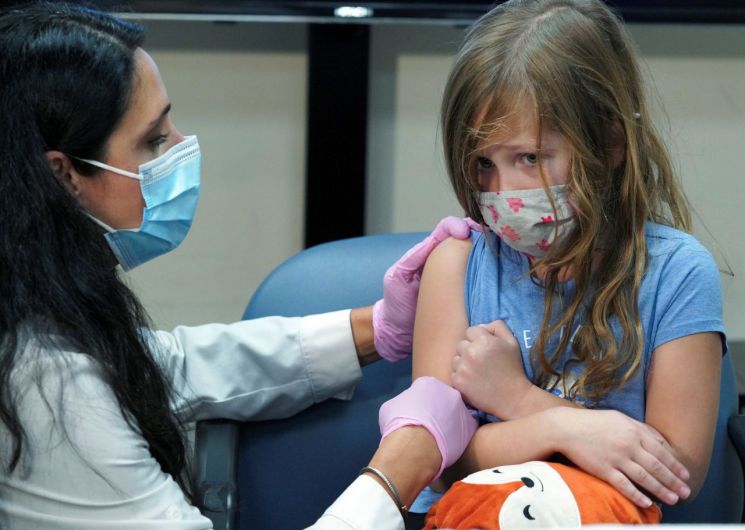
[Asia Economy Reporter Ki Ha-young] Starting from the 31st, COVID-19 vaccinations for children aged 5 to 11 will begin. The health authorities recommend vaccination for immunocompromised children and high-risk groups such as those with diabetes, but the pre-registration rate remains at just over 1%, so actual vaccinations are expected to be low.
According to the COVID-19 Vaccination Response Task Force (Task Force) on the 30th, Pfizer vaccinations will start at about 1,200 designated pediatric vaccination delegated medical institutions nationwide from the 31st. This applies to children born between 2010 who have not yet had their birthday and those born in 2017 who have already had their birthday, aged 5 to 11. The vaccination will be given at an 8-week interval with a dose of active ingredient that is about one-third of the adult dose of the pediatric Pfizer vaccine. A guardian or legal representative must accompany the child during vaccination to monitor for any adverse reactions.
The government has been accepting pre-registrations since the 24th. However, as of the 28th, the reservation rate was only 1.3% (40,925 out of 3,147,942 eligible children).
Although pediatric vaccinations are imminent, parents are still hesitant. Kim (38), a housewife with a 7-year-old daughter, said, "Except for high-risk groups, vaccination is voluntary, so we do not plan to vaccinate. The Omicron wave has already peaked, and adults are experiencing vaccine side effects, so I do not want my child to suffer those side effects." Park (40), an office worker with a 9-year-old son, said, "I plan to observe the situation before deciding on vaccination. Many children are testing positive at school, but most cases are mild, and since vaccination does not completely prevent infection, I am hesitant."
Similar trends appeared in a survey conducted by the Task Force on parents' willingness to vaccinate their children. The survey targeted 359,110 parents of elementary school students nationwide ahead of the primary vaccination for ages 5 to 11. The results showed that only 36.1% (129,802) expressed willingness to vaccinate. Among them, only 7% (25,079) intended to vaccinate as soon as possible. Another 29.1% said they were willing but wanted to observe the situation further. Meanwhile, 63.9% of respondents were either unwilling to vaccinate or negative about vaccination, saying they would wait and see or had no intention to vaccinate for now.
The health authorities recommend vaccination for high-risk children. Due to the spread of the Omicron variant, confirmed cases among children aged 5 to 11, who were previously not included in the vaccination target, have surged, with severe cases and deaths occurring. The cumulative incidence rate (per 100,000 population) for children aged 5 to 11 is 22,162, which is higher than 17,526 for ages 12 to 17 and 12,241 for ages 18 to 59. Especially, children with underlying conditions have a relatively higher risk of severe illness from COVID-19 infection.
Overseas, research results have shown that the Omicron subvariant 'BA.2,' also called 'Stealth Omicron,' is more fatal to children. According to a pre-publication paper by a research team from the University of Hong Kong and Hong Kong Princess Margaret Hospital in the international journal The Lancet, children infected with the BA.2 variant had a seven times higher mortality rate than those hospitalized with influenza. Additionally, the probability of respiratory complications in hospitalized children with BA.2 was about 11 times higher than other COVID-19 variants and about twice that of influenza.
© The Asia Business Daily(www.asiae.co.kr). All rights reserved.

















