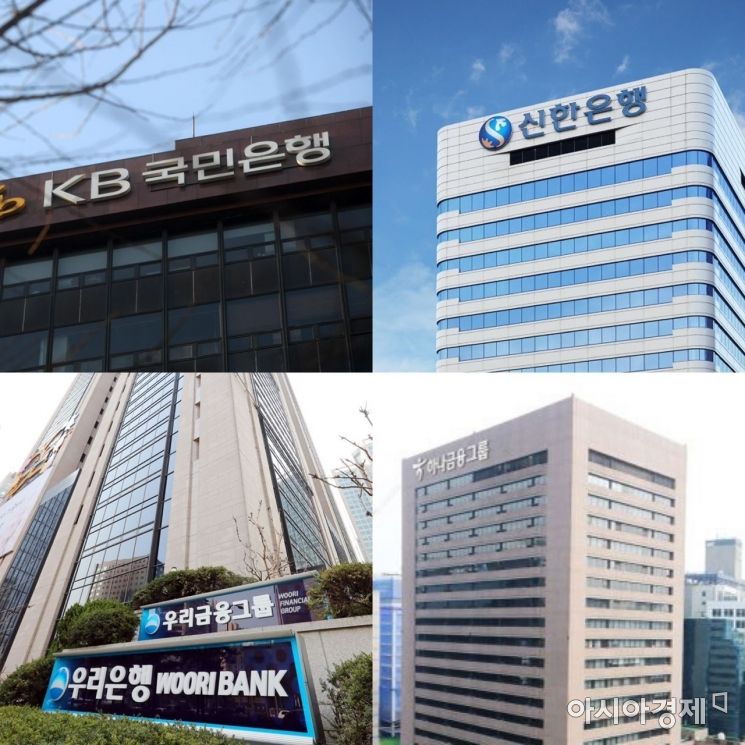
[Asia Economy Reporter Song Hwajeong] As household loans have been declining for three consecutive months this year, banks are loosening their lending restrictions. Following the easing of regulations on jeonse deposit loans, the limits on credit loan products such as overdraft accounts (minus accounts) are also being gradually restored. Accordingly, household loans are expected to turn to an increasing trend again within the first half of this year.
According to the financial sector on the 29th, Shinhan Bank will expand the overdraft account limit from the current maximum of 50 million KRW to up to 100 million KRW starting from the 30th. The credit loan limit will also be restored to up to 200 million KRW within annual income.
Earlier, Woori Bank decided to increase the overdraft account limit from 50 million KRW to between 80 million and 300 million KRW depending on the product type, starting from the 4th of next month. From the same day, the limit of the representative credit loan product ‘Woori WON Workplace Loan’ will also be doubled from a maximum of 100 million KRW to 200 million KRW. KB Kookmin Bank raised the overdraft limit to a maximum of 150 million KRW from the 7th of this month, and Hana Bank did so from the end of January.
Restrictions on non-face-to-face household loans are also being lifted one after another. KB Kookmin Bank allowed applications for ‘conditional refinancing loans,’ which enable switching housing mortgage loans from other banks to KB Kookmin Bank’s loan products via non-face-to-face methods, starting from the 28th. Woori Bank plans to lift the 100 million KRW combined limit on credit loans from the same and other banks applied to non-face-to-face channels starting from the 4th of next month.
Previously, banks also eased regulations on jeonse deposit loans by expanding loan limits and extending application periods.
The reason banks are lowering the loan thresholds like this is that the decline in household loans continues. As of the 24th, the household loan balance of KB Kookmin, Shinhan, Hana, Woori, and NH Nonghyup Banks was 705.1618 trillion KRW, down 7.755 trillion KRW from the end of the previous month. Following 707.6895 trillion KRW in January and 705.9373 trillion KRW in February, the decline is expected to continue at the end of this month as well.
With banks easing loans like this, household loans are expected to shift to an increasing trend within the first half of this year. In particular, if the new government’s real estate and loan regulation easing materializes, it is expected to act as a factor for household loan growth. Jeon Baeseung, a researcher at Ebest Investment & Securities, said, "President-elect Yoon Seok-yeol’s pledges include easing the loan-to-value ratio (LTV), reorganizing reconstruction and redevelopment, expanding housing supply, and tax reform. If real estate regulation easing materializes, it could be positive for loan growth," adding, "However, in this case, while housing transactions and loan growth rates are expected to recover, the sharply increased spread rates due to household loan suppression measures are likely to decrease."
© The Asia Business Daily(www.asiae.co.kr). All rights reserved.

















