Focus on Citizens' Dissatisfaction in the Political Sphere... Potential to Escalate into Political Issues
Three Demands from People with Disabilities
Securing Mobility Budget, Disability Rights Protection Act, Disability Deinstitutionalization Support Act
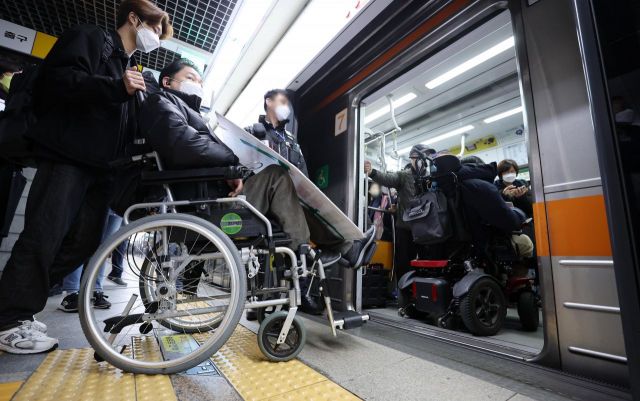 Representatives of the National Solidarity for the Elimination of Discrimination against Persons with Disabilities held a boarding protest on the 24th at Gyeongbokgung Station on Seoul Subway Line 3, demanding the guarantee of mobility rights for persons with disabilities. Photo by Hyunmin Kim kimhyun81@
[Asia Economy Reporter Gong Byung-sun] Since December 6 last year, disability rights organizations have been protesting in the Seoul subway. They disrupt subway operations by blocking the subway doors as people pass through. On the 24th, when such protests continued in front of Gyeongbokgung Station near Tongui-dong, where President-elect Yoon Seok-yeol’s transition committee is located, public dissatisfaction grew.
As public dissatisfaction increased, the political sphere also responded. Lee Jun-seok, leader of the People Power Party, called on the National Solidarity Against Disability Discrimination (Jeonjangyeon) to “stop holding Seoul citizens hostage with protests,” highlighting the infringement of citizens’ rights. In response, Jang Hye-young, policy committee chair of the Justice Party, expressed concern over Lee’s autocracy, saying he was attacking the legitimate protests of transportation-vulnerable groups.
With politicians reacting, the possibility of disability rights issues becoming entangled in politics has increased. However, it is time to focus on why people with disabilities inevitably cause inconvenience to citizens. Before this becomes just another political issue, it is necessary to understand the reasons behind the protests by people with disabilities.
Guaranteeing Budget for Disability Mobility Rights
The main reason for the protests is to secure a budget for the mobility rights of people with disabilities. Currently, the budget for disability mobility rights varies greatly depending on the finances of local governments rather than national funds. Disability rights organizations demand that the Ministry of Economy and Finance revise the enforcement decree of the Act on Transportation for the Vulnerable to set the subsidy ratio for operating special transportation for people with disabilities at 70% national funds and 30% local funds.
In fact, the mobility rights of people with disabilities vary by local government. As of last year, Seoul’s budget related to disability mobility rights was 129.8 billion won. As Lee Jun-seok mentioned, the 93% elevator installation rate in Seoul’s subway is due to the large budget. In contrast, Chungcheongnam-do’s budget for disability mobility rights was only 3.3 billion won as of 2020.
Overall, the mobility rights of people with disabilities are at a poor level. In 2017, the Ministry of Land, Infrastructure and Transport announced through the 3rd Plan for Improving Convenience for the Transportation Vulnerable that it would raise the proportion of low-floor buses nationwide to 41.1% by 2021. However, as of July 2020, the actual introduction rate was only 28.4%.
Disability Rights Guarantee Act
This is a bill to promote the full participation and integration of people with disabilities into the community. The average disability prevalence rate among OECD member countries is 24.5%. In contrast, Korea’s rate is only 5.4%. This indicates that Korean society either makes it difficult to be recognized as disabled or forces people to hide their disabilities.
If the Disability Rights Guarantee Act is enacted, it will move away from the Disability Welfare Act, which focused only on protection and rehabilitation from a medical perspective. Specifically, it is expected to contribute to reforming or abolishing the restrictive disability registration system. Additionally, it will enable securing more budget to support the activities of people with disabilities or provide customized services for individuals with disabilities.
Disability Deinstitutionalization Support Act
This bill is for people with disabilities who have suffered human rights violations while institutionalized. Its purpose is to prevent discrimination and exclusion that have occurred while housing people with disabilities in institutions. If enacted, the state will provide necessary services so that people with disabilities can live independently in the community, free from institutions.
Furthermore, if human rights violations occur in institutions, effective sanctions against the institutions and operating corporations will be possible. In March last year, it was revealed that 15 staff members at the disability residential facility ‘Raphael’s House’ repeatedly assaulted and abused people with disabilities. However, it took two months to separate perpetrators and victims. The ultimate goal is for all people with disabilities to leave institutions within 10 years.
© The Asia Business Daily(www.asiae.co.kr). All rights reserved.

![Clutching a Stolen Dior Bag, Saying "I Hate Being Poor but Real"... The Grotesque Con of a "Human Knockoff" [Slate]](https://cwcontent.asiae.co.kr/asiaresize/183/2026021902243444107_1771435474.jpg)















