Jang Jae-hoon, Hyundai Motor CEO, Reveals at Regular General Meeting
Increased Capability to Handle Unexpected Variables like COVID-19 and War
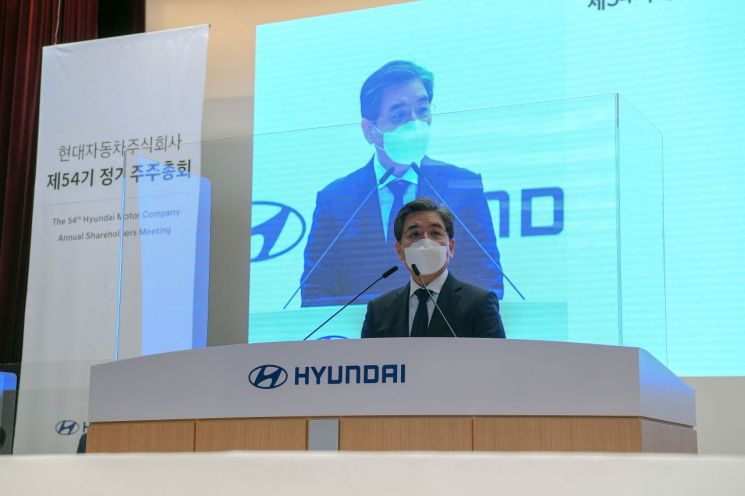 Jang Jae-hoon, CEO of Hyundai Motor Company, is speaking at the regular shareholders' meeting on the 24th.
 [Asia Economy Reporter Choi Dae-yeol] Hyundai Motor Company has decided to overhaul its entire supply chain system by diversifying the sources of key vehicle components and increasing the localization ratio. To secure a stable supply of vehicle semiconductors, which are considered a major cause of production disruptions, Hyundai is strengthening its cooperation system with global semiconductor companies while reducing the total number of parts but increasing the use of parts that can be shared across models. This decision comes amid the global automotive industry's ongoing difficulties in supply chain management for over two years since COVID-19, with the expectation that similar situations will continue.
Jang Jae-hoon, CEO of Hyundai Motor, emphasized in his speech at the regular shareholders' meeting held on the 24th, "Supply chain disruptions such as rising raw material prices and semiconductor supply imbalances will continue following last year," adding, "Since production disruptions due to parts shortages are occurring not only domestically but worldwide, it is important to maintain a stable production and sales system through supply chain management." Despite the challenging business environment last year, Hyundai recorded its highest-ever sales by flexibly managing production and sales systems, outperforming other global automakers, and plans to continue this trend this year.
Diversifying parts suppliers and increasing the localization ratio of overseas factories are measures to minimize unexpected disruptions that could halt factory operations. Previously, Hyundai responded by reducing the number of suppliers for cost reduction, but due to COVID-19 and war, failure to procure one or two parts often led to the entire assembly line being unable to operate or production schedules being adjusted. Since reducing parts and expanding parts sharing are not easy measures to take immediately, they will be pursued in the mid to long term.
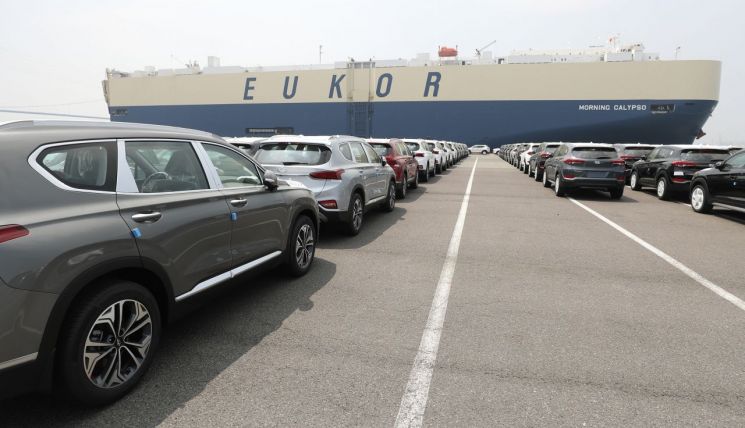
Hyundai also clearly stated its intention to resolve the demand bottleneck where customers wait over a year from new car contract to delivery. Jang said, "We will actively respond to market demand by maximizing supply volume through optimal semiconductor allocation per vehicle and developing alternative components," adding, "We will also increase profitability by raising the proportion of sports utility vehicles (SUVs), luxury cars, and trims."
The premium brand Genesis plans to leverage its foothold in the domestic and North American markets to actively promote sales in Europe and China, where its market share is still minimal. In the electric vehicle market, where competition among global automakers has intensified due to increased adoption, Hyundai intends to enhance the product appeal of electric vehicles by offering new models along with specialized services such as charging, maintenance, and financing.
As part of new business initiatives, Hyundai's hydrogen business will establish a sales base centered on commercial vehicles in Korea, Europe, and North America. The vehicle subscription service will be diversified domestically, while subscription and mobility services introduced in parts of Europe will be expanded to new countries.
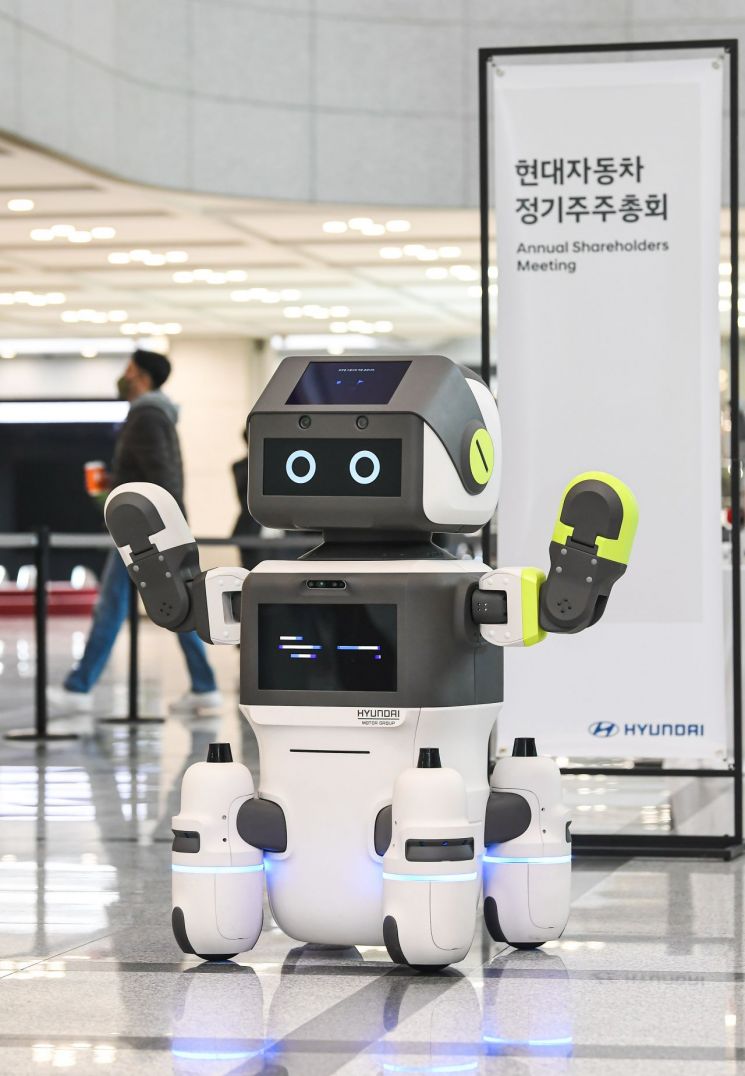 Hyundai Motor Company's self-developed service robot Dali is welcoming shareholders at the regular general meeting of shareholders on the morning of the 24th.
 Meanwhile, at the shareholders' meeting, the agenda to reappoint Chung Eui-sun as an inside director of Hyundai Motor Group was passed. Park Jung-guk, Head of Research and Development Division (President), and Lee Dong-guk, Vice President in charge of domestic production, were also appointed as new inside directors. They are successors to former R&D head Albert Biermann and former CEO Ha Eon-tae.
To enhance understanding of the company, this year, Hyun Dong-jin, Executive Director of Robotics Lab, explained the robotics business, which is being promoted as part of new business initiatives. He explained how robotic technology can create synergy with the existing automotive industry and other group-level new businesses. Prior to the meeting, the company surveyed topics shareholders wanted to hear about online, and robotics was the most requested topic. The company placed its self-developed service robot 'Dari' on the first floor of the headquarters so shareholders attending the meeting in person could see it.
© The Asia Business Daily(www.asiae.co.kr). All rights reserved.
![Clutching a Stolen Dior Bag, Saying "I Hate Being Poor but Real"... The Grotesque Con of a "Human Knockoff" [Slate]](https://cwcontent.asiae.co.kr/asiaresize/183/2026021902243444107_1771435474.jpg)


















