[Report] Visiting Sampyo Industry Yangju Plant (Yangju Quarry), the 'First Case under the Serious Accident Punishment Act'...
About 2,000 Workers in Related Industries Face Revenue Decline and Job Losses
Partner Company Employees Cry Out "When Can We Work?"... Livelihood Threatened
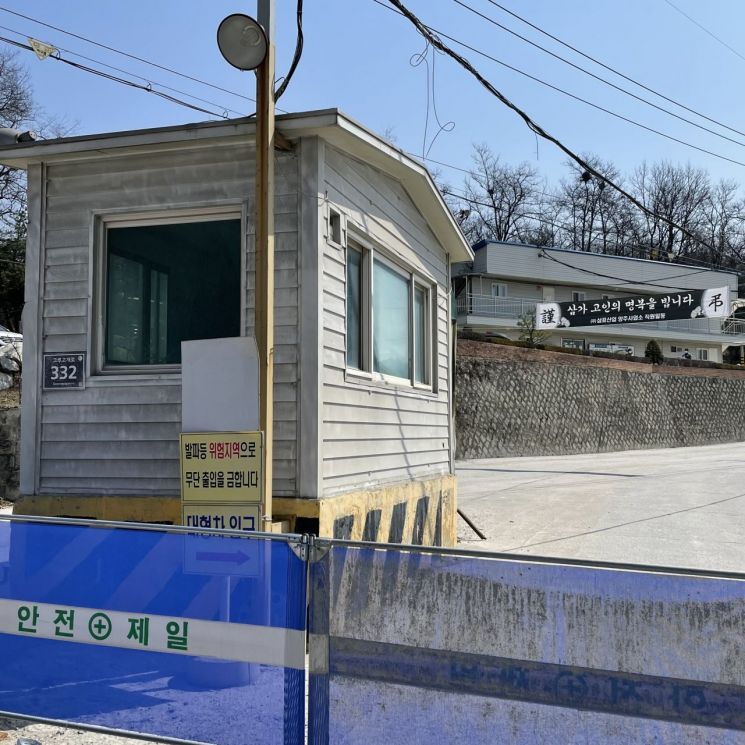 The entrance to Sampyo Industrial Yangju Quarry was blocked on the afternoon of the 22nd.
 [Photo by Kim Jonghwa]
[Yangju=Asia Economy Reporter Kim Jong-hwa] About 500 meters away from Sampyo Industrial Yangju Office (Yangju Quarry) is Woosung Tire, a dump truck maintenance company. Just a few months ago, 20 to 30 dump trucks came and went daily at this company. The employees were so busy changing tires that they often missed meal times. Since the Yangju Office stopped operations two days ago, it has become difficult to see dump trucks. Heo Myeong-yeol (55), the owner of the company, has let go of all three employees and has been working alone since last month. He managed to get by for about a month, but with no income, he made this decision. Heo said, "The store needs to earn at least 10 million won a month to stay afloat, but since last month, the monthly income has not even reached 1 million won," adding, "Whenever I hear the sound of passing trucks, I turn my head hoping it might be one."
The sales of S Industry, a partner company responsible for the maintenance of the crushing plant (a machine that evenly crushes stone materials) at the Yangju Office, have also sharply declined recently. S Industry, which generates about 3 billion won annually, had about 40% of its sales from the Yangju Office. In the metropolitan area, the Yangju Office was the only place producing 20mm coarse aggregates suitable for ready-mixed concrete. Lee Dae-sik (pseudonym, 47), the CEO of the company, said, "We took pride in being a company with expertise in operating and maintaining crushing plants, so we never imagined losing work," adding, "With the large-scale site that accounts for nearly half of our sales stopped for two months, company operations have become difficult." He also said, "We receive several calls a day from employees asking when work will resume." S Industry employs about 20 workers on average, including daily workers, at the Yangju Office. At peak times, up to 100 workers were deployed at once.
As the suspension of aggregate extraction work due to the accident continues for two months, outcries are erupting everywhere. While the facts need to be clarified, the sentiment is that "those who live must survive." The Yangju Chamber of Commerce and Industry stated that about 2,000 people, including partner companies and local residents, are facing threats to their livelihoods due to the two-month halt in aggregate extraction work.
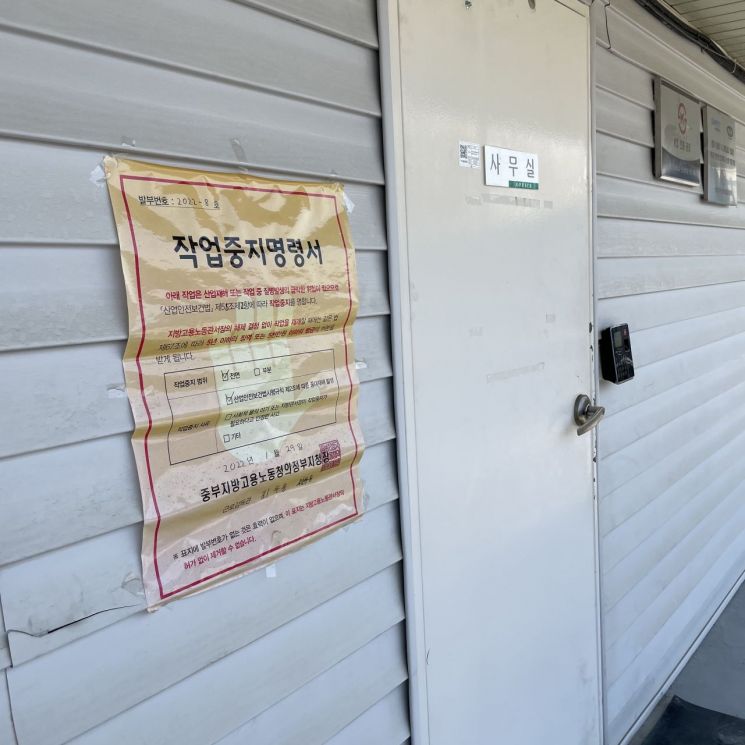 The office of Sampyo Industry Yangju Quarry, closed with a work suspension order posted.
 [Photo by Kim Jonghwa]
On the afternoon of the 22nd, the entrance to Sampyo Industrial Yangju Office (Yangju Quarry) in Eunhyeon-myeon, Yangju-si, Gyeonggi-do, was sealed off, with only a banner mourning the deceased workers fluttering quietly. The office door of the Yangju Office, marked with a 'Work Suspension Order,' was firmly closed. Despite more than 200 dump trucks coming and going daily, kicking up dust, not a single truck was seen for several hours.
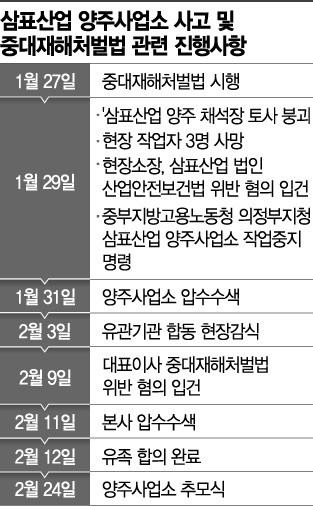
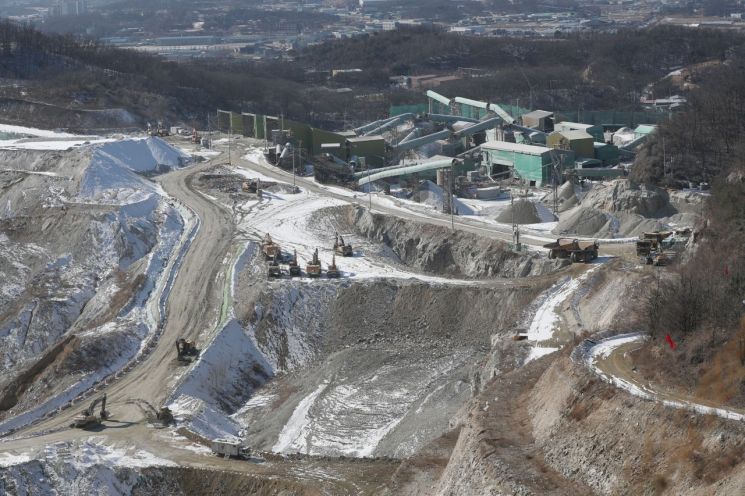
Following the fatal accident at the Yangju Office on January 29, the Ministry of Employment and Labor issued a work suspension order against the Yangju Office for violating the Serious Accidents Punishment Act. Since then, aggregate extraction work has been halted. The Yangju Office is the largest aggregate extraction site in the country, producing 18,000 cubic meters daily and 3.9 million cubic meters annually. About 100 employees of the Yangju Office and 400 partner company workers work here daily, supplying about 20% of the aggregate demand in downtown Seoul and northern Gyeonggi Province. Yangju City, with a relatively low population density compared to its urban area, has developed into an urban area centered around large companies forming commercial districts. Therefore, the rise and fall of companies significantly impact the local economy.
According to estimates by the Yangju Regional Merchants Association and the Yangju Chamber of Commerce and Industry, the suspension of operations at the Yangju Office has caused about 400 partner company employees and 100 transportation workers who commuted daily to lose their jobs. Additionally, about 1,500 merchants and industry workers, including those at around 10 nearby gas stations, 20 maintenance shops, 30 restaurants and convenience stores, and related partner companies in the metropolitan area, have suffered from decreased sales and unemployment. Lee Shin-hoon, chairman of the construction division of the Yangju Chamber of Commerce and Industry, said, "Most of the partner companies and truck transporters were from the Yangju area, but they suddenly became unemployed overnight."
Closed Indefinitely, Livelihoods of 2,000 Threatened
Chogye Construction Heavy Machinery, a company that dispatches transport vehicles to the Yangju Office and collects and transports waste in the Yangju area, has lost more than half of its vehicles to other regions in just over two months. As work dried up, vehicle owners who had barely held on moved their workplaces to nearby Pocheon or Paju. CEO Jeong In-ju (54) said, "Since the work suspension at the Yangju Office, 16 out of 27 dump trucks on the dispatch list have left to find work elsewhere," adding, "Just after overcoming the urea solution shortage, an accident happened at Sampyo, but accidents are accidents, and those who live must survive."
Experts explain that if only the Industrial Safety and Health Act (ISHA) had been applied, the Yangju Office would have already resumed operations. Under ISHA, when a fatal accident occurs, the labor inspector from the local Employment and Labor Office orders a work suspension at the site. Then, the labor inspector, police, and related agencies conduct on-site investigations and inspections, and order repairs or improvements to safety-related facilities.
This time, the application of the Serious Accidents Punishment Act has prolonged the investigation period. While the large-scale accident involving the burial and death of three workers necessitates caution, the fact that this is the first case under the Serious Accidents Punishment Act, with no precedents and ambiguous standards, has also delayed procedures and judgments.
Park Jong-sik, associate researcher at the Korea Labor Institute, explained, "When only ISHA was applied, the work suspension order was usually lifted within a week to two weeks, at most a month, but with the Serious Accidents Punishment Act also applied, the investigation period tends to be longer." He added, "Since this is an unprecedented case, the Ministry of Labor is likely to conduct the investigation carefully due to the burden of the results."
First Case Under the Act, Standards Also Ambiguous
The local authorities, considering the importance of the matter, maintain that even without applying the Serious Accidents Punishment Act, the investigation period would inevitably be longer than before due to the ISHA investigation alone. A representative from the Uijeongbu branch of the Central Regional Employment and Labor Office said, "Since the Sampyo Industrial accident was a burial accident, the Korea Occupational Safety and Health Agency, which is investigating the accident, is selecting related companies for drilling investigations, so we expect the investigation to take considerable time," adding, "We anticipate the investigation results to be available by the end of this month or early next month."
Once the investigation results are out, Sampyo Industrial Yangju Office must accept them, repair the ordered facilities, and submit a work suspension lifting application to the responsible labor inspector. Upon receiving the application, the Uijeongbu branch will hold a Work Suspension Lifting Review Committee to comprehensively assess whether the workplace has established recurrence prevention measures and decide whether to lift the suspension. The investigation results will also determine the level of punishment for the representative of Sampyo Industrial. The Ministry of Labor is investigating under the principle that for accidents involving three or more fatalities, the Serious Accidents Punishment Act is not applied, and arrest warrants are requested under ISHA alone. Ultimately, the on-site investigation results under ISHA and the investigation results under the Serious Accidents Punishment Act concerning the representative are intertwined. This process is also expected to take considerable time.
There are claims that focusing too much on punishment overlooks the essence of prevention and wastes time. Yoon Dong-yeol, professor of business administration at Konkuk University, said, "The purpose of the Serious Accidents Punishment Act is prevention, not punishment, but since the law is implemented focusing on punishing management responsibility, important aspects are being overlooked," adding, "The government and the National Assembly need to promptly pursue supplementary legislation or re-amendments to prevent side effects."
© The Asia Business Daily(www.asiae.co.kr). All rights reserved.



















