Research Team Led by Dr. Kim Taesong at Korea Institute of Science and Technology
[Asia Economy Reporter Kim Bong-su] Domestic researchers have opened a new chapter in the development of artificial cell membranes that can be used for biosensors or artificial organs. They succeeded in extending the maintenance period from the existing five days to over 50 days, paving the way for commercialization.
The Korea Institute of Science and Technology (KIST) announced on the 22nd that Dr. Kim Tae-song's research team at the Brain Science Creative Research Group succeeded in developing an artificial cell membrane structure that remains stable for over 50 days on a silicon substrate. This is the longest period reported in academia. Dr. Kim's team had previously implemented an artificial cell membrane maintained for five days in 2018, and in the following year, 2019, they observed cations being transmitted inside a structure where serotonin proteins were bound to the surface of this artificial cell membrane, confirming its potential application as a biosensor.
However, for life science research using artificial cell membranes and practical commercialization of biosensors, durability of at least one month is essential. To extend the lifespan of artificial cell membranes, which had remained around five days, the research team focused on block copolymers (BCP), a type of polymer material. Block copolymers are polymers composed of two or more blocks, which can be arranged repeatedly and lengthily with different properties, similar to the hydrophilic and hydrophobic characteristics of human cell membranes.
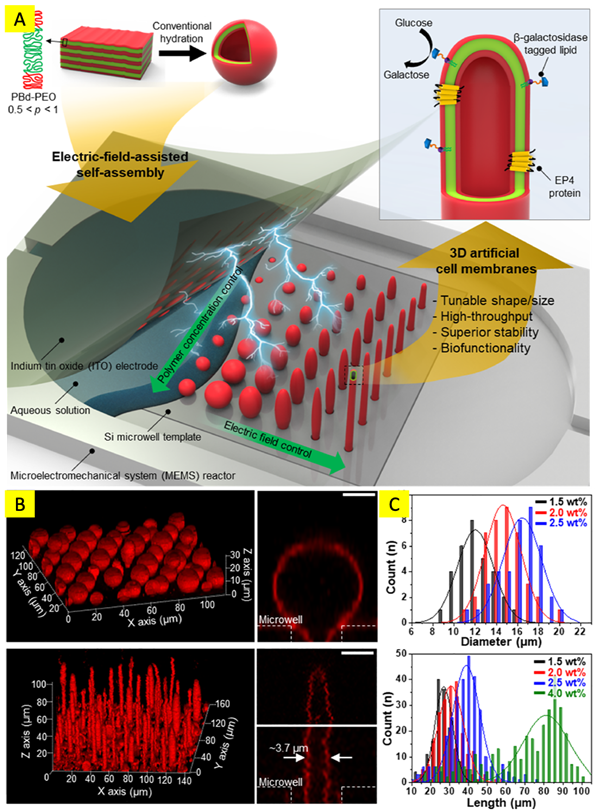
The research team first developed a technique to regularly arrange tens of thousands of holes, each 8 μm (micrometers) in diameter, on a silicon substrate, then applied surface treatment to fill each hole with a certain amount of block copolymer solution and dry it. Next, they applied an electric field between the upper plate electrode of an inserted ultra-micro oil channel and the lower silicon substrate, creating a soap bubble-shaped block copolymer bilayer structure. They discovered regions where specific structural forms were maintained depending on the solution concentration, applied electric field, and frequency, suggesting a way to freely control the size and shape of artificial cell membranes from spherical soap bubble-like to cylindrical tube-like forms.
Finally, the research team successfully implemented an artificial cell membrane that remains stable for over 50 days by firmly fixing the externally formed three-dimensional block copolymer bilayer structure with a porous hydrogel similar in composition to the human body, exhibiting excellent elasticity and resilience. They also mimicked the small intestinal epithelial cells composed of thousands of tube-shaped structures (cilia) using the block copolymer bilayer structure and demonstrated its potential as an artificial organ material by binding it with the sugar-degrading enzyme β-galactosidase.
The cell membrane serves as a protective barrier inside and outside the cell and is also the most accurate and precise biosensor on Earth. The cell membrane, which has a bilayer form with one side hydrophilic and the other hydrophobic, opens and closes ion channels like a faucet, converting external physicochemical stimuli into electrical signals transmitted to the cell. Accordingly, worldwide research on biosensors that mimic the excellent sensing and information conversion functions of cell membranes is active. However, the maintenance period of artificial cell membrane structures has been a bottleneck, limited to a maximum of about five days.
Dr. Kim Tae-song said, “Until now, most artificial cell membrane research worldwide involved placing two-dimensional planar structures on silicon substrates. We have developed the first technology to create three-dimensional artificial cell membrane structures and succeeded in extending the stable maintenance period by more than ten times. We hope this research, which suggests a path for mass production of artificial cell membranes, will further develop into platform technology for ultra-sensitive biosensors resembling cell functions, drug screening for new drug development, and life phenomenon research elucidating the roles of brain neurotransmitters and hormones.”
The results of this research were published in the latest issue of the prestigious international journal Nature Communications.
© The Asia Business Daily(www.asiae.co.kr). All rights reserved.

















