Increased Pricing Power Due to Rising Raw Material Costs Amid Expansion of High-End Premium Product Lineup
[Asia Economy Reporter Park Sun-mi] Office worker Kim Yujin (42, pseudonym) bought a Samsung vacuum cleaner for 170,000 KRW when she moved out independently in 2012. It was a new model equipped with a feature that separately collected the dust in a dust chamber and expelled air through a HEPA filter. Five years later, in 2017, as she was about to get married, Kim purchased a Dyson cordless vacuum cleaner, which was the trend at the time, as a wedding gift. Although it was an expensive vacuum cleaner priced at around 1 million KRW, it was famous for its ‘new features,’ so she added it to her purchase list without hesitation. Five years later, in 2022, Kim bought an LG Electronics premium vacuum cleaner for 1.3 million KRW as a housewarming gift for her younger sibling. She said, “The price of this product, which includes an all-in-one tower and various suction nozzles along with the vacuum cleaner, was in the 1.5 million KRW range, but I bought it 200,000 KRW cheaper through various discount promotions,” adding, “Now it is difficult to find domestic products priced in the 1 million KRW range.”
Due to the prolonged COVID-19 pandemic, the home appliance industry, which enjoyed a boom last year, is expected to implement price increases again this year. Although product prices were raised by up to about 30% last year due to continuous increases in raw material and logistics costs, the burden has grown even more this year as the raw material and supply crisis worsened following Russia’s invasion of Ukraine. The incorporation of increasingly advanced new technologies and the high-price strategy of ‘premium’ product lines are also analyzed as factors driving prices up.
According to the home appliance industry on the 21st, Samsung Electronics, which holds the No. 1 position in the global TV market, saw the average selling price of TVs rise about 32% last year compared to the previous year. LG Electronics also saw the average selling price of TVs increase by 26.4% during the same period. This is about eight times the 3.3% increase from the previous year.
LG Electronics, which overtook Whirlpool to become the global leader in home appliance sales, also saw the average selling prices of refrigerators and washing machines rise by 7.2% compared to the previous year during this period. Following a 7.9% increase in 2020, this marks a two-year consecutive rise in the 7% range. The average selling price of air conditioners also rose 9.8% last year, reversing the previous year’s 4.7% decline.
Although prices are rising, customer demand for premium home appliances is growing stronger. This is because the time spent at home increased due to COVID-19, boosting demand for home appliance replacement, and the MZ generation (Millennials + Generation Z), who tend to purchase customized products they like even if they are expensive, has emerged as the main consumer group.
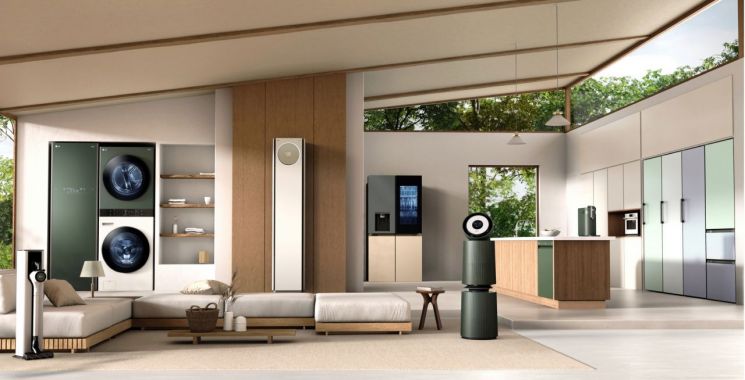
Both Samsung Electronics and LG Electronics are adopting market dominance strategies centered on premium products. For example, Samsung Electronics is expanding its Bespoke brand across all product lines and introducing new product lines such as the Infinite line, which emphasizes premium experiences. For the Infinite Bespoke line, a full custom setup of a 4-door refrigerator, freezer, kimchi refrigerator, and wine cooler costs around 20 million KRW.
Factory operating rates and performance in the home appliance industry are soaring. For LG Electronics, the operating rates of refrigerator, washing machine, and air conditioner factories soared to 126%, 106%, and 110%, respectively, last year. Both Samsung and LG Electronics recorded their highest-ever home appliance sales last year, with increases of 15.9% and 21.7%, respectively.
Despite this boom, the home appliance industry is deeply concerned about the soaring raw material and logistics costs.
In fact, the price of display panels for TVs and monitors, a major raw material for Samsung Electronics’ home appliance division, jumped about 39% last year. LG Electronics also saw the average price of steel, a major raw material for home appliances, rise 21.8% last year, about five times the previous year’s increase of 3.9%. Resin and copper used in heat exchangers for air conditioners and refrigerators also rose by 18.2% and 15.1%, respectively. The reason why there is speculation that home appliance prices will rise further is that the industry is focusing on premium products as a countermeasure against profitability deterioration.
An industry insider said, “The average price of home appliances is rising because sales of premium product lines with higher price points are doing well and manufacturing costs are also increasing due to rising raw material prices,” adding, “Although raw material price increases are not immediately reflected in product prices, if the current trend continues, consumer prices will inevitably rise.”
© The Asia Business Daily(www.asiae.co.kr). All rights reserved.

















