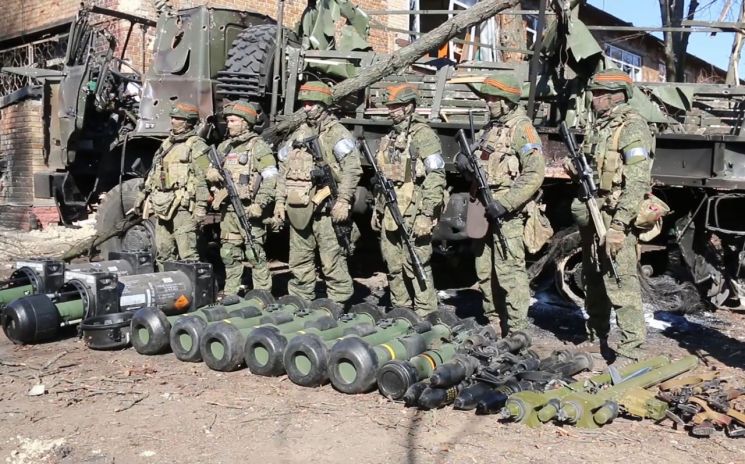
 On the 15th (local time), Russian soldiers displayed Western-supplied weapons they had captured in the Kyiv (Kiyev) area, the capital of Ukraine, and stood in formation behind them.
 [Photo by Yonhap News]
[Asia Economy Reporter Hwang Sumi] Foreign media reports have emerged that Taiwan is drawing lessons from Ukraine's resilience against Russia, a country with overwhelming military power.
On the 20th (local time), the Hong Kong daily South China Morning Post (SCMP) reported, "Ukraine's tenacious defense provides Taiwan with lessons on asymmetric warfare and the power of reservists," adding, "Taiwan, constantly exposed to China's military pressure, is shown how to fight against a much larger army."
Chu Kuo-cheng, Taiwan's Minister of National Defense, recently appeared before the legislature and emphasized, "The greatest lesson we can derive from the Russia-Ukraine war is that despite military inferiority, Ukraine is resisting the massive enemy Russia by utilizing its unique domestic battlefield conditions and asymmetric warfare."
He added that they are studying how Ukrainians are using easily movable and operable weapons as asymmetric forces to repel Russia's invasion.
Asymmetric warfare includes not only attacks using weapons of mass destruction such as nuclear weapons and missiles but also surprise attacks by armed infiltrators through tunnels, submarines, and resistance by irregular forces like guerrillas. This approach demonstrates superior lethality compared to conventional weapons and maximizes effectiveness at relatively low cost.
In fact, Taiwan has reportedly been significantly expanding its defensive weapons overall by importing new weapons such as F-16V fighter jets, M1A2T tanks, High Mobility Artillery Rocket Systems (HIMARS), and M109A6 Paladin self-propelled howitzers from the United States in recent years to counter China's military pressure, while also focusing intensively on strengthening asymmetric warfare capabilities.
Taiwan is also strongly promoting the reinforcement of its reservist forces. First, it has increased the training intensity during the four-month mandatory military service period. Furthermore, under the directive of President Tsai Ing-wen, Taiwan is considering extending the mandatory military service period of four months. If the mandatory service period is extended to over one year, Taiwan will shift from its current volunteer-based system back to a conscription-based system.
© The Asia Business Daily(www.asiae.co.kr). All rights reserved.

















