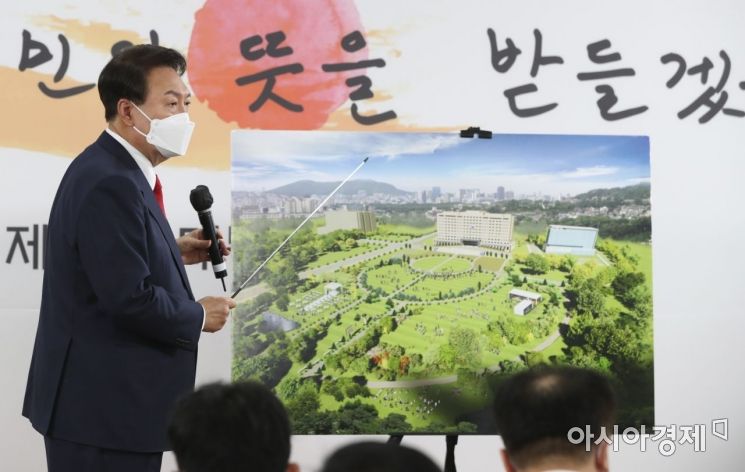
 President-elect Yoon Suk-yeol is entering the Presidential Transition Committee located in the annex of the Korea Institute of Finance in Samcheong-dong, Jongno-gu, Seoul on the 20th for a press conference regarding the relocation of the Blue House presidential office to the Yongsan Ministry of National Defense building. Photo by Yoon Dong-ju doso7@
[Asia Economy Reporters Kim Hyemin and Kim Dongpyo] President-elect Yoon Suk-yeol has made it clear that there will be no additional development restrictions in the surrounding areas even if the presidential office is relocated from the Blue House to the Ministry of National Defense building in Yongsan-gu, Seoul. On the contrary, he stated that regulations on development around the existing Blue House and in the Gangbuk area within its sphere of influence will be eased.
On the 20th, President-elect Yoon held his first press conference since the launch of the Presidential Transition Committee at the committee's office in Samcheong-dong, Jongno-gu, Seoul, officially announcing the 'Yongsan era' for the presidential office.
Regarding concerns from local residents about the possibility of additional development restrictions, Yoon dismissed them. Unlike Jongno-gu, where the Blue House is located, Yongsan-gu is actively engaged in redevelopment projects such as reconstruction and the international business district. There were significant worries that development regulations might be tightened due to security issues upon relocation, potentially disrupting these projects.
However, Yoon stated, "The area near the Ministry of National Defense building in Yongsan is already designated as a military protection zone, so development has proceeded on the premise of protecting military facilities," adding, "New buildings and apartments in the vicinity have been developed within restricted limits." He firmly declared, "There will be no additional regulations due to the relocation of the presidential office."
He also expressed that there is no need to establish additional military facilities around Yongsan and the Namsan area for security measures. The Transition Committee provided supplementary explanations, saying, "The Ministry of National Defense and the Joint Chiefs of Staff are already designated as military facilities, with a restricted protection zone set up to 500 meters from the fence. Any construction activities in this area require military consultation," and added, "Relocating the presidential office to Yongsan will not lead to additional height restrictions or the establishment of new military facilities in the area."
Regarding controversies about whether anti-aircraft batteries need to be installed on apartments around Yongsan and Gangnam, the committee also dismissed these concerns, stating, "The Ministry of National Defense and the Joint Chiefs of Staff already have an air defense system in place to protect military facilities, so there will be no additional installation of anti-aircraft batteries."
Concerns that the use of Yongsan Park, created from the return of the U.S. military base, might be restricted were also rejected. The Ministry of National Defense building, where the presidential office will be located, is adjacent to Yongsan Park on its east and south sides. Currently, the Yongsan base site covers 2.03 million square meters, with 10%, or 217,000 square meters, already returned. A portion of the land adjacent to the Ministry of National Defense building is expected to be returned around June this year. President-elect Yoon expressed his intention to expedite the creation of Yongsan Park and open it to the public as soon as the land is returned. He added, "Even the Ministry of National Defense and military zones will only have low fences installed within the minimum area where the presidential office is located and will be opened," and said, "The Ministry of National Defense site is about one million pyeong, and at least 500,000 pyeong of the park will be returned to the citizens."
Yoon also explained that some development restrictions around the Blue House, such as in Samcheong-dong, Hyoja-dong, and Cheongun-dong, might be partially lifted. He said, "I understand that there are many invisible restrictions around the Blue House extending to Pyeongchang-dong," adding, "While landscape restrictions due to the presence of palaces will remain, many of the previously invisible restrictions are expected to be eased."
Regarding this, a Seoul city official stated, "Development restrictions in the surrounding areas are mainly due to national heritage sites like Gyeongbokgung Palace rather than the Blue House. Even if the Blue House is opened, drastic deregulation is difficult. High-rise buildings will not be allowed," but also explained, "In the area around the Blue House, various uses can be considered through changes in district unit plans."
The possibility of development in the Gangbuk area is expected to increase further. The Transition Committee explained in briefing materials, "The Gangbuk area, which was designated as a military zone from Jeongneung to near Gyeongbokgung Palace, will see increased convenience for residents and greater development potential due to the lifting of military zone restrictions, leading to higher added value," and added, "The no-fly zone has also been reduced by more than half compared to before, allowing for more effective use of airspace."
© The Asia Business Daily(www.asiae.co.kr). All rights reserved.

















