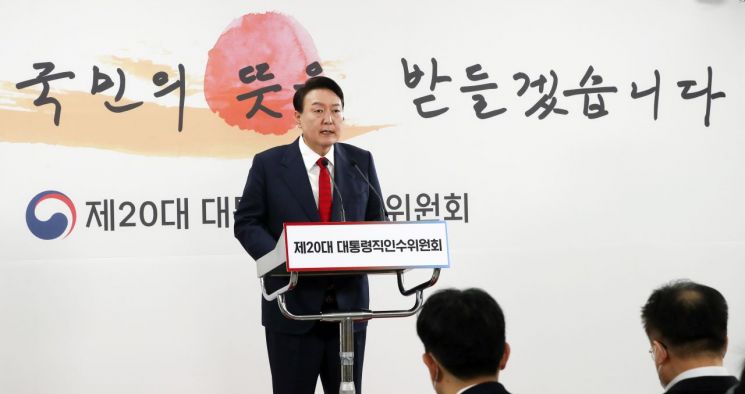
[Asia Economy Reporter Lee Seon-ae] As President-elect Yoon Seok-yeol's pledge to abolish the 'capital gains tax on stock transfers' (stock transfer tax) has become embroiled in fairness controversies and faced widespread predictions of difficulty in implementation, individual investors are showing collective movements demanding its execution. Although the abolition of the stock transfer tax sparked fairness debates from the moment the pledge was announced, communities of individual stock investors have actively expressed their support.
According to the financial investment industry on the 20th, the stock community 'Sanghanmun,' which has 20,000 members, is actively encouraging participation in the Blue House's national petition supporting the abolition of the stock transfer tax. They are promoting participation through messages.
On the 15th, a petition titled "President Yoon Seok-yeol, please abolish the stock transfer tax" was posted on the Blue House national petition site. As of 1:25 PM that day, 1,153 people had participated. The petitioner emphasized, "I understand the capitalist principle that taxes exist where income exists, but I believe it is really wrong to target even the small money of individual investors," adding, "If funds do not flow into the stock market, ultimately everyone will suffer more."
The Korea Stock Investors Union, a stock community with 50,000 members, also strongly supports the abolition of the stock transfer tax. Jeong Eui-jeong, the representative of the Korea Stock Investors Union (Hantuyun), said, "Among emerging countries, almost no country imposes a stock transfer tax, and in Taiwan, the government attempted to introduce such a tax but the stock market crashed," adding, "Ultimately, it is the big players who move the stock market, so if funds flow out due to the transfer tax, small investors will inevitably suffer losses," emphasizing that abolition is necessary.
However, the financial investment industry views the abolition of the stock transfer tax as unlikely to be easy.
With the taxation of financial investment income scheduled for next year, exempting only stocks from the transfer tax could provoke backlash from investors in other financial products such as bonds and funds, making it impossible to quell fairness controversies. Moreover, in the current situation where the ruling party holds fewer seats than the opposition, the Democratic Party has expressed opposition to the pledge, making legislative revision practically difficult.
There is also significant controversy over tax cuts favoring the wealthy. Criticism has arisen that the abolition of the stock transfer tax would benefit only a small number of high-net-worth investors. Currently, the stock transfer tax is imposed only on capital gains exceeding 50 million KRW. According to the National Assembly Budget Office, only 2% of stock investors paid the stock transfer tax between 2014 and 2017. This means that the benefits of abolishing the stock transfer tax could go only to this '2% of investors.'
Jeon Bae-seung, a researcher at Ebest Investment & Securities, pointed out, "The next government will prioritize real estate-related laws such as the three lease laws and comprehensive real estate tax," adding, "Without a sudden political consensus, it will be difficult to revise the stock transfer tax." A financial investment industry official remarked, "The tax law would have to be overturned, but would the Democratic Party, which holds 180 seats, cooperate willingly?" and criticized it as "the most difficult policy among the pledges to realize."
© The Asia Business Daily(www.asiae.co.kr). All rights reserved.

















