The Heart of Power in South Korea Since Government Establishment
Considered the Place of Royal Energy in Pungsu Geography During the Goryeo Dynasty
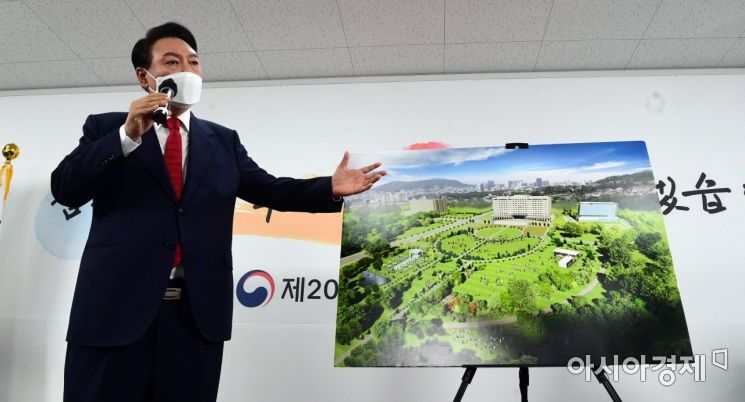 President-elect Yoon Suk-yeol is holding a press conference on the relocation of the Blue House presidential office to the Yongsan Ministry of National Defense building at the press conference room of the Presidential Transition Committee, located in the annex of the Korea Financial Training Institute in Samcheong-dong, Jongno-gu, Seoul, on the 20th. Photo by Yoon Dong-ju doso7@
[Asia Economy Reporter Lee Ji-eun] President-elect Yoon Seok-yeol announced on the 20th that he will relocate the presidential office from the Blue House to the Ministry of National Defense building in Yongsan, Seoul, marking the official beginning of the "Yongsan era." The site of the Blue House, where presidents have resided since the establishment of the Republic of Korea, has been regarded as a "pungsujiri myeongdang" (a geomantically auspicious site) since the Goryeo Dynasty and will soon return to the people.
At 11 a.m. on the same day, Yoon held a press conference at the annex of the Korea Financial Training Institute in Samcheong-dong, Jongno-gu, where the transition committee office is located, officially confirming the relocation of the presidential office to the Ministry of National Defense building. The intention is to return the Blue House, a symbol of "imperial power," to the people.
The current Blue House site was the secondary palace of Namgyeong, one of the "Samgyeong" during the Goryeo period. Dominated by geomancy and prophecy beliefs, Goryeo built a palace in the Namgyeong area under Samgaksan Mountain, believing it held the energy of kingship, and even considered relocating the capital there in the late Goryeo period.
During the Joseon Dynasty, with the establishment of Gyeongbokgung Palace, the site became its rear garden and was called "Gyeongmudae." After Gyeongbokgung was reconstructed in the 5th year of King Gojong's reign, buildings such as Yungmundang, Yungmudang, and Oungak were erected, and it was a place for civil service exams, martial arts competitions, and where the king personally engaged in farming. It was also the site of the "8-bae rice paddies," cultivated by the king himself to remind that "farming is the foundation of national affairs."
However, after the Japanese colonial period began, Gyeongbokgung was used as the Government-General of Korea building, the rear garden buildings were demolished, and the area was turned into a park. A new governor-general's residence was built and used by the 7th to 9th governors-general.
After liberation, the site was used by General Hodge, commander of the U.S. Army Military Government in Korea, and after the establishment of the Republic of Korea in 1948, it became the official residence of the first President Syngman Rhee. At the same time, it regained the name "Gyeongmudae" as the residence's name, but in 1960, under the Yun Bo-seon administration, it was renamed "Cheongwadae" (Blue House) to erase the perception of dictatorship from the previous regime.
The old Blue House building, which continued to serve as the presidential office for successive presidents, was demolished in November 1993 under the directive of President Kim Young-sam to restore national dignity, and the site was thereafter called "Sugungteo."
Successive presidents have promised to relocate the Blue House office to promote "de-authoritarianization," but due to reasons such as security and protection, the plans were never realized. Presidents Kim Young-sam, Kim Dae-jung, and Roh Moo-hyun all promised relocation, and President Moon Jae-in also pledged in 2017 to become the "Gwanghwamun President" and even considered it seriously, but the plan was canceled in 2019.
Yu Hong-jun, former head of the Cultural Heritage Administration and one of the experts advising the Gwanghwamun Presidential Era Committee at the time, stated at a press conference, "If the presidential office is moved to Gwanghwamun, there is no alternative site near Gwanghwamun to replace key functions such as the Blue House guesthouse, main building, and helipad," adding that the plan could only be reconsidered after the Gwanghwamun Plaza restructuring project is completed.
© The Asia Business Daily(www.asiae.co.kr). All rights reserved.
![Clutching a Stolen Dior Bag, Saying "I Hate Being Poor but Real"... The Grotesque Con of a "Human Knockoff" [Slate]](https://cwcontent.asiae.co.kr/asiaresize/183/2026021902243444107_1771435474.jpg)
















