Disappearing Korean Buffet... Rapid Decline in Store Numbers by Brand
Double Hardship from Changing Dining Trends and COVID-19
Industry Shifts Focus from Offline Stores to RMR
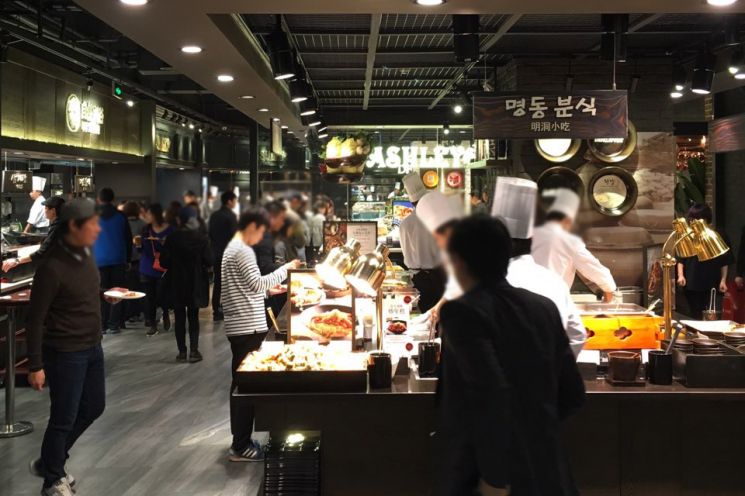
[Asia Economy Reporter Song Seung-yoon] Korean buffet restaurants, which once caused a sensation, are now in the process of withdrawing. Changes in dining trends, the increase in single-person households, and the impact of COVID-19 have combined to push them into the annals of history.
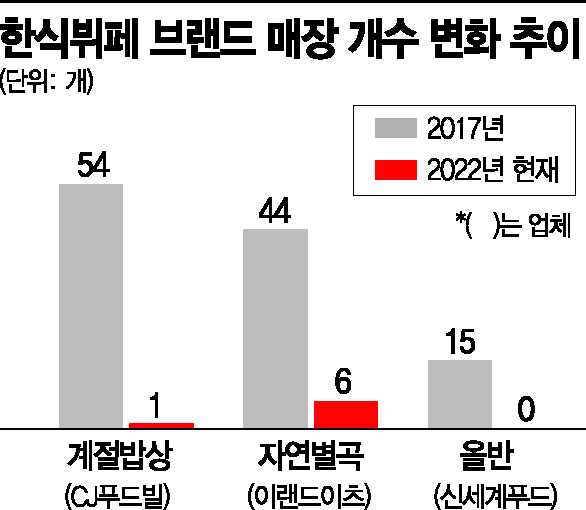
According to the industry on the 18th, CJ Foodville's Seasonal Table, which led the Korean buffet trend in the mid-2010s, is reportedly winding down its offline business. Seasonal Table was the first brand among large conglomerate-affiliated Korean buffets and once operated 54 stores, but now only runs a location at COEX Mall in Samseong-dong, Gangnam-gu, Seoul. The lease for this store expires in June. A CJ Foodville official said, "It is true that the contract expiration date is approaching, but we are still reviewing whether to renew the contract, so nothing has been decided yet." If the contract is not renewed, the offline stores will effectively be completely withdrawn. Although the brand will not disappear, the focus is expected to shift toward RMR (Restaurant Meal Replacement) products.
Shinsegae Food's Olban operated 15 stores in 2017 but sharply declined to 5 stores by 2019 and has now completely disappeared. E-Land Eats' Jayeon Byeolgok also peaked at 46 stores in 2016 but dropped to 4 last year. Recently, two more locations opened, bringing the total to 6. Fullipchae, a pioneer in franchise Korean buffets, also saw its store count plummet from 47 in 2016 to 6 currently. In 2020, the company even entered corporate rehabilitation procedures, leading to the closure of all stores.
The decline of Korean buffets was already predicted around 2016. Although they enjoyed their heyday in the mid-2010s, they were designated as a small and medium-sized enterprise (SME) suitable industry, which imposed restrictions on new openings, making it difficult to open stores in desired commercial areas. As consumer dining trends polarized into fine dining and value-for-money markets, their popularity waned. Meanwhile, the outbreak of COVID-19 in Korea dealt a direct blow. Buffets were designated as high-risk facilities and were forced to suspend operations at times, and customers gradually stopped visiting due to infection concerns.
With 'home-cooked meals' and 'eating alone' becoming new trends, this pattern is expected to continue for some time. Professor Kim Si-wol of Konkuk University's Department of Consumer Studies analyzed, "Meal kits and fresh delivery services are very well developed, and dining trends have changed significantly from the past, so except for some famous hotel buffets, it will not be easy for Korean buffets to survive in the future." He added, "Although Korean buffets might be revisited later from an analog perspective, structurally they do not fit well with current dining trends."
© The Asia Business Daily(www.asiae.co.kr). All rights reserved.
![Clutching a Stolen Dior Bag, Saying "I Hate Being Poor but Real"... The Grotesque Con of a "Human Knockoff" [Slate]](https://cwcontent.asiae.co.kr/asiaresize/183/2026021902243444107_1771435474.jpg)

















