4th Dose Lowers Severe Risk in Populations with Risk Factors
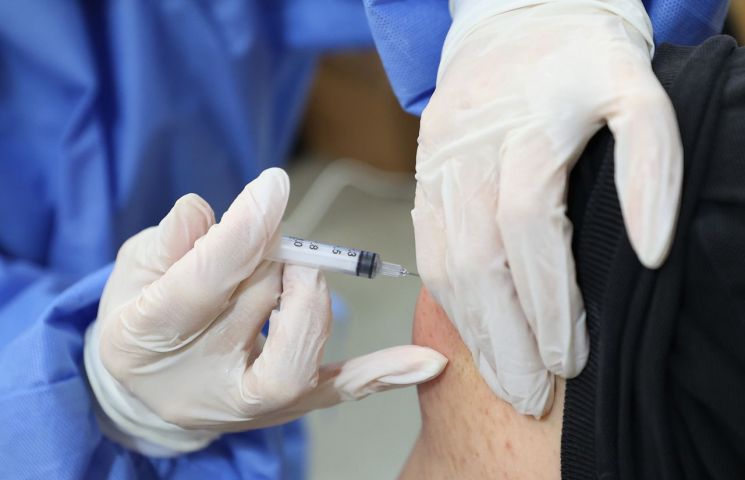 On December 20, 2021, medical staff administered the third dose of the COVID-19 vaccine at Jungnim-dong Community Center in Jung-gu, Seoul. To increase the third dose vaccination rate, Jung-gu, Seoul, will operate a visiting vaccination team at community centers for ten days starting from this day. Eligible vaccine recipients are residents aged 18 and over who are three months past their second dose. [Image source=Yonhap News]
[Asia Economy Intern Reporter Kang Wooseok] Research results have shown that for mRNA (messenger ribonucleic acid) COVID-19 vaccines such as Pfizer and Moderna, the infection prevention effect of the 4th dose is either nonexistent or extremely limited.
Sheba Medical Center, Israel's largest medical institution, announced the preliminary results of a 4th COVID-19 vaccine trial conducted on its own medical staff in a research paper published on the 16th in the international academic journal The New England Journal of Medicine (NEJM).
The research team compared 274 medical staff who received an additional dose of Pfizer (154 people) or Moderna (120 people) vaccines four months after their 3rd dose with an equal number of 3rd dose recipients. The results confirmed that the infection prevention efficacy of the 4th dose in young and healthy individuals was generally similar to that of the 3rd dose.
Gili Regev-Yochay, head of infection prevention and control at Sheba Medical Center and lead researcher, explained, "One month after the 4th dose, the levels of immunoglobulin G (IgG) and neutralizing antibodies were similar to those of the 3rd dose recipients," adding, "The COVID-19 infection rate in the 4th dose group was only slightly lower than that of the control group."
However, she emphasized, "The 4th dose is important in reducing the risk of severe illness in populations with risk factors," and "The 3rd dose remains very important for those who have not yet been infected with COVID-19."
Meanwhile, Israel began administering the 4th dose of the vaccine at the end of December last year to immunocompromised individuals such as patients who received immunosuppressive therapy to reduce rejection after organ transplantation. Subsequently, the 4th dose eligibility was gradually expanded to all adults. Currently, there are approximately 737,000 people in Israel who have received the 4th dose.
© The Asia Business Daily(www.asiae.co.kr). All rights reserved.

















