Tax Benefits for Locally Produced Models... Duty-Free Exports to Nearby Southeast Asia
Indonesian Government Expresses Commitment to Electric Vehicle Industry Development... Partnership with Hyundai Motor
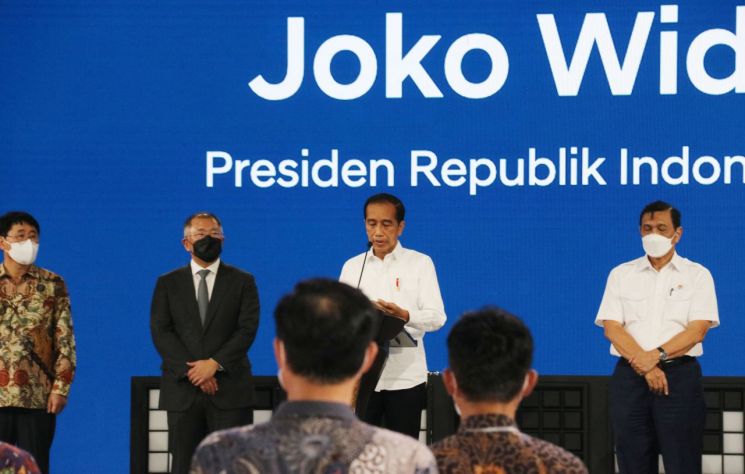 Indonesian President Joko Widodo is delivering a congratulatory speech at the inauguration ceremony of the Hyundai Motor Indonesia plant in Bekasi on the 16th.
 [Asia Economy Reporter Choi Dae-yeol] Hyundai Motor Company's establishment of a complete vehicle factory in Indonesia is a move aimed at the growing electric vehicle market. Indonesia, along with Thailand, Malaysia, and Vietnam, has been regarded as a new emerging market following the BRICS countries due to its large population and rising income levels. Additionally, with the Indonesian government's multifaceted support for fostering the electric vehicle industry, Hyundai Motor has judged that Indonesia is sufficient to serve as a strategic base for targeting the ASEAN market.
According to the company, the Indonesian government offers tax benefits to companies producing electric vehicles locally if they meet localization rate conditions by utilizing local parts and labor. The localization rate is set at 40% until next year, 60% from 2024 to 2029, and 80% from 2030 onward. The local government exempts import tariffs on parts and luxury tax (15%). Furthermore, government vehicles will be converted to electric vehicles by more than 10,000 units annually from last year through 2030, totaling over 130,000 units.
Supply conditions for batteries, a core component of electric vehicles, are also expected to improve. Hyundai Motor Group is building a battery cell factory through a joint venture with LG Energy Solution. Construction began last year in the Karawang industrial complex and is scheduled for completion in the first half of next year. The company anticipates mass production of battery cells to be possible in the first half of 2024.
Since the factory will produce various electric vehicles, including Hyundai and Kia's dedicated electric cars, it is expected to receive various benefits from the local government. Production of Hyundai's first dedicated electric vehicle, the Ioniq 5, began on the 16th, the day of the local factory's completion ceremony.
Indonesian President Joko Widodo said, "Congratulations on the completion of Hyundai Motor's Indonesia factory and the mass production of the Ioniq 5, the first electric vehicle produced in Indonesia," adding, "The Ioniq 5 will be an important milestone in the development of electric vehicles in Indonesia."
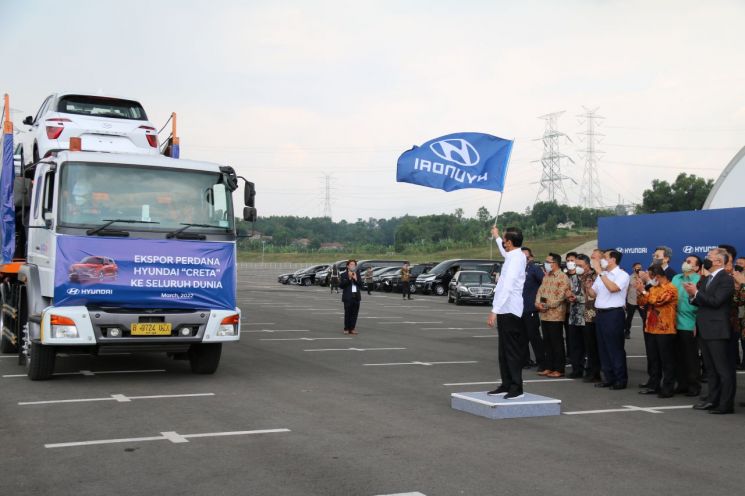 Indonesian President Joko Widodo is celebrating the export of Creta vehicles produced at Hyundai Motor Indonesia's Bekasi plant on the 16th. The inauguration ceremony of Hyundai Motor Indonesia's plant and the export celebration were attended by Chairman Chung Eui-sun, key Indonesian ministers, and ambassadors from both countries.
 Hyundai plans to accelerate its ASEAN market penetration by using the Indonesia factory as a base. Although extraterritorial tariffs on complete vehicles in the ASEAN market can be as high as 80% depending on the country, under the ASEAN Free Trade Agreement, if the parts localization rate exceeds 40% from 2018, trade is tariff-free. This means it will be easier to export new cars made at the Indonesia factory to neighboring countries. The Comprehensive Economic Partnership Agreement between Korea and Indonesia, which is expected to eliminate or reduce tariffs, is also a positive factor, making it easier to send automotive parts or steel products from Korea.
The Regional Comprehensive Economic Partnership (RCEP), involving 10 ASEAN countries and Korea, came into effect last month. The company explained, "As a result of various free trade agreements and the New Southern Policy, producing and exporting complete vehicles in Indonesia, which has emerged as a key partner, will bring more long-term advantages."
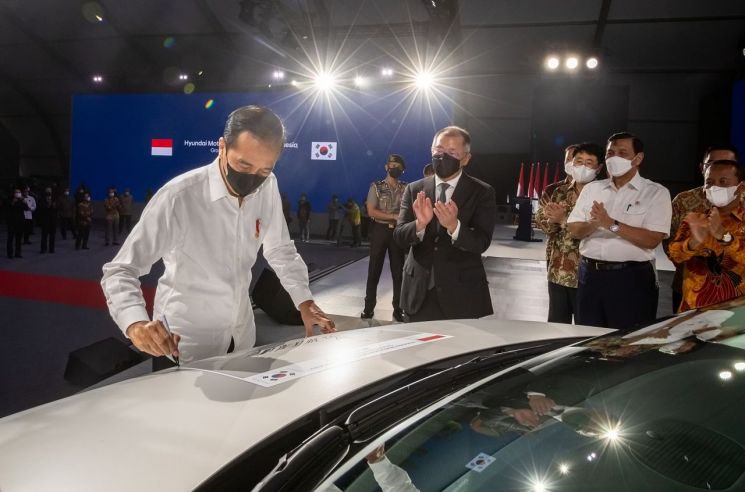 Indonesian President Joko Widodo is signing an Ioniq 5 vehicle at the factory completion ceremony on the 16th.
 Indonesia is the largest ASEAN market, with over one million vehicles sold annually from 2012 to 2018. The industry expects the market in the five major ASEAN countries?Indonesia, Thailand, Malaysia, the Philippines, and Vietnam?to grow to about 3.58 million units by around 2025.
Hyundai is focusing on all processes, including developing strategic models suitable for the local market and promoting technical partnerships between domestic and local parts suppliers. The company also applies a build-to-order (BTO) production method, producing products based on consumer orders, which enhances responsiveness to consumers. This approach also helps reduce inventory management costs.
Additionally, Hyundai is introducing a sales method that integrates online, offline, and mobile channels. This omnichannel approach is the first in the local complete vehicle industry. The online sales platform "Click to Buy" enables financing and payment online for the first time among local brands. Considering local consumer patterns, dealers have been placed in major shopping malls. The strategically established offline base, City Store, has opened 10 locations so far. Nationwide, 100 dealer networks have been opened, with plans to increase to 150 in the mid to long term.
© The Asia Business Daily(www.asiae.co.kr). All rights reserved.



















