6-7 Type Inherpes Virus Cause
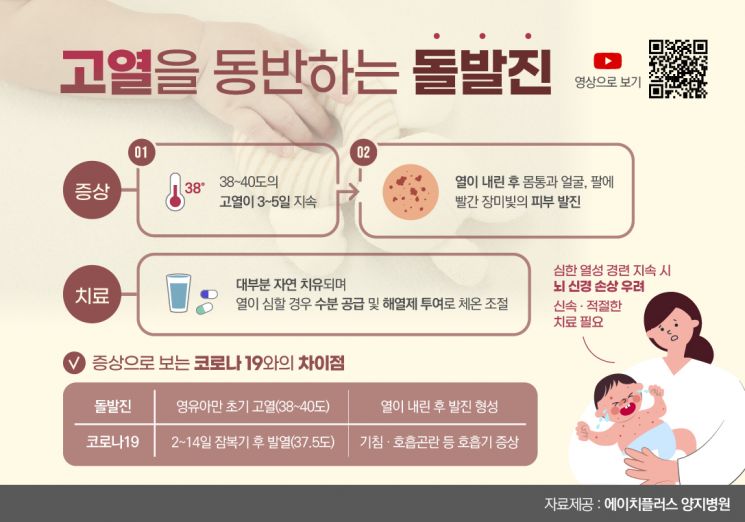
High Fever Over 38°C Lasting 3-5 Days
Rose-Colored Skin Rash After Fever Subsides
Beware of Antibody Disappearance Within 6-24 Months
[Asia Economy Reporter Lee Gwan-joo] The contagious disease "dollbaljin," which frequently occurs in infants and toddlers, is accompanied by high fever and can easily be confused with COVID-19 symptoms. Dollbaljin commonly affects infants aged 6 to 24 months. It is caused by infection with human herpesvirus types 6 and 7, with fever and skin rash as the main symptoms. The antibodies received from the mother usually remain until about 6 months of age, and the disease mainly occurs when these antibodies disappear.
Specifically, a fever above 38 degrees Celsius lasts for several days, then suddenly drops, followed by the appearance of rash symptoms on the neck, face, and limbs. The rash does not cause itching, blisters, or pus formation. The rash usually disappears after 1 to 3 days. Most patients have no special symptoms other than high fever, but rarely, seizures, runny nose, vomiting, and diarrhea may accompany.
Because there are no symptoms other than high fever, early diagnosis is not easy. It is important to differentiate dollbaljin from diseases accompanied by fever and rash that have a high possibility of complications, such as measles. Unlike dollbaljin, which causes red-pink rashes, measles skin rashes are red or reddish-brown. Also, dollbaljin slowly recovers after the fever drops and the rash appears, whereas measles symptoms persist even during the rash phase.
Dollbaljin is diagnosed by comprehensively considering age, medical history, and physical examination findings, and confirmed by serological tests, virus culture, antigen detection, PCR tests, etc., to verify infection with human herpesvirus types 6 and 7. Recently, with the rapid increase in Omicron variant cases, there may be confusion between typical dollbaljin and COVID-19 infection.
Dr. Yang Mu-yeol, a pediatric specialist at H Plus Yangji Hospital, explained, “The difference between dollbaljin and COVID-19 infection is that infant dollbaljin presents with initial high fever followed by rash after the fever subsides, whereas COVID-19 shows fever above 37.5 degrees Celsius, cough, and respiratory difficulties after an incubation period of 2 to 14 days, and sometimes asymptomatic infections can occur.”
Treatment mainly involves symptomatic therapy according to symptoms, with most cases healing naturally. However, if the fever is high, adequate hydration should be provided, and antipyretics administered to control body temperature. Immunocompromised patients are given antiviral drugs. Since dollbaljin is contagious, contact with other children should be avoided until the rash disappears. Dr. Yang cautioned, “Although dollbaljin generally has a good prognosis, if severe febrile seizures persist, there is a risk of brain nerve damage, so prompt and appropriate treatment is necessary.”
© The Asia Business Daily(www.asiae.co.kr). All rights reserved.
![Clutching a Stolen Dior Bag, Saying "I Hate Being Poor but Real"... The Grotesque Con of a "Human Knockoff" [Slate]](https://cwcontent.asiae.co.kr/asiaresize/183/2026021902243444107_1771435474.jpg)
















