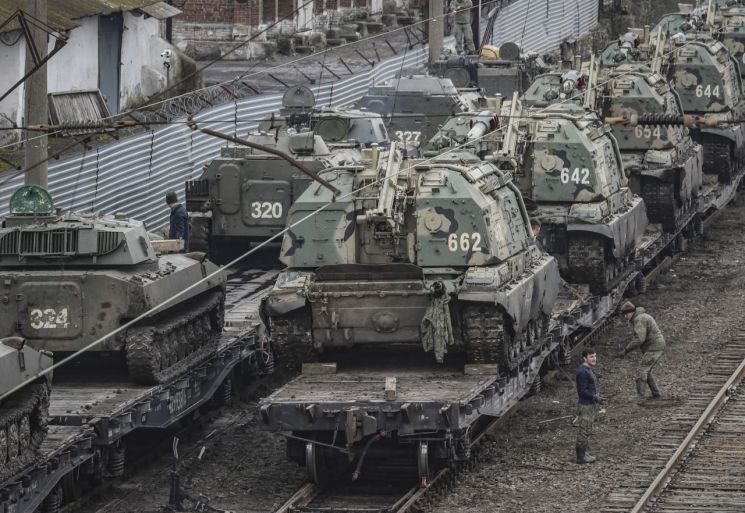
 Russian Military Armored Vehicles Loaded on a Train at a Station Near the Ukraine Border
 [Image Source=Yonhap News]
[Asia Economy Reporter Sumi Hwang] Foreign media reports have emerged that European countries have assessed the actual state of Russia's military power, once considered the strongest in the world.
On the 8th (local time), according to The New York Times (NYT), military and intelligence agencies from various countries confirmed that the Russian military is not functioning properly from frontline soldiers to the top leadership.
Initially, Russia, which possessed overwhelming military power, set a goal to immediately capture Kyiv after invading Ukraine. However, it has struggled to take Kyiv and is being drawn into a prolonged war.
NYT pointed out that the problem lies in the excessive concentration of authority in Chief of the General Staff Valery Gerasimov. Gerasimov’s aides must obtain prior approval even for minor matters, which reduces efficiency.
Additionally, NYT reported that the young conscripted Russian soldiers lack experience and were not given the authority to make flexible decisions on the battlefield. The same lack of authority applies to non-commissioned officers.
There is also an analysis attributing this to risk-averse attitudes rooted among Russian military commanders. Risk aversion refers to a tendency to avoid taking on risks as much as possible.
Western intelligence agencies believe that due to commanders’ conservative judgments, Russia, despite having overwhelming air force capabilities, has not fully controlled Ukrainian airspace.
In fact, the Russian Air Force reportedly operated only some bombers and helicopters in northern Ukraine, judging the weather was not optimal for flying. According to a U.S. Department of Defense official, low-altitude flight was ordered citing weather reasons, exposing aircraft to attacks from Ukrainian air defenses.
Along with this, the Russian military’s logistics are also not functioning properly. According to CNN, the Russian military is facing difficulties in supplying military provisions amid shortages of fuel and food. Some Russian soldiers who entered Ukraine were supplied with combat rations that expired in 2002.
Andrei Kozyrev, who served as foreign minister under former Russian President Boris Yeltsin, recently criticized on Twitter, saying, "The Kremlin spent money over the past 20 years to modernize the Russian military, but a significant portion of the budget was siphoned off in the middle to buy luxury yachts."
However, despite these problems, military experts believe that Russia, with its large size, will ultimately have the upper hand in the Ukraine war. The Russian military numbers 900,000, with reserves reaching 2 million. Excluding various weapons, the troop count alone is eight times that of Ukraine.
Meanwhile, Poland has stepped up to support the Ukrainian Air Force. On the 8th, according to AFP, the Polish Ministry of Foreign Affairs decided to deploy 28 Soviet-made MiG-29 fighter jets, previously operated by its air force, to a U.S. Air Force base in Germany and entrust their disposition to the U.S.
The Polish Ministry of Foreign Affairs also urged NATO member countries to provide MiG-29 fighter jets.
With Poland officially supporting Ukraine’s air force, the possibility of escalation is increasing. Previously, Russia warned that providing fighter jets or other air support would be considered war intervention and threatened retaliation.
© The Asia Business Daily(www.asiae.co.kr). All rights reserved.

















