Lee and Yoon Break Away from Social Distancing... Actively Boost Domestic Demand
Investment Appeal in Liquor, Duty-Free, Cosmetics, and Apparel Sectors
No Pledge to Lower Communication Fees, Yet Telecom Stocks Also Attract Attention
[Asia Economy Reporter Minji Lee] As the presidential election results approach in one day, differentiated trends by industry are expected to emerge, and it is increasingly forecasted that regardless of which candidate wins, maintaining interest in reopening and telecommunications-related industries would be beneficial.
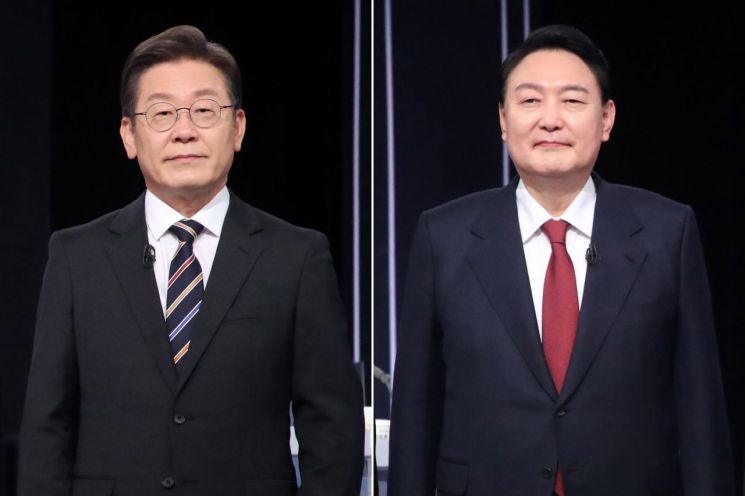
On the 8th, looking at the major political parties' presidential candidates' pledges, they commonly propose easing quarantine measures and providing extensive support to small business owners and self-employed individuals. Lee Jae-myung, the Democratic Party candidate, has proposed introducing ‘smart quarantine’ measures, such as relaxing business restrictions to 24 hours for those who have received the third vaccine dose. Yoon Seok-youl, the People Power Party candidate, mentioned completely abolishing the quarantine pass and immediately allowing 24-hour business operations.
Expectations for reopening have risen whenever the number of confirmed cases decreased but were repeatedly dashed by various variants such as Delta and Omicron. However, since the new government has announced its intention to actively stimulate domestic demand by moving away from strict social distancing, it is expected that industries such as liquor, duty-free, cosmetics, apparel, travel, and distribution will increase their investment appeal. Despite external uncertainties such as Russia's invasion of Ukraine and shifts in monetary policy, reopening-related ETFs like TIGER Cosmetics have risen 14% since last month, and KODEX Transportation also increased by 4.7%.
Reopening stocks have low valuation burdens, so their rebound potential is significant. The KRX300 Essential Consumer Goods sector index, which includes Amorepacific, HiteJinro, Lotte Chilsung, and BGF Retail, fell 15.35% from last year until the day before, marking the second-largest decline after the healthcare sector (-43%). By segment, offline consumption expansion is expected to drive the largest rebounds in department stores and convenience stores, while the travel and leisure sectors are anticipated to show gradual recovery. Cosmetics, however, are unlikely to see long-term upward trends. Orin Ah, a researcher at Ebest Investment & Securities, explained, "Short-term stock price increases are expected, but market fragmentation and intensified competition make the business environment somewhat challenging."
Telecommunication stocks are also worth watching closely. In this election, there was no fierce competition over pledges to reduce telecom fees, and since leading candidates have announced policy support for digital transformation, the potential for future growth is increasing. Candidate Yoon Seok-youl pledged to actively promote the establishment of 5G, 6G, private cloud, and digital talent development, while candidate Lee Jae-myung proposed related pledges including Internet of Things (IoT), cloud, 5G, and 6G. Junseop Kim, a researcher at KB Securities, analyzed, “The digital-related pledges presented by leading candidates raise expectations for the development of new businesses by telecom companies,” adding, “Separately, the fact that telecom companies are expanding their dividend policies annually is also a key investment factor.”
© The Asia Business Daily(www.asiae.co.kr). All rights reserved.

















