[Asia Economy Reporter Chunhee Lee] March has arrived, marking the start of a new school semester. It is a season of rapid environmental changes for children as they meet new schools and new classmates. In particular, fractures caused by rough play with new friends or allergic rhinitis that troubles children during seasonal transitions can be significant obstacles to their growth. Here, we look at ways to prevent these issues.
When a new semester begins and children meet new friends, the risk of injuries may increase. Especially as each school autonomously decides on in-person or remote classes, the risk grows if in-person classes increase. According to the School Safety Mutual Aid Association, safety accidents totaled 39,212 cases in 2020, when remote learning was prevalent during the early COVID-19 period, but surged to 86,905 cases last year as in-person classes expanded.
In particular, when children play rough with friends or fall while riding bicycles or playing ball games, they instinctively put their hands or knees on the ground, leading to injuries on the hands, arms, or knees, and in severe cases, fractures. Such fractures can cause damage to the growth plate, potentially hindering a child’s growth.
The bones of growing children and adolescents are largely composed of cartilage, unlike adults, making them vulnerable to external impacts. Children grow as the growth plate (epiphyseal plate), made of cartilage cells, gradually turns into hard bone. During this process, the length of the long bones increases, resulting in growth. Therefore, pediatric fractures occurring during growth can cause premature closure of the growth plate due to damage, or lead to bone deformities such as bending of long bones.
Kim Yu-geun, an orthopedic surgeon at Bupyeong Himchan Hospital, explained, “Because the growth plate is an incomplete cartilage structure, it is often difficult to diagnose growth plate damage early even with simple X-ray examinations. It takes at least 2 to 6 months, and sometimes up to a year, to confirm whether growth has stopped, so regular check-ups are necessary to monitor for any aftereffects of growth plate damage.”
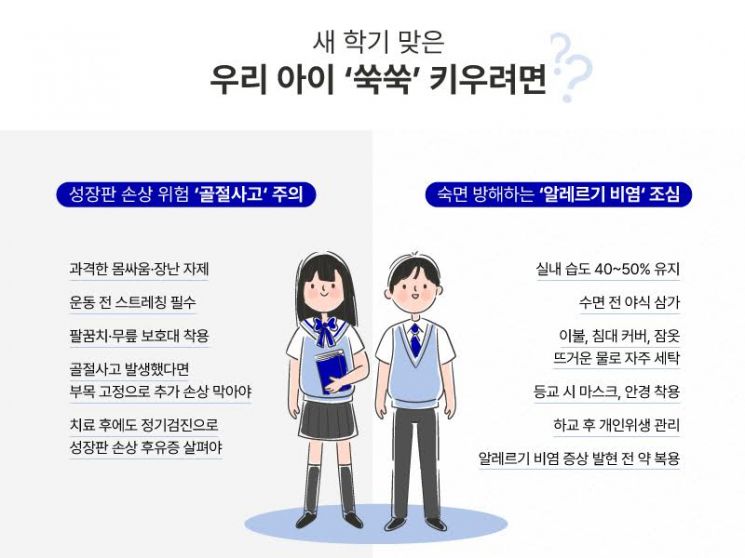
To prevent fracture accidents, it is important to instill safety awareness by guiding children to avoid rough physical fights or horseplay. Additionally, when exercising, muscles and ligaments should be sufficiently relaxed through stretching, and children should develop the habit of wearing safety gear such as helmets, wrist guards, and knee pads. If a fracture accident occurs, emergency treatment to immobilize the injured area is essential. Use thick paper or boards to securely fix the fracture and surrounding areas to prevent further damage to the soft tissues around the fracture site.
Another common unwelcome visitor for children in March is allergic rhinitis. This is because children, whose immunity is weakened by large temperature fluctuations during seasonal changes, start group school life and are easily exposed to allergens that cause allergic rhinitis. Allergic rhinitis is a hypersensitive inflammatory disease caused by specific allergens such as pollen, dust, mites, and pet hair. Its main symptoms include runny nose, nasal congestion, sneezing, and itching.
It particularly lowers concentration and academic performance, while also disturbing deep sleep, which can negatively affect height growth. Growth hormone is most actively secreted about two hours after falling asleep, between 10 p.m. and 2 a.m. However, if the nose is blocked and breathing is impaired during sleep, oxygen levels in the body drop, making it difficult to enter deep sleep and reducing growth hormone secretion. Additionally, a decline in olfactory function can reduce appetite, leading to poor nutrient intake and slower development.
Seo Won-na, a pulmonologist at Incheon Himchan General Hospital, advised, “If you have allergic rhinitis, it helps to avoid late-night snacks that disrupt sleep and maintain indoor humidity at 40-50%. Pillows and mattresses should be covered with protective covers, and covers and pajamas should be frequently washed in water hotter than 60 degrees Celsius.” She added, “When going to school, it is best to wear masks and glasses, and after returning home, take a shower and change clothes immediately to minimize exposure to harmful substances brought in from outside. Identifying allergens through skin tests and taking antihistamines 1-2 weeks before symptom onset can also be an effective preventive measure.”
© The Asia Business Daily(www.asiae.co.kr). All rights reserved.
!["The Woman Who Threw Herself into the Water Clutching a Stolen Dior Bag"...A Grotesque Success Story That Shakes the Korean Psyche [Slate]](https://cwcontent.asiae.co.kr/asiaresize/183/2026021902243444107_1771435474.jpg)
















