Seven Platforms Including Coupang Sanctioned for Violations of the Electronic Commerce Act
Inadequate Consumer Complaint and Dispute Resolution Standards
Fair Trade Commission Conducts On-Site Inspection of Coupang Ahead of Designating Head
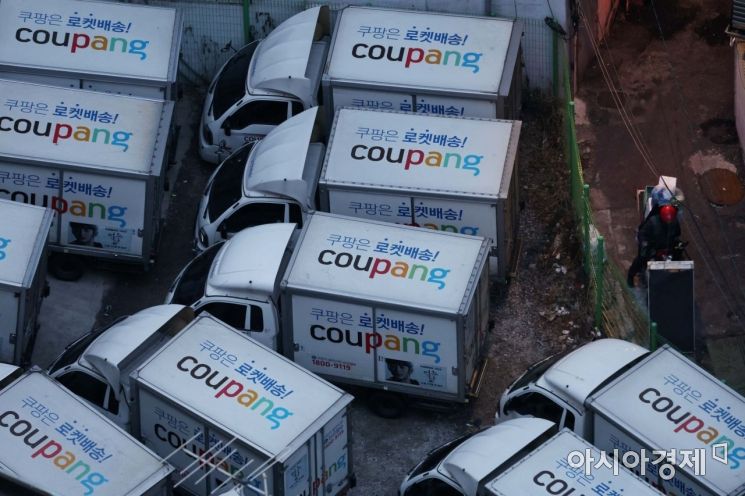
[Asia Economy Sejong=Reporter Lee Jun-hyung] Coupang has been sanctioned by the Fair Trade Commission (FTC) for violating the Electronic Commerce Act. This came just four days after the FTC conducted an on-site investigation to secure related materials ahead of designating Coupang's identical person (head of the group) in May this year.
On the 6th, the FTC announced that it decided to impose corrective orders on seven platform operators, including Coupang, for violating the Electronic Commerce Act. The FTC found that the seven platform operators, including Coupang, violated Article 20 of the Electronic Commerce Act. This article requires intermediary businesses to inform consumers that they are not the sellers of the products. In Coupang's case, consumers who purchased products on the intermediary transaction platform 'Marketplace' were given contracts that did not indicate that Coupang was not the seller of the products.
Additionally, the FTC judged that the presence of the 'Coupang' logo at the bottom of the contract made it easy for consumers to mistakenly believe that Coupang was the contracting party. If consumers confuse the contracting party with Coupang, they may be confused about who the product seller is when requesting returns, refunds, or holding someone responsible for defects. If consumers experience trial and error in identifying the contracting party, their ability to exercise their rights may be hindered. Following the FTC's corrective order, Coupang added a sentence at the bottom of the contract indicating that it is an intermediary business.
Insufficient Measures to Resolve Consumer Complaints
Coupang also failed to establish specific standards for handling consumer complaints and dispute resolution. According to Article 20, Paragraph 3 of the Electronic Commerce Act, intermediary businesses must have personnel and facilities to receive and handle complaints or disputes that may arise during platform use. They must also establish standards for resolving consumer complaints and disputes in advance and notify consumers through the platform. Furthermore, when consumer complaints or disputes occur, the cause must be investigated and the progress of the investigation must be communicated to the consumer within three business days.
The FTC found that the consumer complaint and dispute resolution measures of the seven platform operators, including Coupang, did not meet the level required by current law. According to the FTC, the seven platforms, including Coupang, Naver, and Kakao, did not create specific standards for resolving consumer complaints and disputes but only included general content in the 'Consumer Terms of Use' or posted it on 'Q&A boards.' The FTC judged that such actions by the platforms inevitably restrict consumers' rights to resolve complaints or disputes according to procedures guaranteed by current law.
 Comparison before and after correction of the Coupang Marketplace contract.
 [Photo by Korea Fair Trade Commission]
On-site Investigation of Coupang Ahead of Head of Group Designation
This decision came just four days after the FTC conducted an on-site investigation at Coupang's headquarters. Previously, on the 2nd, the FTC's Corporate Group Division conducted an on-site investigation to secure materials related to Coupang's designation as a large business group (publicly disclosed business group) and head of the group. The FTC usually does not conduct on-site investigations ahead of designating large business groups and heads of groups. However, given the controversy surrounding Coupang's head of group designation last year, it is interpreted as a sign that the FTC intends to examine related materials more closely.
Coupang was designated as a large business group last year after its total assets exceeded 5 trillion won. However, the head of the group was designated as the Coupang corporation, not Chairman Kim Beom-seok, who effectively controls Coupang Korea. This is because the FTC judged that it could not designate Chairman Kim, a U.S. citizen, as the head of the group. The identical person designation system was created to regulate domestic conglomerates, and there has been no precedent of designating a 'foreigner' as the head of the group.
 Chairman Kim Beom-seok of Coupang posing in front of the New York Stock Exchange
(Washington AP=Yonhap News) Kim Beom-seok, Chairman of Coupang's Board of Directors, posed in front of the New York Stock Exchange (NYSE) on the 11th (local time) ahead of the company's listing. Coupang's shares, listed on the NYSE that day, started trading at $63.50. [Provided by NYSE. DB prohibited]
sungok@yna.co.kr
(End)
<Copyright (c) Yonhap News Agency, unauthorized reproduction and redistribution prohibited>
Meanwhile, platforms that receive corrective orders for violating Article 20, Paragraph 3 of the Electronic Commerce Act must establish substantial and specific standards for resolving consumer complaints and disputes within 60 days from the date of receiving the FTC's resolution document. The implementation plan for the corrective order, including these standards, must be submitted to the FTC. The FTC plans to thoroughly review the implementation plans submitted by the platforms and supplement the content through consultation with the operators if necessary.
An FTC official said, "If it is confirmed in advance whether standards for resolving consumer complaints and disputes are properly provided, consumers can assert their rights when damage or disputes occur," adding, "We will do our best in law enforcement and system improvement centered on the 'Digital Market Response Team' to strongly protect the rights and interests of consumers using electronic commerce platforms."
© The Asia Business Daily(www.asiae.co.kr). All rights reserved.














