Advertisement for Late Corporal Byeon Approved at Subway Station After 7 Months
Rejected Twice by Transportation Corporation Review Committee
Lack of 'Social Consensus' Hindered Advertisement Approval
"Concerns Over Restricting Minority Opinions," Human Rights Commission Also Worried
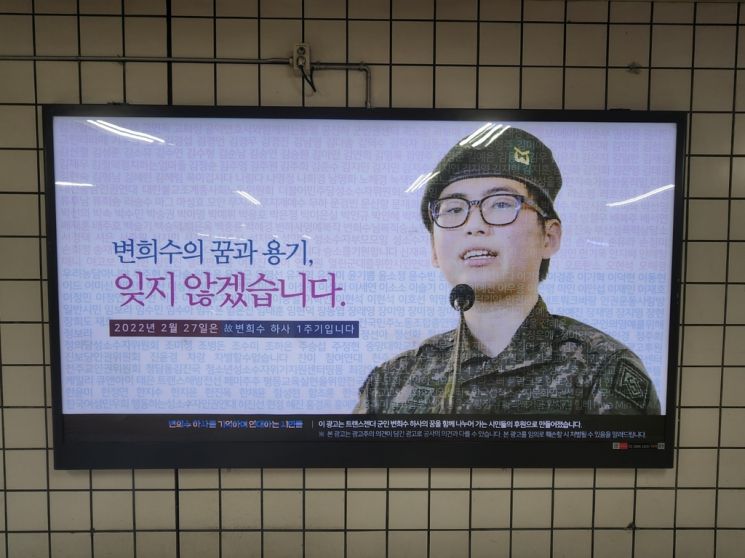 Memorial advertisement for Sergeant Byeon Hee-soo's first anniversary hung at Exit 4 of Itaewon Station, Seoul, on the 28th of last month / Photo by Yonhap News
[Asia Economy Reporter Lim Ju-hyung] A subway advertisement supporting the late Corporal Byeon Hee-soo was recently displayed at Itaewon Station in Seoul. Originally, this advertisement was requested in August last year, but Seoul Metro did not approve its display, causing a delay of nearly seven months before it could finally be revealed to the public. In particular, criticism has grown after it was revealed that the reason Seoul Metro gave for not approving the advertisement was the "lack of social consensus." Questions have been raised as to whether even acts of mourning for the deceased, who suffered unfair social discrimination after gender transition, require "social consensus."
◆Subway Advertisement for Late Corporal Byeon Hee-soo Approved After Three Review Requests
The memorial advertisement for Corporal Byeon was displayed on the wall near Exit 4 of Itaewon Station on the 25th of last month. The screen featured a photo of Corporal Byeon in military uniform along with phrases such as "We will not forget Byeon Hee-soo's dreams and courage" and "February 27, 2022, marks the first anniversary of the late Corporal Byeon Hee-soo."
This advertisement was requested by the "Joint Countermeasures Committee for the Reinstatement and Honor Restoration of Corporal Byeon Hee-soo" (Joint Committee), which includes 33 civic groups, including the Military Human Rights Center. The Joint Committee announced in a statement on the 28th of last month, "From the 25th, a memorial advertisement for the first anniversary of Corporal Byeon Hee-soo has been posted at Itaewon Station." The posting period is about one month from the date the advertisement was displayed.
Although the advertisement mourns the tragic death of Corporal Byeon, it had to go through several months of difficulties before it could be publicly displayed.
Initially, the Joint Committee requested a review of the "advertisement supporting Corporal Byeon's reinstatement lawsuit" from Seoul Metro on August 9 of last year. However, about a month later, on September 2, Seoul Metro decided not to approve the advertisement. The Joint Committee requested a re-review on September 30, but Seoul Metro again denied the advertisement.
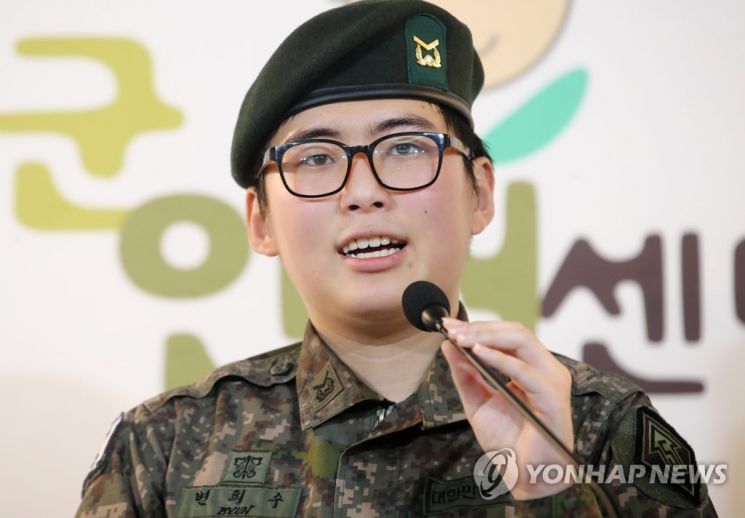 In June 2020, Sergeant Byeon Hee-soo is expressing her position on the military's forced discharge measures at a press conference. / Photo by Yonhap News
The Joint Committee requested another review of the advertisement from Seoul Metro on the 17th of last month. This was the third request for advertisement review. Seoul Metro held a review through the External Advertisement Review Committee on the 21st, four days later, and approved the advertisement. Approximately seven months passed from the first review request until the advertisement was actually displayed in the subway station.
◆Seoul Metro's Advertisement Regulations Become Obstacle to Approval of Corporal Byeon's Advertisement... Human Rights Commission Warns of "Threat to Democratic Principles"
The reason Seoul Metro had denied permission to display the advertisement was reportedly due to the "lack of social consensus." Previously, the Joint Committee filed a complaint with the National Human Rights Commission of Korea (NHRCK), arguing that Seoul Metro's denial was an act of "hate and discrimination against minorities."
Subsequently, the NHRCK conducted an investigation and on October 29 of last year, concluded that Seoul Metro's decision to deny the advertisement was discriminatory against social minorities and infringed upon freedom of expression.
According to the NHRCK investigation, opinion advertisements displayed in the Seoul subway are independently reviewed by the Seoul Metro Advertisement Review Committee, which consists of up to nine external members. Initially, the committee voted 3 in favor and 5 against, rejecting the advertisement application. In the re-review, the vote was 4 in favor and 5 against, again resulting in denial.
The opposing committee members reportedly based their decision on the "Checklist Evaluation Form," which is part of Seoul Metro's advertisement regulations. They cited reasons such as "conflicting opinions and lack of social consensus," "an issue related to gender identity without social consensus," and "an ongoing lawsuit that could interfere with the company's political neutrality."
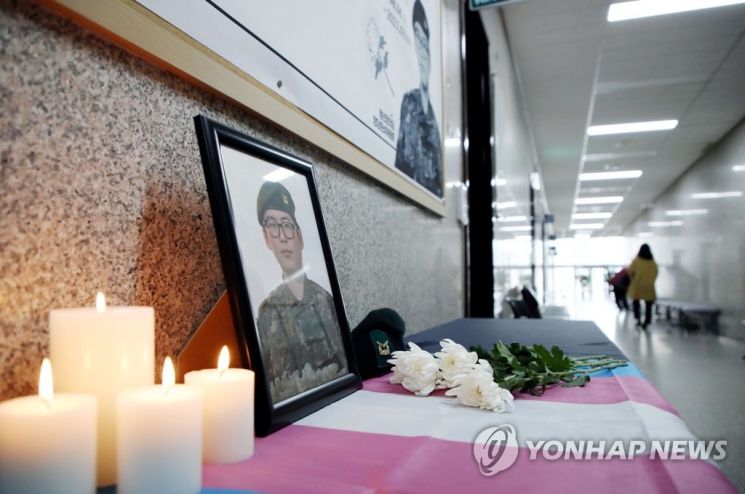 Memorial space for Corporal Byeon set up in the National Assembly on March 4 last year / Photo by Yonhap News
Regarding this, the NHRCK stated, "This advertisement is not related to any specific politician or political party but concerns a lawsuit seeking the cancellation of a discharge order," and judged that "displaying an advertisement related to a lawsuit with administrative authorities does not necessarily undermine the company's political neutrality."
Furthermore, the NHRCK criticized the inclusion of "lack of social consensus" as a reason to prohibit advertisements in the "Checklist Evaluation Form," stating, "The opinions of social minority groups are highly likely to be restricted," and "there is a risk of undermining the fundamental democratic principle of freedom of expression." The NHRCK also recommended deleting such items from the evaluation form.
◆Expert: "The State Has an Obligation to Actively Lead Social Consensus"
Civilians raised their voices, arguing that refusing to display advertisements supporting sexual minorities solely because of a lack of social consensus is unfair.
A 20-year-old university student, A, said, "As seen in the case of Corporal Byeon, sexual minorities are already socially vulnerable groups suffering from discrimination and prejudice in our society. Silencing the voices of such vulnerable groups on the grounds of insufficient 'social consensus' is effectively condoning discrimination."
A 31-year-old office worker, B, said, "Because of a lack of social consensus, the comprehensive anti-discrimination law has been blocked in the National Assembly for years, and now we can't even freely mourn someone who tragically passed away? Erasing sexual minorities under the pretext of social consensus must never happen," strongly criticizing the situation.
Civic groups also continued their criticism. Kim Hyung-nam, Secretary-General of the Military Human Rights Center, attending the first anniversary memorial event for Corporal Byeon held at Sinchon U-Plex Plaza in Seoul on the 27th of last month, said, "The subway advertisement mourning Corporal Byeon will be installed starting near Exit 4 of Itaewon Station and next week at Sinchon Station and City Hall Station," adding, "We must remember that Seoul Metro previously rejected the advertisement citing lack of social consensus."
The Joint Committee issued a press release on the 28th of last month, stating, "Although late, we welcome the posting of the advertisement, but we deeply regret the anti-human rights handling that made even citizens' mourning feelings a subject of consensus for seven long months under the pretext of social consensus," and urged, "Fundamental measures must be taken to reflect on and correct the low human rights sensitivity."
Experts emphasized the need for state institutions to take an active role in leading social consensus.
Kim Ji-hak, Director of the Korea Diversity Research Institute, said, "The state has an obligation to guarantee that all citizens can live equally regardless of gender, physical condition, or gender identity," adding, "If social consensus becomes a source of conflict, state institutions should take the lead to help civil society reach consensus. Persisting in a passive stance may be closer to neglecting responsibility."
© The Asia Business Daily(www.asiae.co.kr). All rights reserved.
!["The Woman Who Threw Herself into the Water Clutching a Stolen Dior Bag"...A Grotesque Success Story That Shakes the Korean Psyche [Slate]](https://cwcontent.asiae.co.kr/asiaresize/183/2026021902243444107_1771435474.jpg)


















