Large Escort Convoy Arrives in Kyiv, Airstrikes Resume
Indiscriminate Attacks After Six Days of Failed Major City Occupations
Russian Anti-War Protests Spread... Two Independent Media Outlets Halt Broadcasts
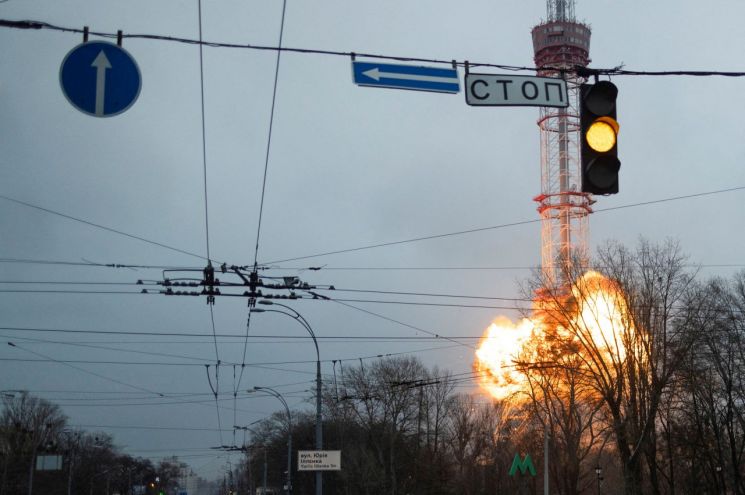
[Asia Economy Reporter Hyunwoo Lee] As the Russian military resumed airstrikes on major cities including Ukraine's capital Kyiv and the second-largest city Kharkiv, the operation has shifted to indiscriminate bombing of civilian residential areas, causing increasing damage. On the sixth day of the invasion of Ukraine, the Russian forces have failed to capture major cities and remain in a stalemate, which is interpreted as an operation to lower the morale of the Ukrainian military and spread fear. However, with the strengthening of Western sanctions and worsening public opinion within Russia, the indiscriminate bombing operation is expected to backfire.
According to foreign media including the Associated Press (AP) on the 1st (local time), the Russian military carried out indiscriminate bombing on residential areas and government offices in Kyiv and Kharkiv. According to the Ukrainian Ministry of Foreign Affairs, the Russian military attacked the Ukrainian TV broadcasting tower in Kyiv, killing five civilians, and in Kharkiv, eight civilians died due to residential area bombings and ten died from attacks on government buildings, resulting in continuous civilian casualties.
Previously, the Russian military had halted offensives from the 27th of last month, claiming to negotiate with the Ukrainian delegation, but it is known that the offensive resumed as a large convoy arrived near Kyiv on this day. According to CNN, a large Russian convoy 64 km long was spotted moving from the Belarus border area to near Kyiv, and the convoy was composed of armored units and artillery for shelling Kyiv, along with vehicles carrying additional troops and supplies.
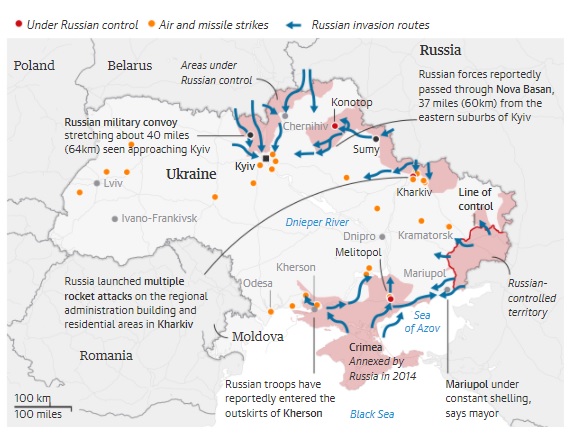
Until now, the Russian military had continued offensives focusing on key military bases and military airports in Ukraine, but due to strong resistance from the Ukrainian military and citizens, it failed to capture major cities such as Kyiv and Kharkiv, leading to a shift in operations. According to the New York Times (NYT), the think tank Institute for the Study of War (ISW) stated in a report on this day, "The main Russian forces advancing from the eastern border area toward Kyiv failed to capture Kharkiv and are advancing toward Kyiv via a detour rather than the main arterial road, significantly slowing their advance," and "It appears that the Russian military has shifted to indiscriminate bombing of major urban areas including civilian residential zones to create a breakthrough."
The main arterial road from the eastern border area of Russia to Kyiv connects Poltava and eastern Kyiv through Kharkiv and is about 480 km long. Contrary to initial expectations, the Russian military has not properly captured major cities even on the sixth day of the war, raising concerns about a prolonged conflict. Accordingly, ISW analyzes that the Russian military has resorted to indiscriminate bombing to lower the morale of the Ukrainian military and instill fear to break their fighting spirit.
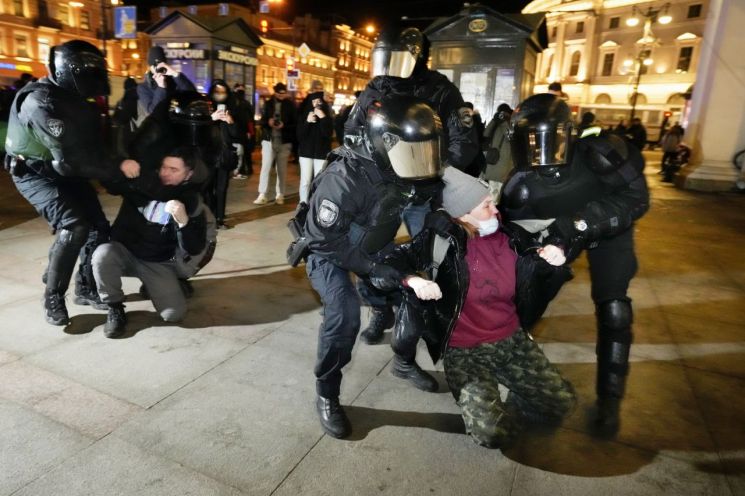
However, as civilian casualties increase, anti-war protests are intensifying not only internationally but also within Russia. According to the Wall Street Journal (WSJ), anti-war protests have significantly spread in major Russian cities including Moscow until the 28th of last month, with 6,435 protesters arrested by Russian police so far. Approximately 10 million people of Ukrainian origin live in Russia, and many Russian citizens are also known to oppose the invasion war.
The Russian government, fearing the spread of anti-war sentiment, has even ordered independent media outlets to cease broadcasting. The Russian prosecutor's office stated in a press release on this day, "We are suspending the broadcasts of Echo of Moscow and TV Rain," adding, "These two media outlets violated broadcasting guidelines related to public order and security and are considered to have incited illegal assemblies conducted without government permission, so the decision was made to suspend their broadcasts."
Earlier, on the 27th of last month, Roskomnadzor, Russia's broadcasting and telecommunications regulator, announced that it would suspend all broadcasts of 10 independent media outlets across Russia, including the two mentioned, if they did not stop spreading false information using terms such as 'attack' or 'invasion' related to the Ukraine war. The Russian government is currently promoting the narrative that the Ukraine war is not an invasion by Russia.
© The Asia Business Daily(www.asiae.co.kr). All rights reserved.



















