Russian Economy Vulnerable to International Financial Sanctions... Limited Uses for Held Chinese Yuan
Concerns Over Economic Turmoil in Russia Including Inflation if Ruble Collapses
[Asia Economy International Desk Reporter] An analysis has emerged that Russia has only $12 billion (approximately 14.5 trillion KRW) in cash available to prevent the collapse of the ruble. This indicates that the Russian economy is vulnerable to international sanctions imposed due to the invasion of Ukraine.
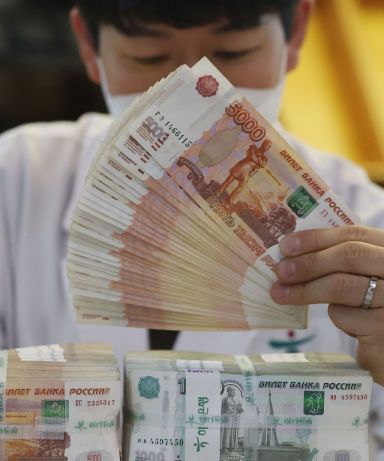
The New York Times (NYT) reported on the 28th (local time) that despite Russia holding $631 billion (752 trillion KRW) in foreign exchange reserves, ranking fourth in the world, the Russian ruble plummeted the previous day.
Russia was initially assessed to have a certain level of resilience against external economic sanctions based on its sufficient foreign exchange reserves. However, as the international community escalated sanctions, such as excluding Russian banks from the Society for Worldwide Interbank Financial Telecommunication (SWIFT) payment network, the value of the ruble dropped to an all-time low.
The Russian Central Bank took emergency measures by sharply raising the benchmark interest rate from 9.5% to 20% after the ruble fell by 30% the previous day.
Experts explain that the reason for the sudden volatility in Russia’s financial market is the discrepancy between the book value of foreign exchange reserves and the actual reserves.
According to Michael Barnstam, a researcher at Stanford University's Hoover Institution, of the $631 billion in foreign exchange reserves, the Russian Central Bank currently holds only $12 billion in cash. Additionally, foreign currency assets held in Chinese government bonds amount to $84 billion (101 trillion KRW), and assets held in gold total $139 billion (167.4 trillion KRW).
More than 65% of the reserves, amounting to $400 billion (482 trillion KRW), are held in foreign financial institutions in cities such as New York, London, Berlin, Paris, and Tokyo. Russia’s foreign currency assets deposited in foreign banks are fully exposed to the risk of international sanctions. If the international community freezes the Russian Central Bank’s foreign currency assets in foreign banks through financial sanctions, a huge amount of $400 billion could be locked up. In fact, the U.S. Treasury Department’s Office of Foreign Assets Control (OFAC) has frozen all assets owned by the Russian Central Bank in the United States.
Even if the Russian Central Bank liquidates some of its Chinese government bonds to obtain yuan, major overseas companies may refuse or hesitate to accept yuan payments.
Therefore, it is calculated that the ammunition the Russian Central Bank can use to defend the ruble’s value currently amounts to only $12 billion.
Russia’s move to force export companies to sell 80% of their foreign currency earnings also appears to reflect the country’s urgent situation.
Robert Person, a professor at the U.S. National Defense University, predicted, "If the ruble collapses, it could lead to severe inflation and economic recession," adding, "The situation could be much more serious than expected."
© The Asia Business Daily(www.asiae.co.kr). All rights reserved.
![From Hostess to Organ Seller to High Society... The Grotesque Scam of a "Human Counterfeit" Shaking the Korean Psyche [Slate]](https://cwcontent.asiae.co.kr/asiaresize/183/2026021902243444107_1771435474.jpg)
















