Operation of In-Person and Remote Classes by School for Two Weeks from the 2nd
Conflicts Arise Despite Reflecting Parent Survey Results
School Operations After the 11th Based on COVID-19 Cases and Quarantine Indicators
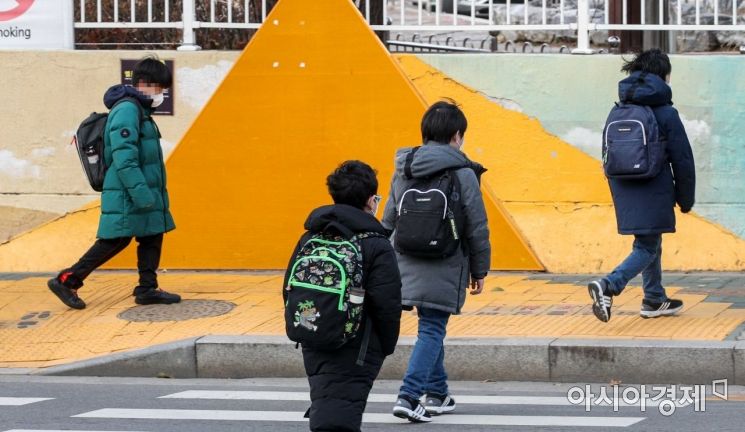 As the government decided to reinforce social distancing measures, it was announced on the 17th that all schools in the metropolitan area and large schools and overcrowded classes in non-metropolitan areas will suspend full in-person attendance starting from the 20th. Students are seen going to school near an elementary school in Seoul on the 17th. Photo by Kang Jin-hyung aymsdream@
[Asia Economy Reporter Han Jinju] "The government shifted responsibility to schools, and schools shifted it to parents."
The Ministry of Education, which insisted on the principle of full in-person attendance, has changed its academic operation policy, plunging schools into confusion once again. Considering the Omicron variant, the Ministry decided to leave the decision to schools for two weeks starting in March. Accordingly, each school will operate classes in various ways for two weeks from the new semester, ranging from full remote classes to partial remote or full in-person attendance. Although most schools decided on the academic operation method through parent surveys, disagreements among parents have erupted in many places.
A parent sending their child to an overcrowded school in Seoul said, "Since many families have both parents working, the voting results are predictable, but it is difficult to reflect the opinions of opposing families, so I wish the education office would at least issue a directive for remote classes." A parent of an elementary school student in Gyeonggi-do said, "The survey results on daily attendance versus remote classes differed by only 10%. Since the decision was made for full in-person attendance, complaints among parents are inevitable."
A parent of an elementary school student who was informed that classes would be conducted fully remotely said, "Adults go to work and children go to academies, so remote classes are inconvenient. Third graders are going to have remote classes for the third year in a row." Another parent said, "I even think it might be better to transfer to a school with fewer students to ensure attendance." Some schools decided to conduct full remote classes for two weeks without surveys, fearing disagreements among parents. Many schools that conduct remote classes do not provide real-time lessons, causing dissatisfaction among parents receiving remote classes. Some dual-income families planned vacations and work schedules assuming remote classes, only to have to adjust them again.
When the Ministry of Education recommended full in-person attendance for kindergartens, grades 1-2, and small schools, parents of prospective elementary students became even more anxious. Since most 1st and 2nd graders attend school daily, many parents are considering home study in preparation for a surge in confirmed cases. In Seoul, home study can be used for up to 38 days, which is 20% of the legally required school days. Many schools operate substitute meals, but meal times are divided by grade into the 3rd and 4th periods, or dismissal routes are separated into front and back gates.
From the 11th onward, academic operation standards will be set according to the occurrence of confirmed and quarantined cases by school, so attendance criteria by grade and class may change frequently within schools. The Ministry of Education set the criteria for partial remote classes at 3% confirmed cases and 15% confirmed plus quarantined cases.
According to the Korea Disease Control and Prevention Agency, as of the 27th, the number of COVID-19 confirmed cases per 100,000 people was 5,875 for ages 0-9 and 6,269 for ages 10-19. This is an increase from the 20th, a week earlier, when the numbers were 5,619 for ages 0-9 and 5,822 for ages 10-19. As of the 28th, two days before the new semester attendance, the Ministry of Education has not yet compiled the academic operation status by school.
The Ministry of Education is not considering unifying academic operations. A Ministry official said, "Academic operation plans should be tailored to regional situations. The adjustment was made on the premise that it is inappropriate for the Ministry to set uniform standards. There is no nationwide uniform standard for switching to remote classes, and the leadership of school principals and superintendents is crucial at this time."
© The Asia Business Daily(www.asiae.co.kr). All rights reserved.
![From Bar Hostess to Organ Seller to High Society... The Grotesque Con of a "Human Counterfeit" [Slate]](https://cwcontent.asiae.co.kr/asiaresize/183/2026021902243444107_1771435474.jpg)
















