Despite Omicron Surge, Guidelines Relaxed... From 1st, Household Contacts of Confirmed Cases Exempt from Self-Quarantine
"Worried It Might Increase the Number of Confirmed Cases"
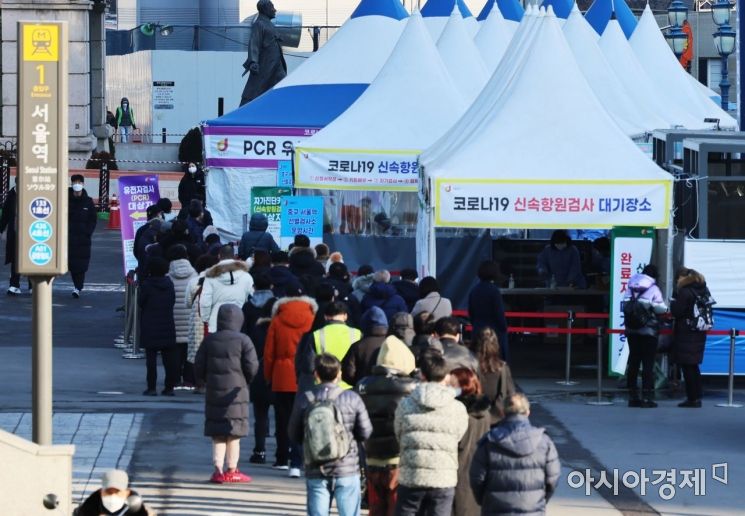 On the 27th of last month, citizens who visited the screening clinic set up at Seoul Station Plaza in Jung-gu, Seoul, are waiting to get tested. Photo by Yoon Dong-joo doso7@
[Asia Economy Reporter Heo Midam] Starting today (the 1st), the quarantine system for cohabitants of COVID-19 confirmed cases will change. This measure is in response to the Omicron variant's widespread outbreak, with daily new COVID-19 cases consistently reaching 160,000, and the surge in home treatment patients increasing the workload of public health centers.
However, some express concerns that the number of 'hidden infections' may rise. Due to Omicron's highly contagious nature and the difficulty of separating living spaces within families, infections among family members, such as parents getting infected while caring for children, are occurring frequently. The quarantine authorities have stated that in the face of the surge in confirmed cases, they will focus on managing high-priority confirmed patients.
According to the Central Disaster and Safety Countermeasures Headquarters (CDSCH), from the 1st, cohabitants of confirmed cases will be subject to passive monitoring regardless of vaccination status and will decide on quarantine themselves. Those under passive monitoring can continue their daily lives without quarantine but must report to the public health center if COVID-19 symptoms appear.
Initially, only fully vaccinated individuals were exempt from quarantine, while unvaccinated persons had to quarantine for seven days. However, now even unvaccinated individuals are no longer obligated to quarantine.
Additionally, the mandatory PCR testing for cohabitants has been removed. They are recommended to take one PCR test within three days of the confirmed case's test date and a rapid antigen test on the seventh day. Rapid antigen tests can be conducted not only by healthcare professionals but also by self-testing using kits.
Regarding this, Lee Gi-il, the first controller of the CDSCH, said at a briefing on the 25th of last month, "When there are 100,000 to 170,000 confirmed cases, it means 1,000 to 1,700 cases per public health center." He added, "The staff numbers remain the same, but the workload has increased, and sometimes only 70% of confirmed case tasks were processed on the same day."
He continued, "The most challenging task on the front lines was the quarantine of cohabiting family members," and explained, "We judged that handling confirmed cases, such as notification, home treatment, or hospital bed allocation, was most important, so we made this decision."
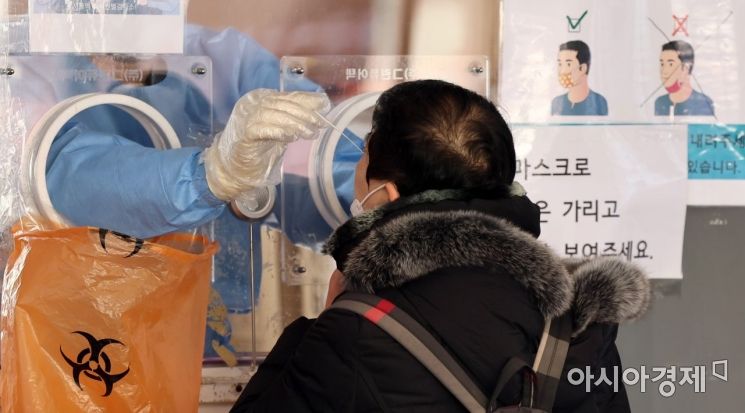 A citizen visiting the screening clinic set up at Seoul Station Plaza in Jung-gu, Seoul, on the 27th of last month is undergoing a PCR test. Photo by Yoon Dong-joo doso7@
However, concerns have been raised that neglecting the management of contacts who may be infected could worsen the spread. Cohabitants infected by confirmed cases might unknowingly engage in social activities, potentially causing community transmission.
Go, a worker in his 20s, said, "They say Omicron is highly contagious, but is it really okay for people living with confirmed cases not to quarantine? Isn't this like encouraging everyone to get COVID? It seems the vaccine pass has become useless. I don't understand why small business owners had to suffer for over two years if this is the case."
Another worker in his 30s, Yang, pointed out, "Since cohabitants of confirmed cases are exempt from quarantine, they might roam around without knowing whether they are positive or negative. What are the chances that cohabitants won't get COVID?"
There are also concerns that this measure could lead to an increase in critically ill patients, as the number of severe cases tends to rise with the scale of confirmed cases.
Recently, the number of critically ill patients has shown a steep increase. As of midnight yesterday, the number of critically ill patients was 715. This figure was in the 200s just fifteen days ago but has rapidly risen to around 700.
Meanwhile, the quarantine authorities explained that although there is a possibility of additional transmission from confirmed patients' families, considering the current scale of the outbreak, this decision was unavoidable.
Park Young-jun, head of the epidemiological investigation team at the Korea Disease Control and Prevention Agency's Central Disease Control Headquarters, said on the 25th of last month, "There is a possibility of additional community transmission because cohabitants are not quarantined. However, with about 170,000 confirmed cases occurring daily, we had no choice but to shift the focus to managing confirmed cases."
© The Asia Business Daily(www.asiae.co.kr). All rights reserved.
![Clutching a Stolen Dior Bag, Saying "I Hate Being Poor but Real"... The Grotesque Con of a "Human Knockoff" [Slate]](https://cwcontent.asiae.co.kr/asiaresize/183/2026021902243444107_1771435474.jpg)

















