139,626 New Confirmed Cases ... 114 Deaths, Highest in a Day
 On the 27th, citizens who visited the COVID-19 screening clinic set up at Seoul Station Plaza in Jung-gu, Seoul, are waiting to get tested. Photo by Yoon Dong-joo doso7@
As the Omicron variant pandemic continues, the cumulative number of COVID-19 cases in South Korea has surpassed 3 million, resulting in the highest number of daily deaths over the weekend. With nearly 800,000 patients undergoing home treatment and an increase in critically ill patients, the early part of next month?marked by the March 1 public holiday, March 2 new semester start, and March 9 presidential election?is expected to be the peak of the Omicron wave.
Cumulative Cases Surpass 3 Million
According to the Central Disease Control Headquarters on the 28th, as of midnight that day, 139,626 new COVID-19 cases were reported, bringing the total cumulative cases to 3,134,456. This comes just one week after surpassing 2 million cumulative cases on the 20th. Since the first confirmed case in South Korea on January 20, 2020, the cumulative cases exceeded 1 million for the first time on the 6th of this month, then doubled to 2 million in 15 days, and again reached 3 million within a week, showing an accelerating upward trend.
Daily new cases surged to the 170,000 range on the 23rd and remained between 160,000 and 170,000 for five consecutive days until the 27th. Due to fewer tests conducted over the weekend, the number of confirmed cases on the 28th slightly fell short of 140,000, but the number is expected to spike again on Wednesday, March 2, when the weekend effect ends.
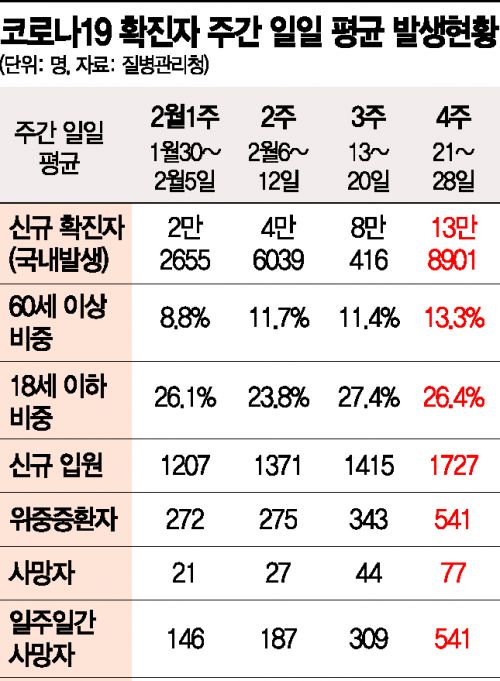
Looking at the weekly daily average incidence, new cases have been doubling every week. The daily average new cases were 22,655 in the first week of February (January 30?February 5), 46,039 in the second week (February 6?12), 80,416 in the third week (February 13?19), and 138,901 in the fourth week (February 20?26), maintaining a weekly doubling pattern. Notably, new cases among the high-risk group aged 60 and above have also doubled each week, increasing from a daily average of 2,075 in the first week of February to 5,383 in the second, 9,199 in the third, and 18,560 in the fourth week. During the same period, their proportion among total confirmed cases rose from 8.8% to 13.3%.
Deaths and Critical Cases Surpass Delta Variant Levels
The surge in new cases has led to an increase in critically ill patients and deaths, raising concerns. Since the onset of COVID-19, the cumulative death toll has exceeded 8,000 (8,058), with 1,303 deaths (16.2%) occurring since the spread of Omicron began in February. Particularly on the 27th, 114 deaths were reported in a single day?the highest since the pandemic started. During the fourth week of February (21?27), there were 539 deaths, averaging 77 per day, more than triple the 21 daily deaths in the first week of February, and surpassing the 70.3 daily deaths recorded during the Delta variant peak at the end of last year (December 25?31).
Critically ill patients, who were in the 200s until the 13th, rose to the 300s on the 14th, 400s on the 19th, 500s on the 23rd, 600s on the 25th, and reached 715 as of the 28th. The daily average number of critically ill patients was 272 in the first week of this month but nearly doubled to 541 in the fourth week within three weeks. Of the 2,704 intensive care unit beds secured by health authorities (as of 5 p.m. on the 27th), 1,303 are currently in use, bringing the bed occupancy rate close to 50% (48.2%). Since it takes about two weeks for new cases to progress to critical illness, the number of critically ill patients is expected to increase significantly in the near future.
Experts predict that if the current trend continues, daily new cases could exceed 200,000 as early as the beginning of next month. Professor Baek Soon-young, Emeritus Professor at the Catholic University College of Medicine, stated, "With the start of the new semester, the possibility of cluster infections among students increases, and the rise in movement during public holidays will cause the epidemic to reach its peak. However, if the rapid increase slows down around the 200,000 case level, the growth in cases may decrease by late March."
© The Asia Business Daily(www.asiae.co.kr). All rights reserved.
!["The Woman Who Threw Herself into the Water Clutching a Stolen Dior Bag"...A Grotesque Success Story That Shakes the Korean Psyche [Slate]](https://cwcontent.asiae.co.kr/asiaresize/183/2026021902243444107_1771435474.jpg)

















