[Seoul District News] Yangcheon-gu Introduces Automation (RPA) for Sending Isolation Notices to Home Treatment and Self-Quarantine Patients from March 2; Automatic Entry of Isolation Notice Information and Text Message Transmission upon Registration of Target List to Ease Health Center Workload... Mirae Asset Management-Jongno-gu-Jungbu Education Support Office Corporate-Linked Convergence Creative Education... Jung-gu Provides Disaster Relief Funds Worth Approximately 900 Million Won for Livelihood Measures
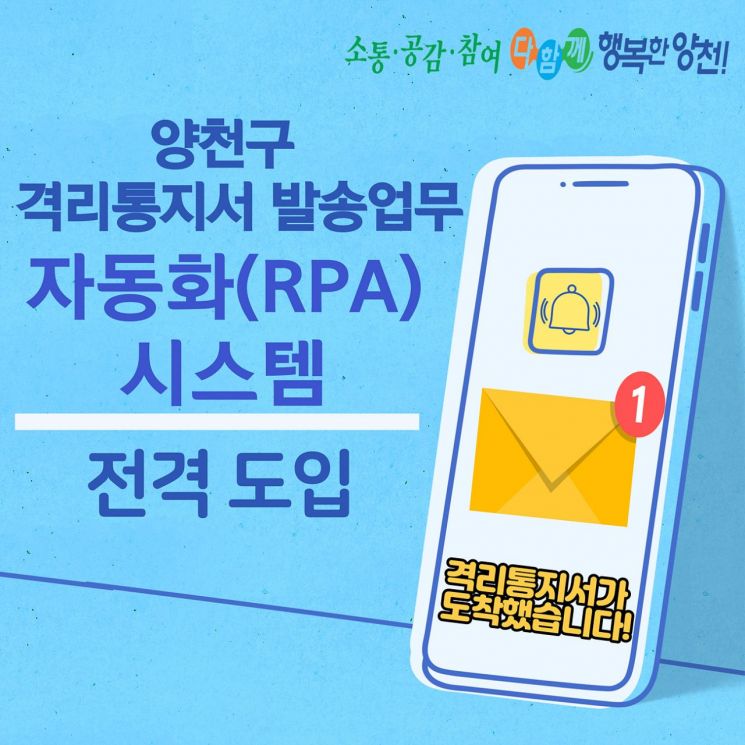
[Asia Economy Reporter Park Jong-il] Yangcheon-gu (Mayor Kim Soo-young) announced that starting from March 2, it will boldly introduce an ‘Automation (RPA) System’ for the task of sending COVID-19 quarantine notices.
The ‘Automation (RPA) System’ is a technology that uses robot software to structure and logically automate data generated during work processes. When applied to regularly repetitive tasks such as data collection and input, it can reduce processing time and costs.
Recently, due to the rapid increase in confirmed cases caused by the spread of Omicron, public health centers have experienced the inconvenience of individually sending quarantine notices via text messages to hundreds of home treatment and self-quarantine patients every day.
In response, the district will boldly introduce the Automation (RPA) System, which will automatically fill in the recipient’s name, date of birth, and other information on the quarantine notice and send the text message automatically once the public health center staff registers the recipient list into the system.
Using the ‘Automation (RPA) System,’ it is possible to automatically send 1,800 quarantine notices per day (8 hours). In particular, without additional personnel, it can handle about 3.6 times more volume than before, greatly improving the efficiency of self-quarantine management tasks.
Kim Soo-young, Mayor of Yangcheon-gu, said, “As the number of confirmed cases reaches 170,000, the workload for staff has explosively increased, so we aim to reduce their burden through the automation system.” He added, “We will continue to expand the application areas step by step so that administrative power can focus on essential tasks beyond simple work.”
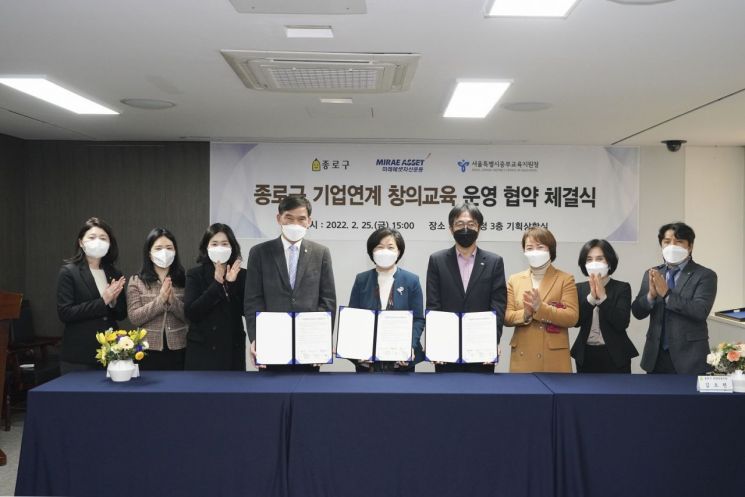
Jongno-gu signed a business agreement on the 25th at the district office’s planning situation room to promote creative education, and based on this, will introduce economic and financial education programs for youth starting in March.
‘Corporate-linked Convergent Creative Education’ is a project that supports school education by utilizing the technology and infrastructure of companies. It was prepared to provide students with career exploration opportunities and high-quality experiential education.
Building on the successful operation last year, this year they plan to conduct new convergent creative education based on mutual cooperation and support among industry (Mirae Asset Global Investments Co., Ltd.), government (Jongno-gu), and academia (Jungbu Office of Education).
From March to July during the first semester, Mirae Asset Global Investments Co., Ltd. will conduct its self-developed customized creative education program for the free semester system, ‘Economic and Financial Education for Youth,’ targeting about 300 students from five middle schools in the district.
Additionally, the program ‘I am a Currency Expert’ will be provided to 500 students at four elementary schools. The classes combine theory and experience, actively using various teaching aids to stimulate students’ interest.
Jongno-gu signed an agreement last year with Hyundai Engineering & Construction and Hyundai Engineering for corporate-linked creative education and has since devoted efforts to discovering participating companies to ensure the sustainability of related projects.
As a result, this year, in collaboration with three companies, they will present high-quality convergent creative education covering finance, environment, and culture and arts. In addition to Mirae Asset Global Investments, which signed the agreement this time, they plan to lead creative education throughout the first and second halves of the year in partnership with LG Household & Health Care and DL E&C.
A district official said, “We will continue to discover companies committed to social contribution activities,” adding, “We will expand experiential creative education so that youth can prepare for the 4th Industrial Revolution, acquire essential competencies for future society, and grow healthily.”
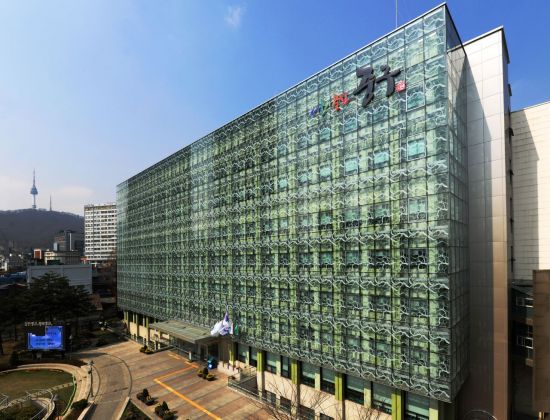
Jung-gu, Seoul (Mayor Seo Yang-ho) will provide disaster relief funds totaling about 900 million KRW to revive the livelihood economy, which has been stagnant due to the prolonged COVID-19 pandemic.
The support targets are vulnerable residents such as care facilities, religious facilities, unemployed youth, closed small business owners, and transportation workers who have suffered actual damage from COVID-19.
First, 14 kindergartens in the area will each receive 1 million KRW in quarantine support funds in early March to cover the purchase of quarantine supplies and prevention of infectious diseases.
Four local children’s centers, which have faced operational difficulties since entering the emergency care service system after the outbreak of COVID-19, will receive 1 million KRW each to help cover operating expenses. The funds can be used for personnel costs, program operation costs, meal expenses, and quarantine costs.
Due to the ongoing infectious disease situation and resulting financial difficulties from decreased income from children and childcare fees, 42 daycare centers (excluding workplace daycare centers) will receive 1 million KRW each on the 28th to support staff employment retention, purchase of teaching materials and tools, and improvement of meal expenses.
For elderly care facilities, funds will be provided differentially by facility. Eight care facilities in the area will receive quarantine funds ranging from 500,000 KRW to a maximum of 1 million KRW per facility.
Additionally, to establish autonomous quarantine systems at religious facilities and prevent the spread of infectious diseases in the community, 13 small religious facilities will be provided with quarantine supplies worth about 500,000 KRW, including masks and disinfectants, starting from the first week of March.
To support job-seeking activities of unemployed youth, 500,000 KRW per person will be provided as employment incentives in the form of local gift certificates. Eligible applicants are unemployed youth aged 19 to 34 residing in Jung-gu who have graduated within the last two years. However, university or graduate students, students on leave, and military service members are excluded. Even if they received support last year, they can apply again if they meet the eligibility criteria. Applications are scheduled for early April.
Small business owners who closed their businesses due to the government’s quarantine guidelines, which caused the greatest damage to businesses subject to gathering bans and business restrictions, will also receive support. Eligible are small business owners who operated a business in Jung-gu for more than 90 days and closed after March 22, 2020 (the start date of strengthened social distancing). A payment of 500,000 KRW will be made to the representative based on the closed business, with an additional 500,000 KRW for Jung-gu residents. However, those who already received damage support in the 2021 support project for closed small business owners in gathering ban/business restriction sectors or who closed after March 4 (announcement date) are excluded. Applications are accepted from March 7 to May 31 at the Small Business On-site Reception Center on the first floor of Jung-gu Office main building by submitting required documents.
Individual and corporate taxi transportation workers will also receive 400,000 KRW each. Eligibility requires operating a business before January 21, 2022, being active as of the announcement date (February 18, 2022), having a registered address in Jung-gu (for those who moved in before January 21, 2022), and being registered in the transportation worker management system. The application period is from February 18 to March 4. Seoul Individual Taxi Association members should apply at the association’s central branch, while non-members and corporate taxi drivers should apply at the Jung-gu Office Transportation Administration Division.
Seo Yang-ho, Mayor of Jung-gu, said, “Despite economic difficulties caused by COVID-19, we hope this support will provide practical help to residents who have been in the blind spots of government support.”
© The Asia Business Daily(www.asiae.co.kr). All rights reserved.


















