[Asia Economy Reporter Hyungsoo Park] Competition among edutech companies surrounding the rapidly growing smart learning worksheet market, accelerated by COVID-19, is fierce. Icecream Edu, which launched Icecream Home Run, is expanding its investment despite operating at a loss. They have increased research and development expenses to develop technology that enhances learning immersion, as well as advertising and promotional expenses to raise brand awareness.
Icecream Edu provides the home self-directed learning program ‘Icecream Home Run’ to elementary and middle school students through digital multimedia content and dedicated learning devices. It was established in May 2013 by splitting the Icecream Home Run division from Icecream Media. In 2012, it pioneered the self-directed learning market based on dedicated terminals in Korea. The service, initially offered mainly to elementary students, was expanded to include prospective elementary and middle school students starting May 2020. By offering various educational content such as computer coding and leadership education in addition to school subjects, customer satisfaction has increased.
Smart learning worksheets such as Icecream Home Run, Genius Education’s ‘Milk Tea’, and Visang Education’s ‘Wise Camp’ are rapidly replacing the existing paper worksheet market. As of the end of 2020, the elementary school smart learning market formed a scale of approximately 370 billion KRW. It recorded an average annual growth rate of 34% over the previous five years. Considering that the domestic worksheet market is about 2 trillion KRW in size, the smart learning service market is expected to continue growing steadily. The global spread of COVID-19 has fostered a non-face-to-face culture, increasing demand for smart learning worksheets. Edutech companies have incorporated not only artificial intelligence (AI) technology but also augmented reality (AR) and virtual reality (VR) technologies into smart learning worksheets to enhance learning effectiveness and customer satisfaction.
Icecream Edu analyzes over 15 million learning data points such as correct answer rates and problem-solving patterns to provide personalized learning guidance. The AI Student Record Book, which applies a personalized diagnostic system, offers tailored learning guidance and motivation systems according to student levels. In July 2014, the company established a corporate research institute to research and develop new educational services utilizing AI, big data, and cloud technologies. Last year, it obtained various patents including ▲business methods and systems using AI learning platforms ▲customized learning methods and systems applied with AI home tutor interfaces ▲AI-based customized learning methods and systems applied with immersive content.
Additionally, in October last year, Icecream Edu developed the world’s first active AI home tutor ‘Aitturu’. Aitturu guides learners to develop self-directed learning habits. An Icecream Home Run official said, "The advanced technology of Aitturu will help reduce the widening learning gap."
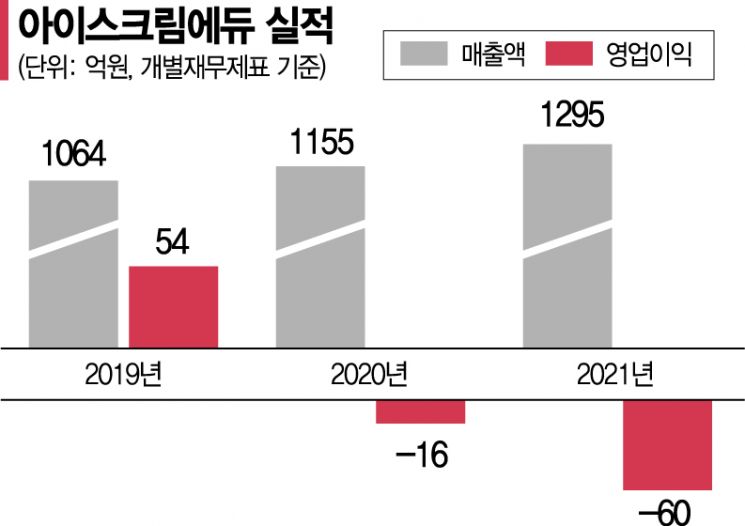
Through first-mover advantages and continuous technological development, brand awareness has increased, and sales have steadily grown. Icecream Edu recorded sales of 129.5 billion KRW and an operating loss of 6 billion KRW last year. Sales increased by 29% over the past three years, but profitability deteriorated due to expanded investments. The company turned to a loss in 2020, and the deficit increased in 2021. During this period, the number of employees rose from 477 to 532, and salaries and welfare expenses also increased. To survive the intensified competition, research and development expenses were increased. Ordinary R&D expenses rose from 2.6 billion KRW in 2019 to 6.3 billion KRW in 2020. Advertising and promotional expenses accumulated through the third quarter of last year were 15.6 billion KRW, up 4.1 billion KRW from 11.5 billion KRW in the same period the previous year. Icecream Edu explained that despite increased sales, the larger loss was due to continuous new investments and increased promotion and sales expenses.
The slower growth rate of sales compared to the increasing pace of R&D and advertising expenses is considered a challenge to be addressed in the future. Recently, the stock price has remained near its lowest level since listing. Icecream Edu appointed Park Ki-seok, chairman of Sigong Tech, as co-CEO in September last year. Along with edutech expert CEO Jo Yongsang, they are expected to contribute to improving profitability.
© The Asia Business Daily(www.asiae.co.kr). All rights reserved.
![Clutching a Stolen Dior Bag, Saying "I Hate Being Poor but Real"... The Grotesque Con of a "Human Knockoff" [Slate]](https://cwcontent.asiae.co.kr/asiaresize/183/2026021902243444107_1771435474.jpg)











