Trust Level Drops from 68.2% in 2021 to 54.2% This Year
Poor COVID-19 Response and Leadership Changes Cited as Background
[Asia Economy Reporter Kim Hyunjung] Japan, which has repeatedly faced political frictions with neighboring countries and shown poor response to the spread of COVID-19, is losing trust among ASEAN countries.
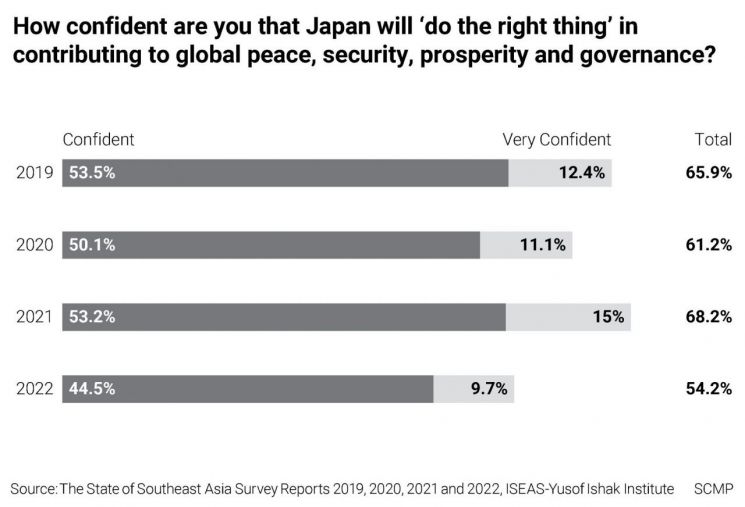
On the 23rd, Hong Kong's South China Morning Post reported that Singapore's think tank ISEAS-Yusof Ishak Institute recently released a survey with these findings. According to the report, the ISEAS-Yusof Ishak Institute surveyed 1,677 respondents from various backgrounds including government and academia, asking, "Are you confident that Japan will do the right thing in future world peace, security, prosperity, and governance?" Only 54.2% answered affirmatively.
This figure marks a significant drop compared to the trust level of 68.2% in the same survey last year. Comparing with survey results since 2019, 65.9% trusted Japan in 2019, 61.2% in 2020, and this is the first time the trust level has fallen below 60%.
The country showing the largest change in trust in this survey was Cambodia, where the percentage of respondents trusting Japan plummeted from 84.6% in 2021 to 32.1% this year. The Philippines showed relatively high trust, followed by Vietnam and Myanmar.
Regarding the question of which 'third party' ASEAN would prefer to offset uncertainties in the US-China strategic competition, the proportion choosing Japan as a preferred country also fell from 37.4% in 2021 to 29.2% this year.
Additionally, when asked which is the most influential economic power in Southeast Asia, only 2.6% of respondents chose Japan. This also decreased from 4.1% last year. More than three-quarters of respondents identified China (with $9.9 billion investment), which has less investment in ASEAN than Japan ($20.9 billion as of 2018), as the economic power.
Regarding the reasons behind Japan losing its standing, some respondents diagnosed that Japan lacks confidence due to insufficient capability or political will for global leadership. Others viewed that Japan is preoccupied with domestic affairs and relations with China, Korea, and Taiwan.
Experts pointed out that China’s poor response and management of COVID-19 over the past two years was a factor. Chan Heng Chee, a political scientist and former Singapore ambassador to the US, said, "During the 2020 COVID-19 pandemic, Japan struggled with its initial response," adding, "Also, China provided 57.8% of ASEAN vaccines, while Japan’s contribution was only 4.1%."
© The Asia Business Daily(www.asiae.co.kr). All rights reserved.


















