KIST Develops Terahertz Metamaterial Sensor
Mobile Sensors Enable Rapid Screening
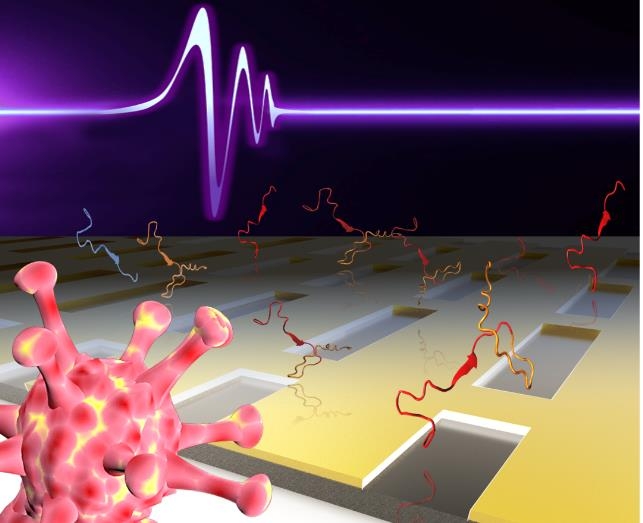 Terahertz Wave COVID-19 Diagnostic Technology Schematic. Source=Korea Institute of Science and Technology.
[Asia Economy Reporter Kim Bong-su] A diagnostic technology that can easily and quickly detect the COVID-19 virus, including its variants, using electromagnetic waves has been developed.
The Korea Institute of Science and Technology (KIST) announced on the 22nd that the research team led by Dr. Seo Min-ah and Dr. Song Hyun-seok developed a diagnostic technology that identifies COVID-19 protein monomers using a high-sensitivity label-free terahertz metamaterial sensor (a method that does not alter the virus properties).
The research team utilized terahertz (THz) waves, which can interpret subtle intrinsic information of biological samples. Terahertz waves are a type of electromagnetic radiation vibrating 100 billion times per second. Due to their ability to penetrate objects, they have been used not only for pathological tissue diagnosis but also to detect explosives or drugs hidden in mail. They respond sensitively to the intrinsic vibrations of biomolecules, enabling differentiation of minute differences in biological samples. The challenge was how to amplify the signals and the limitation that it was only possible at extremely low temperatures.
The research team created a biomolecular diagnostic platform that can sensitively measure terahertz optical signals reflecting the intrinsic information of samples by utilizing metamaterials that amplify signals in specific electromagnetic wave bands. In particular, they developed terahertz metamaterials that amplify signals after identifying amino acids with excellent absorption rates in the terahertz band. Subsequently, to closely observe changes in terahertz signals, samples were uniformly dispersed on the metamaterial surface, and the optical constants of the samples were analyzed.
The team explained, "Within minutes, we were able to detect monomers and infer sample characteristics and quantities such as charge, polarity, and hydrophobicity indicators," adding, "By sensing changes at the amino acid unit level, this technology can be used to identify variant viruses with similar structures."
These research results are expected to greatly aid early infection diagnosis and containment by enabling faster and simpler COVID-19 testing. Although the existing polymerase chain reaction (PCR) test is highly accurate, it takes over four hours for diagnosis. Rapid antigen tests take about 20 minutes but have lower accuracy, showing a false positive rate of around 25%.
This study was published in the latest issue of the international journal Biosensors and Bioelectronics.
© The Asia Business Daily(www.asiae.co.kr). All rights reserved.
![Clutching a Stolen Dior Bag, Saying "I Hate Being Poor but Real"... The Grotesque Con of a "Human Knockoff" [Slate]](https://cwcontent.asiae.co.kr/asiaresize/183/2026021902243444107_1771435474.jpg)
















