Concerns Over Social Unrest in Middle East and Africa, Major Exporters of Corn and Wheat
Some Predict Limited Impact Compared to Adverse Factors Like COVID-19
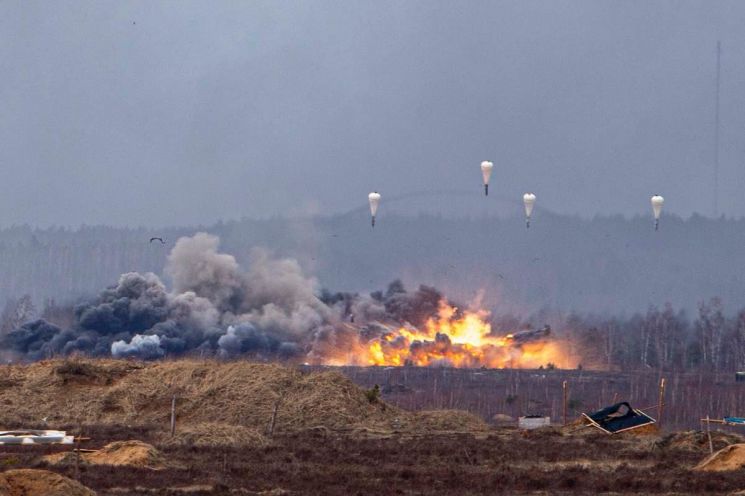
[Asia Economy Reporter Kim Hyunjung] If Russia and Ukraine physically clash, it is expected to accelerate global inflation. This is because disruptions may occur not only in the supply of natural gas and oil produced by Russia but also in raw materials such as nickel and palladium, while Ukraine’s corn and wheat grain exports?known as the "breadbasket of Europe"?may be cut off or sharply reduced.
The New York Times (NYT) reported on the 21st (local time) that Europe obtains about 40% of its natural gas and 25% of its oil from Russia. The NYT explained, "Europe will face difficulties due to further increases in already soaring heating and gas prices," adding, "Countries are accusing Russian President Vladimir Putin of reducing supply to gain political advantage."
According to the United Nations Food and Agriculture Organization (FAO), the global food price index in January this year reached 135.7, the highest in 11 years since the 2011 'Arab Spring.' Russia is the world's largest wheat supplier, and combined with Ukraine’s production, they account for about 25% of global wheat exports. Countries like Egypt and Turkey import about 70% of their total wheat from these two countries. Turkey has already recorded nearly a 50% inflation rate, and with additional rises in food and electricity prices due to this situation, the burden is expected to increase.
The problem is that low-income and underdeveloped countries, vulnerable to price increases, will be hit even harder. In fact, 40% of Ukraine’s wheat and corn exports, long called the "breadbasket of Europe," go to the Middle East and Africa. Lebanon imports about half of its wheat consumption from Ukraine. Professor Ian Goldin of Oxford University in the UK explained, "The most vulnerable to inflation are the poor," adding, "The proportion of their income spent on food and heating is higher than anyone else’s."
Concerns about inflation are further fueled by supply issues in raw materials such as palladium, used in mobile phones and automobiles, and nickel, used in steel and electric vehicle batteries. As Russia, the world’s largest mineral exporter, is likely to tighten supply, the West has taken measures to mitigate the impact on Europe, such as increasing liquefied natural gas (LNG) supplies in case President Putin retaliates. Russia supplies 40% of Europe’s natural gas.
However, some believe that the impact from Russia and Ukraine will not be as destructive compared to adverse factors like COVID-19. The NYT pointed out, "Russia is a country with a population of 146 million and massive nuclear weapons, but its impact on the global economy is not large compared to China." Professor Jason Furman of Harvard University, former advisor to former U.S. President Barack Obama, said, "Russia is not tremendously important to the global economy except for oil and gas," likening Russia to a 'big gas station.'
© The Asia Business Daily(www.asiae.co.kr). All rights reserved.
![Clutching a Stolen Dior Bag, Saying "I Hate Being Poor but Real"... The Grotesque Con of a "Human Knockoff" [Slate]](https://cwcontent.asiae.co.kr/asiaresize/183/2026021902243444107_1771435474.jpg)
















