[Asia Economy Military Specialist Yang Nak-gyu] In the movie "Wanted," an ordinary young man Wesley (James McAvoy) spins a bullet to avoid obstacles ahead and hit the target. Is such a technique possible in reality like the movie protagonist? It is impossible.
A bullet is fired spinning like a top along the rifling inside the barrel. The spinning projectile maintains a stable posture. Due to the spinning projectile, there is a misconception that the back side of the target has a larger hole than the side hit. However, when the projectile enters a human body, the spin usually stops after about 10 to 15 cm.
Generally, when shooting an enemy without protective gear, a force of 80 joules (joule: the force required to move a specific object 1 meter with 1 newton of force) is needed. The effective range of a rifle with 80 joules of force is 450 to 500 meters. This distance is the effective firing range. Penetrating a steel helmet requires 420 joules. For simulated guns shooting BB pellets, the energy is 0.2 joules, and arrows shot from a crossbow have kinetic energy of 100 to 200 joules. A collision with a car at 80 km/h generates about 3.3 million joules of kinetic energy.
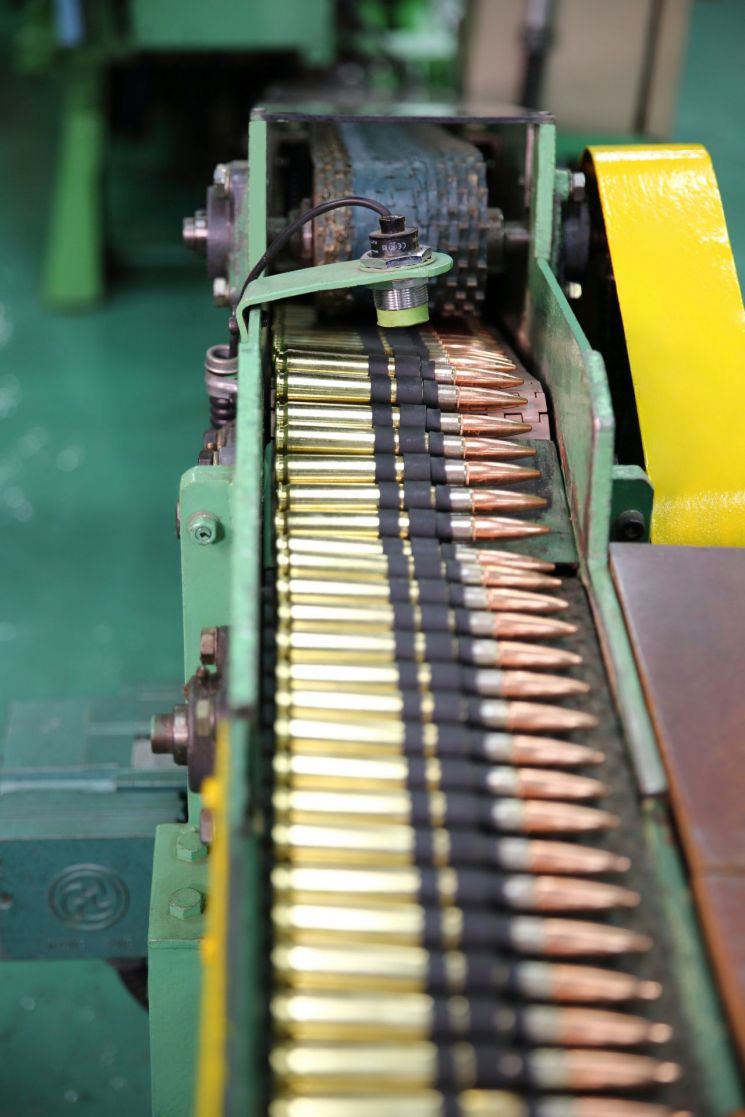
In the past, bullets were made of lead. Lead was cheap, relatively soft for easy processing, and heavy relative to its volume. However, recently copper has been used instead of lead. Poongsan started supplying copper bullets to the army in 2018.
The term "caliber" used to describe bullet specifications refers to the diameter of the barrel or the projectile. Expressions like "38 caliber" or "45 caliber" indicate the diameter of the bullet in inches. In continental Europe, including Germany, it is expressed as "8 mm × 20 mm," where the first number is the bullet diameter and the second is the cartridge case length. The bullets produced by Poongsan have the manufacturing factory and year marked on the lower part.
The fastest bullet among small arms ammunition is the fin-stabilized discarding sabot round. It is fired at a muzzle velocity of 1,400 m/s. When the bullet reaches 120 mm class, the velocity increases further to 1,600 to 1,800 m/s. One of the slower projectiles among artillery shells is the mortar round, with a velocity of 240 m/s. However, it should not be underestimated because the mortar falls almost vertically to the ground and its fragments form an almost circular pattern, making it very powerful.
Poongsan has developed an observation round with added reconnaissance capabilities. After firing, it observes the enemy in the air and assists in precision strikes with the next round. Developed over seven years since 2011, this round contains a self-guided projectile with a camera inside the shell. It was developed as ammunition for the K-9 self-propelled howitzer, the main firepower of the Marine Corps on Yeonpyeongdo and Baengnyeongdo islands. When the observation round is first loaded and fired from the K-9, it can identify the enemy's location.
In particular, it can accurately observe whether the shell hit the target after firing. Until now, artillery observation teams used binoculars or the naked eye to determine if the gunfire hit the target properly. However, as the firing range extended up to 40 km, it became difficult to judge. Using observation rounds makes observation sufficiently possible.
The U.S. Army also developed the 155 mm Precision Guidance Kit (PGK) in 2015, equipped with various sensors and GPS devices. After the gun is fired, artillery can adjust the explosion timing and method in real time. It is known that this round has been deployed to the 15th Field Artillery Battalion and the 2nd Combat Battalion stationed in Afghanistan.
© The Asia Business Daily(www.asiae.co.kr). All rights reserved.

















