[Seoul District News] Dongdaemun-gu Family Center 1 Center Multicultural Family Support, 2 Center Healthy Family Support and Childcare Program Operation... Yongsan-gu Job Support Project Challenges to Raise Employment Rate by 70%... Mapo-gu Raises 1.28 Billion Won for '2022 Warm Winter Campaign'... Gwangjin-gu Focuses on Preventing Middle-aged Loneliness Deaths and Identifying High-risk Groups... Chungmuro Food Alley Designated as 'Junggu 4th Alley-type Shopping District'
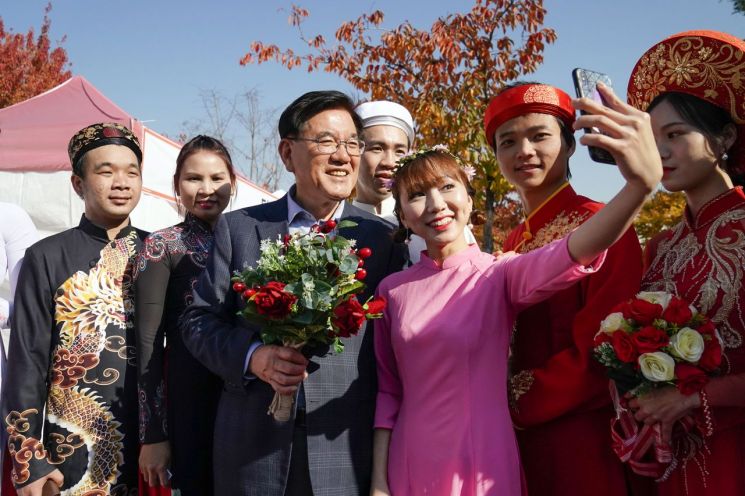
[Asia Economy Reporter Park Jong-il] Dongdaemun-gu (Mayor Yoo Deok-yeol) Health Family and Multicultural Family Support Center will change its name to ‘Dongdaemun-gu Family Center’ from this year according to the guidelines of the Ministry of Gender Equality and Family and will begin more systematic operations.
The Dongdaemun-gu Family Center will operate in two locations by separating the health family and multicultural family support tasks into Center 1 and Center 2. Center 1 (521 Cheonggyecheon-ro, Dasarang Happiness Center 6th and 7th floors) is responsible for multicultural family support tasks such as Korean language education for multicultural families, interpretation and translation support, and home education services. Center 2 (89 Muhak-ro, Dongdaemun-gu Citizen Happiness Center 2nd floor) operates health family tasks and childcare programs.
The Dongdaemun-gu Family Center promotes various family settlement support projects such as family education, counseling, family care, childcare, community, and support for single-person households as part of health family support projects, as well as home education for multicultural families, child language development support, life cooking classes, and cultural arts programs for multicultural children.
The Family Center has separate counseling rooms and interpreters for multicultural families on site, allowing families to comfortably consult on family matters and issues of multicultural families as if with their own family. Various programs can be participated in after phone inquiries or visiting consultations at the center.
Yoo Deok-yeol, Mayor of Dongdaemun-gu, said, “The Dongdaemun-gu Health Family and Multicultural Family Support Center, which has worked hard to create a healthy family culture and warm community in Dongdaemun-gu, has changed its name to Dongdaemun-gu Family Center,” and added, “We expect the Dongdaemun-gu Family Center to play a key role in fostering a culture that embraces diverse family forms.”
The Dongdaemun-gu Family Center received the Prime Minister’s Commendation last year and was designated as an excellent center nationwide by receiving the Minister of Gender Equality and Family Commendation for its good evaluation through the promotion of regional specialized projects such as support projects for single-person households and the World Culture Festival.
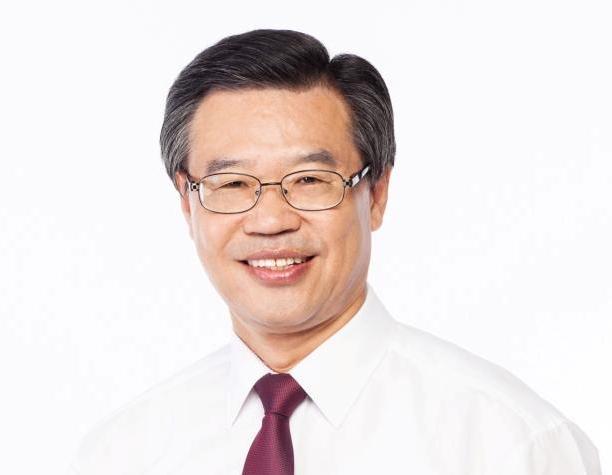
Yongsan-gu (Mayor Seong Jang-hyun) has completed preparations for the ‘2022 Employment-linked Training Course’ as part of the district’s public-private cooperation job project. The project scale is 220 million KRW.
The district promoted a public contest for the first public-private cooperation job project of 2022 and selected four projects last month, signing agreements with implementing agencies. The goal of the first project is 76 trainees and a completion employment rate of over 70%.
The training courses are ▲Air Conditioner Installation Maintenance and Repair Technician Training Course (Korea Polytechnics I University Seoul Jeongsu Campus Industry-Academic Cooperation Group) ▲Caregiver Training Course (Seoul Metropolitan Jungbu Education Technology Institute) ▲Video Content Marketing Practitioner Training Course (Yongsan Women’s Human Resources Development Center) ▲Graphic Technology Utilization AI Learning Data Processing Personnel Training Course (Seoul Metropolitan Jungbu Technical Education Institute).
The Air Conditioner Installation Maintenance and Repair Technician Training Course runs from March 14 to April 8 for 26 days (180 hours). The number of trainees is 20. After completing the course, trainees can be employed at companies such as Myungil and Samsung Electronics Logitec’s second-tier partners. Trainees are recruited until March 6.
The Caregiver Training Course covers introduction to caregiving, basic knowledge related to caregiving, and detailed caregiving topics. It runs from April 25 to June 16 for 34 days (248 hours). The district recruits 20 middle-aged and older residents living in the area until April 18.
The Video Content Marketing Practitioner Training Course teaches digital marketing practice, content planning document writing, and job application writing. The training runs from April 25 to June 29 for 45 days (180 hours). The district recruits 16 unemployed or career-interrupted women living in the area. Recruitment dates are undecided.
The Graphic Technology Utilization AI Learning Data Processing Personnel Training Course covers basics of artificial intelligence, AI learning data processing, and graphic technology. It runs from September 19 to November 4 for 26 days (180 hours). The district recruits 20 residents aged 19 to 49 living in the area. Recruitment dates are undecided.
A district official said, “Since 2019, we have operated employment courses with 274 people completing the courses and 166 of them successfully employed,” and added, “We hope many residents participate in education where they can learn about fields of interest and also get employed.”
Residents who wish to participate can inquire at the operating institutions.
The district’s public-private cooperation job project is part of the ‘Tomorrow (my job) Dream’ project, a campaign pledge of the 7th mayor. To secure project funds, the district enacted the ‘Job Fund Establishment and Operation Ordinance’ in 2018, accumulating 11 billion KRW in funds, and since 2019 has promoted job discovery and employment linkage through collaboration with private specialized technical education institutions.
Seong Jang-hyun, Mayor of Yongsan-gu, said, “With the establishment of the job fund, Yongsan has been stably supporting citizen employment despite COVID-19,” and added, “We will continue job projects suitable for regional characteristics and citizen demand.”
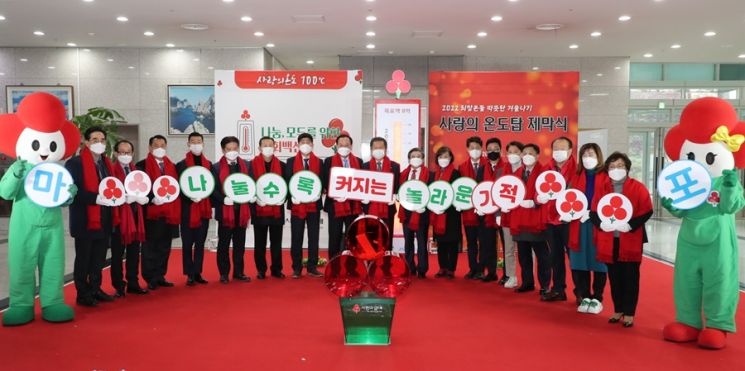
Mapo-gu (Mayor Yoo Dong-gyun) announced that it raised a total of 1.28 billion KRW in donations and goods through the ‘2022 Hope Ondol Warm Winter Project’ conducted over three months from November 15, 2021, to February 14, 2022.
This amount exceeded the initial target of 800 million KRW by 160%. Although the total amount of donations and goods decreased by 9.6% compared to the previous year due to the prolonged COVID-19 economic downturn, the amount of donations increased by 2.17%, reaching a record high of 599 million KRW. Goods worth about 686 million KRW were collected.
Hyosung, which has participated in the Mapo-gu Warm Winter Project for several years, donated the largest single donation of 40 million KRW and goods worth 54.45 million KRW (converted value).
Other steady donors include ▲Jeoldusan Martyrs’ Shrine ▲Orient Star Logistics ▲West Seoul Nonghyup.
Especially, ‘Salmcheon Sikdang’ in Yeonnam-dong, where you can enjoy spicy stir-fried pork with a 3,000 KRW meal coupon, donated meal coupons collected in donation boxes to neighbors in need, becoming a hot topic on YouTube and SNS.
The donations collected through the warm interest of companies and residents residing in Mapo-gu are used for low-income vulnerable residents’ ▲living expenses ▲housing costs ▲medical expenses ▲education expenses, and also for special projects reflecting local needs such as ▲‘Finding Bright Smiles’ dental treatment project ▲‘Warm Neighborhood Request’ regional welfare excellent program contest project ▲energy-vulnerable cooling and heating equipment support project.
The district plans to conclude the Warm Winter Project by expressing gratitude to supporters and presenting appreciation plaques to outstanding donors.
Yoo Dong-gyun, Mayor of Mapo-gu, said, “Thanks to those who share warm hearts, neighbors in difficulty can survive the cold winter,” and added, “We will continue to prepare sufficient courtesy for donors so that sharing activities for the underprivileged can continue and develop various activities to spread the culture of donation in the local community.”
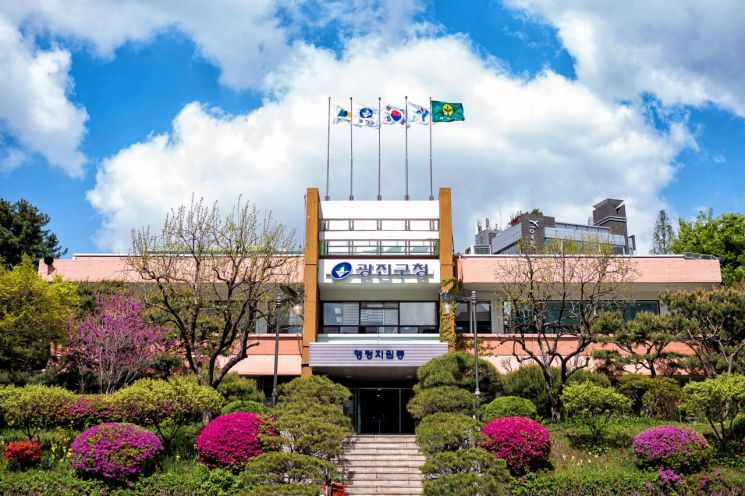
Gwangjin-gu (Mayor Kim Seon-gap) is promoting various and active solitary death prevention projects targeting middle-aged single-person households whose risk of solitary death has increased due to the prolonged COVID-19 pandemic.
According to recent data submitted by the Ministry of Health and Welfare to Kim Won, a member of the Democratic Party of Korea, the estimated number of solitary deaths in 2021 was 3,159, an increase of 57.3% compared to 2,008 in 2017 before the COVID-19 outbreak.
As of the end of last year, Gwangjin-gu had 81,256 single-person households, accounting for 48.3% of the total 167,949 households in the district. Especially, middle-aged single-person households generally have unstable income and poor health conditions, making them at high risk of solitary death.
Accordingly, the district is building a dense social welfare network by implementing projects such as ▲a full survey of middle-aged single-person households to identify solitary death risk groups ▲single-person household welfare check service ▲solitary death prevention smart plug project ▲Seoul Salpimi app for single-person households ▲Our Neighborhood Care Group project ▲NaHonJal (Living Well Alone) Full Shopping Basket project.
First, the district conducts a full survey of crisis households expected to be at risk of solitary death due to social network disconnection through an annual survey of middle-aged single-person households. Newly identified solitary death risk groups are classified into high, medium, and low risk and linked to customized welfare services with regular monitoring.
Also, the district provides a ‘single-person household welfare check service’ to 3,000 middle-aged solitary death risk households. For those with no wired or wireless call records for a certain period, an ARS welfare call is made, and if the call is not received, the person in charge conducts welfare checks via phone or visits.
Additionally, the ‘smart plug project’ measures electricity usage and brightness changes of middle-aged solitary death risk groups and requests welfare checks from the person in charge if no changes occur over a certain period. The ‘Seoul Salpimi app’ project requests welfare checks from designated guardians or local community centers if there is no mobile phone usage within a certain period.
Furthermore, there are solitary death prevention projects involving residents. The ‘Our Neighborhood Project Group’ connects local residents who understand the status of each neighborhood with welfare-vulnerable groups in need, performing solitary death prevention activities through regular visits and welfare checks. This project is also meaningful in fostering a resident autonomy ecosystem by solving local problems by residents themselves.
Especially, the district started a new project this year called the ‘NaHonJal (Living Well Alone) Full Shopping Basket Project,’ which provides a 100,000 KRW annual essential goods purchase coupon to middle-aged single-person households.
The target is 700 middle-aged single-person households residing in Gwangjin-gu, with income below 160% of the median and who have applied for solitary death prevention projects and agreed to receive welfare service information. However, recipients of livelihood benefits are excluded.
Kim Seon-gap, Mayor of Gwangjin-gu, said, “The district is striving to restore social networks disrupted by COVID-19 and to identify socially isolated residents to prevent solitary death risk,” and added, “We will continue to do our best to early detect and assist solitary death risk groups through thorough management and active investigation.”
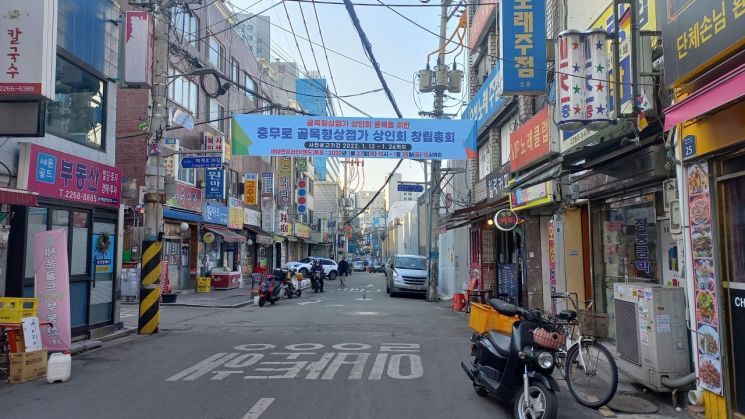
Jung-gu (Mayor Seo Yang-ho) designated Chungmuro Food Alley as the 4th alley-type shopping district in Jung-gu on the 16th.
An ‘alley-type shopping district’ is an area within 2,000㎡ where more than 30 stores operated by small business owners are densely located, and designation is possible regardless of business type if a merchants’ association is formed.
The Chungmuro printing alley, stretching from Exit 8 of Chungmuro Station to Jinyang Shopping Center and Inhyeon Market, is full of old restaurants such as affordable baekban (set meal) restaurants, nostalgic pubs perfect for a drink after work, and jeon (Korean pancake) restaurants. However, due to the impact of COVID-19, the previous bustling atmosphere has disappeared, and merchants are going through a tougher time than ever.
To revitalize the depressed alley commercial district, the district enacted the ‘Ordinance on Support for Revitalization of Alley-type Shopping Districts’ in July 2021, establishing criteria and requirements for designation and grounds for support measures.
Starting with Sindang-dong Tteokbokki Town (official name: Sindang Future Heritage Food Shopping District) in September last year, followed by Donghwa-dong and Pildong alley-type shopping districts, and now Chungmuro alley-type shopping district, a total of four commercial districts in the area have been designated as alley-type shopping districts. In March, Yaksu Market Shopping District is scheduled to be designated as the 5th alley-type shopping district. This will enable merchants outside the traditional Yaksu Market commercial district to receive support.
Once designated as an alley-type shopping district, opportunities to participate in national government-supported projects or management voucher projects are provided. Other benefits include Onnuri gift certificate affiliation (excluding some industries), promotion and marketing support, and various other advantages.
In December last year, the district held a ‘visiting merchants’ meeting’ to collect on-site opinions and simplified the application procedure through ordinance amendments to reflect them. The clause requiring consent from landowners and building owners was deleted from the application requirements, so now only merchants’ consent forms are needed to apply for alley-type shopping district designation.
Merchants’ associations wishing to be designated as alley-type shopping districts can prepare application documents such as merchants’ consent forms and association bylaws and apply to the Jung-gu Office Traditional Market Division.
Seo Yang-ho, Mayor of Jung-gu, said, “We hope the designation of the alley-type shopping district will bring back the former vitality to the alley commercial district,” and added, “We will continue to prepare support measures that can realistically help merchants.”
© The Asia Business Daily(www.asiae.co.kr). All rights reserved.
![Clutching a Stolen Dior Bag, Saying "I Hate Being Poor but Real"... The Grotesque Con of a "Human Knockoff" [Slate]](https://cwcontent.asiae.co.kr/asiaresize/183/2026021902243444107_1771435474.jpg)


















