Despite Twice-Weekly Preemptive Testing 'Recommendation' Instead of Mandate, Parents Demand Withdrawal
Opposition Due to Test Kit Accuracy and Children's Resistance
Concerns That Preemptive Testing Is a Preliminary Step for Pediatric Vaccination
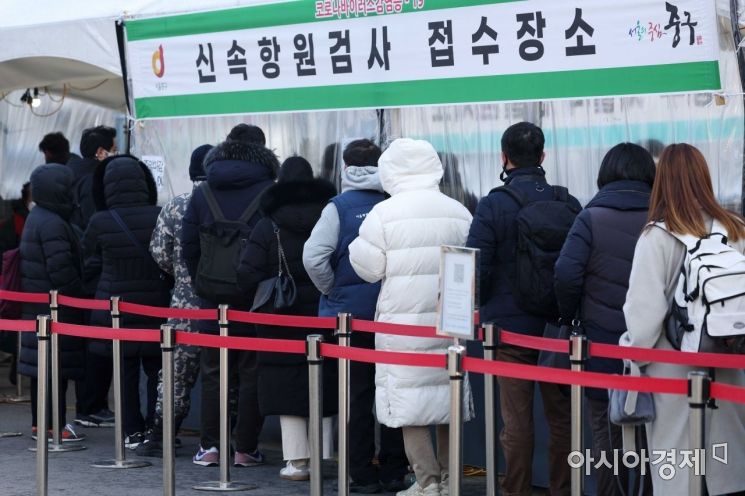 On the 17th, as the spread of COVID-19 continued, citizens waited for rapid antigen tests in the freezing cold at the temporary screening clinic at Seoul Station. Photo by Mun Ho-nam munonam@
[Asia Economy Reporter Han Jinju] Parents are strongly opposing the Ministry of Education's recommendation to undergo rapid antigen tests twice a week before attending school starting from the new semester. They cite concerns over the low accuracy of the tests, the possibility of mandatory testing at schools, and the lack of fairness compared to adults.
On the 17th, parents also demanded the withdrawal of the preemptive testing policy on the Blue House's public petition site and the Seoul Metropolitan Office of Education's citizen petition website. As of 10 a.m. that day, the Blue House petition titled "Opposition to Kit Testing for Kindergarten and Elementary Students" had 80,608 signatures, and 9,049 people agreed to the petition on the Seoul Metropolitan Office of Education's website calling for the withdrawal of the kit testing plan after school starts. The day before, the Ministry of Education announced that rapid antigen test kits for preemptive testing would be provided twice a week starting from the fourth week of February for kindergarten and elementary students, and from March for middle and high school students. It was recommended that students test themselves at home before attending school and enter the test results into a self-diagnosis app.
A parent in Seoul said, "Some test kits state that they are not recommended for those under 18, and there is concern that the testing solution might contain substances harmful to children. Children follow quarantine rules better than adults, and most infections occur within families," adding, "Will children without symptoms have to argue with their parents every time they are tested, making them reluctant to go to school?"
Many parents also raised issues about the accuracy of rapid antigen test kits and the fairness compared to adult-targeted quarantine measures. Another parent said, "Because the test accuracy is low, I’m not sure if (testing before school) has much meaning. It seems like a waste of tax money." Another elementary school parent pointed out, "If children are tested twice a week, is full attendance really necessary? It would be better to have only two-thirds attend school like before rather than forcing tests."
Parents expressed their opposition to preemptive testing by sharing contact information for the Ministry of Education officials in charge. The Ministry initially considered making preemptive testing mandatory before school attendance but announced it would operate as a "strong recommendation" due to such backlash. Parents believe that since government funds are involved and schools bear the burden of quarantine, preemptive testing will effectively be enforced at a mandatory level. A parent in Seoul said, "They say it’s a recommendation, but entering test results into the self-diagnosis app is practically mandatory," adding, "The youth vaccine was initially recommended but suddenly became mandatory. It will become mandatory at schools as well."
Some parents view the twice-weekly rapid antigen test recommendation as a preparatory step for vaccinating children aged 5 to 11. The Korea Disease Control and Prevention Agency plans to establish a vaccination implementation plan as soon as approval for pediatric COVID-19 vaccines is granted. Opposition is also expected during the current vaccine rollout process for the target group. Since early this month, the Ministry of Education and the Disease Control and Prevention Agency have been conducting a survey asking parents of children aged 5 to 11 about their willingness to vaccinate. The survey includes questions about opinions on vaccination, reasons for recommending or not recommending vaccination, and views on the benefits and risks of vaccination. A Ministry of Education official stated, "The survey is conducted at the request of the Disease Control and Prevention Agency, and we have not received any information about the vaccination schedule."
© The Asia Business Daily(www.asiae.co.kr). All rights reserved.

















