Service Enhancement Planned to Enable Type Classification Using Only Future Consumer Data
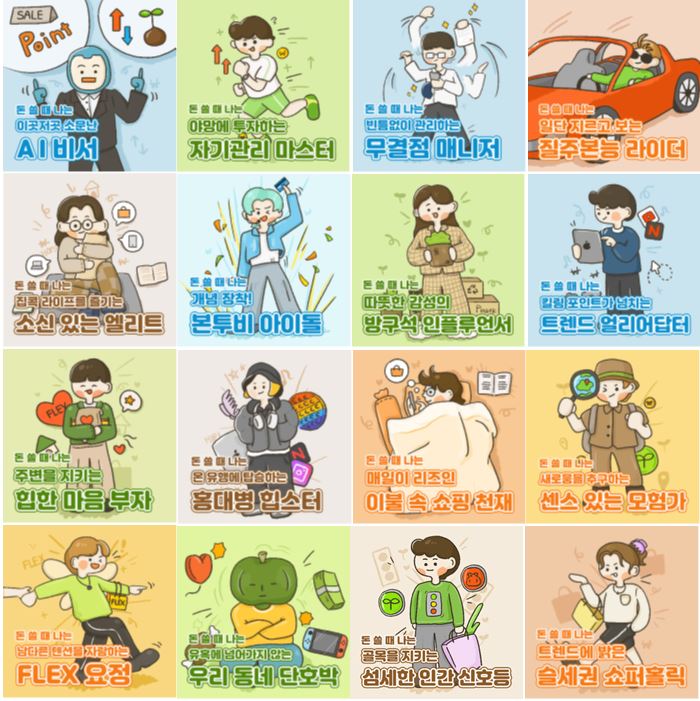
[Asia Economy Reporter Yu Je-hoon] Shinhan Card recently launched a service that applies the personality type indicator 'Myers-Briggs Type Indicator (MBTI),' which is popular among the MZ generation (born between the 1980s and 2000s), to reveal individuals' consumption tendencies.
On the 17th, Shinhan Card announced the launch of the 'SoBTI (Consumption + MBTI)' service, which categorizes customers' consumption characteristics through big data analysis. To this end, Shinhan Card utilized the MBTI framework to classify consumption types into four categories: place, method, priority, and value criteria, deriving eight types accordingly.
The eight types are divided as follows: ▲ by consumption place, 'External/Long-distance E (Extraversion)' - 'Near home I (Introversion)'; ▲ by consumption method, 'Offline/Experiential S (Sensing)' - 'Online N (iNtuition)'; ▲ by consumption priority, 'Logical/Self-oriented T (Thinking)' - 'Emotional/Group-oriented F (Feeling)'; ▲ by consumption value criteria, 'Planned J (Judging)' - 'Trend-preferring P (Perceiving)'.
Type E enjoys various leisure activities and tends to spend on travel, camping, and airline industries, while type I mostly consumes near home, focusing on delivery, subscriptions, and interior design sectors. Type S prefers direct experiential consumption such as department stores, marts, and exhibitions, whereas type N has high digital familiarity and proficiency, with a high proportion of online consumption.
Additionally, type T tends to spend on personal growth activities such as reading, exercise, academies, and beauty, while type F shows value-driven consumption like donations for a better society or electric vehicles. Type P follows trends with consumption like hotel vacations and popular restaurants for today's self, whereas type J is thorough in comparison, focusing on cost-effectiveness and tends to use check cards, small investments, and cards with many benefits.
Shinhan Card classified customers with significant consumption data into 16 types by combining the eight types and named each type based on their characteristics. For example, ESTP, characterized by a wide activity range (E), experiential offline consumption (S), investment in self-care (T), and enjoyment of trends (P), was named 'Hongdae-byeong Hipster Riding All Trends.' The Hongdae-byeong Hipster group accounted for 10% of the analyzed customers, the highest proportion, with 32.6% in their 20s and 31% in their 30s, indicating a high proportion of the MZ generation.
Moreover, MZ generation customers showed a relatively distinct consumption tendency with an 85.2% proportion of the eight types, 23.6 percentage points higher than other generations.
Shinhan Card's SoBTI service is available on the 'pLay&' page of the Shinhan pLay app. The service initially helps customers understand their consumption tendencies using a questionnaire and Shinhan Card's big data. In the future, the system will be enhanced to identify consumption tendencies and their levels solely based on customers' consumption data without the auxiliary questionnaire.
© The Asia Business Daily(www.asiae.co.kr). All rights reserved.

















