Phase 1 Demonstration Project Next Year... UAM Commercialization Expected by 2025
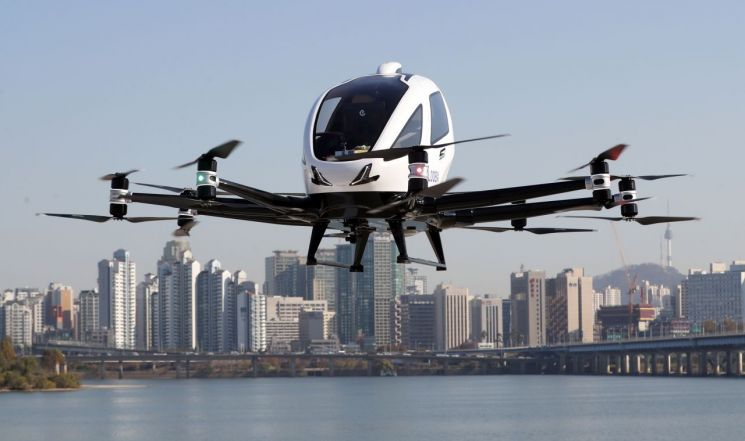
The government is set to actively promote the Korean Urban Air Mobility (K-UAM) 'Grand Challenge,' a large-scale demonstration project aimed at the commercialization of Urban Air Mobility (UAM).
On the 16th, the Ministry of Land, Infrastructure and Transport (MOLIT) announced that it will hold a briefing session for participants of the 'UAM Grand Challenge Korea' at the Grand Hyatt Seoul on the 17th. UAM refers to a transportation system utilizing personal aerial vehicles capable of vertical takeoff and landing, commonly known as 'flying taxis' or 'air taxis,' representing the next-generation mobility industry.
This event is a large-scale demonstration project designed to test new technologies and future research and development outcomes for UAM commercialization in environments similar to real-world conditions.
MOLIT planned the Grand Challenge to verify safety before UAM commercialization and to establish operational concepts and technical standards suited to domestic conditions.
Domestically, 53 companies including Hyundai Motor Company, Hanwha Systems, SK Telecom, Kakao Mobility, Incheon International Airport Corporation, Korea Airports Corporation, Hyundai Construction, and Korean Air are participating. Internationally, 29 companies such as Joby Aviation from the United States, Volocopter from Germany, EHang from China, Thales from France, and Skyport from the United Kingdom are involved. As policy support institutions, 42 organizations including MOLIT, the Korea Aerospace Research Institute, and NASA from the United States are participating.
The briefing session will be attended by potential domestic and international UAM operators and manufacturers, traffic management providers, as well as domestic startups and small and medium-sized enterprises interested in operating vertiports (vertical takeoff and landing sites).
MOLIT plans to commence the demonstration project in the first half of next year. In particular, it expects to obtain data necessary for institutionalizing UAM operation methods through this demonstration.
The first phase of the Grand Challenge will take place next year at the National Comprehensive Flight Performance Test Site in Goheung, Jeollanam-do. MOLIT will verify the safety of UAM aircraft and communication systems through preliminary tests at the flight test site.
The second phase will be conducted in urban areas and is expected to begin as early as 2024, depending on the results of the first phase. The government plans to soon start selecting testbeds necessary for urban environment demonstrations.
In 2025, the Grand Challenge demonstration data will be analyzed to support commercialization by providing related technologies and infrastructure to private companies. UAM is expected to be commercialized for the first time on the phase two demonstration routes in 2025.
MOLIT is currently in the planning stage for integrated research and development demonstrations related to UAM vertiports and aims to begin a preliminary feasibility study this year.
Hwang Seong-gyu, the 2nd Vice Minister of MOLIT, stated, "We will share the demonstration results obtained through the Grand Challenge with participants and use them as a reference for institutionalization," adding, "It is expected to be utilized in creating a new internationally competitive traffic management system in the future."
© The Asia Business Daily(www.asiae.co.kr). All rights reserved.
![Clutching a Stolen Dior Bag, Saying "I Hate Being Poor but Real"... The Grotesque Con of a "Human Knockoff" [Slate]](https://cwcontent.asiae.co.kr/asiaresize/183/2026021902243444107_1771435474.jpg)
















