Total Number of Employed Persons Decreased by Over 2.09 Million Since 2017
Full-Time Employment Decline Hits 30-40s Generation, Retail, and Accommodation Food Services Hard
Significant Gap Found Between Government Statistics Claiming "Employment Rate Increase" and Reality
'Statistical Bubble' Due to Increase in Short-Hour Public Sector Jobs
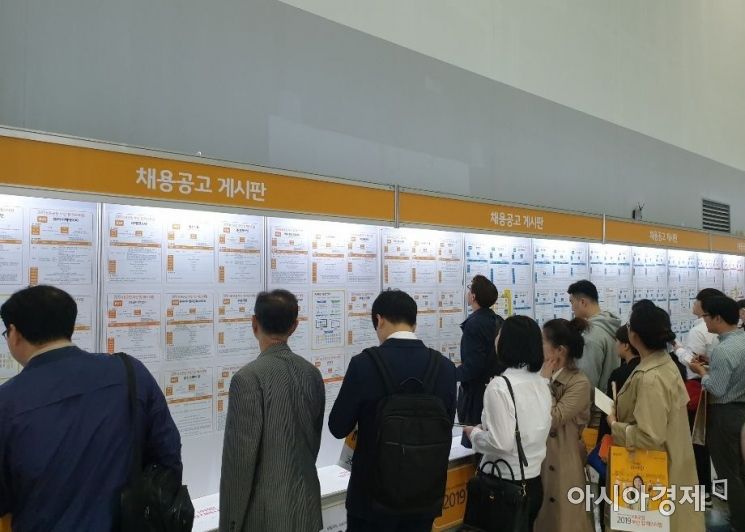
[Asia Economy Reporter Lee Hye-young] An analysis has emerged indicating that the quality of the domestic labor market environment has deteriorated under the Moon Jae-in administration. Over the past four years, the number of employed persons decreased by more than 2.09 million, revealing a significant gap between the government’s announced employment indicators and reality. Not only vulnerable employment groups but also the 30s and 40s age group, considered the 'backbone' of the Korean economy, could not avoid the shock caused by poor employment conditions.
The Korea Economic Research Institute under the Federation of Korean Industries commissioned a team led by Professor Park Ki-sung of Sungshin Women’s University to examine labor market changes from 2017 to last year using the full-time equivalent (FTE) method, and announced these findings on the 14th.
The full-time equivalent method calculates one employed person as someone working 40 hours per week. A person working 20 hours per week is counted as 0.5, and someone working 60 hours per week as 1.5. This method supplements the limitations of the general employment rate, which counts anyone working even one hour per week as one employed person, and is officially used in statistics by the Organisation for Economic Co-operation and Development (OECD).
Government Statistics Show 'Employment Increase'... Reality Was Different
Applying the full-time equivalent method, the number of employed persons in Korea increased from 2011 to 2017 but reversed to a decline starting in 2018. Specifically, the number of employed persons decreased from approximately 28.6 million in 2017 to about 26.51 million last year, a drop of over 2.09 million in four years.
This contrasts with Statistics Korea’s announcement of a 2.1% (about 540,000) increase in employed persons during the same period. Since 2017, the number of employed persons reported by Statistics Korea has steadily risen, but there was a large discrepancy between the statistics and reality.
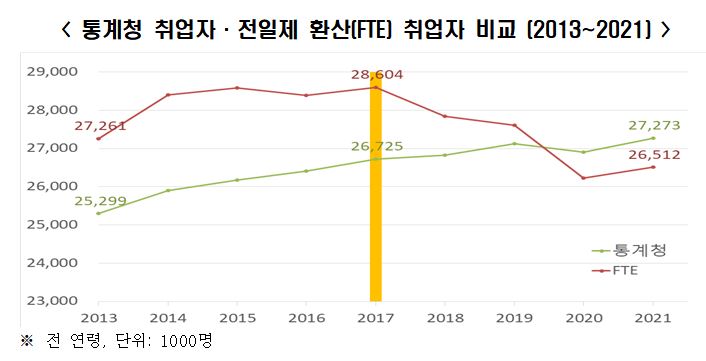
Professor Park explained the contrasting results by saying, "The 'headcount' of employed persons increased, but the total working hours decreased," adding, "Although the employment situation appeared to improve externally, it deteriorated qualitatively, causing a 'statistical bubble' to grow." He further analyzed that "the increase in employed persons since 2017 mainly relied on the government’s short-hour public job policies."
Since the Moon Jae-in administration took office, it expanded the total number of employed persons by investing massive fiscal resources to increase public sector jobs, but this produced relatively low-quality jobs and did not lead to qualitative improvement.
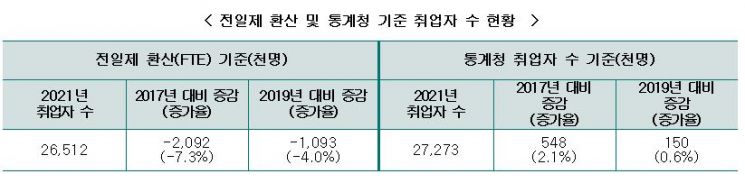
The employment situation over the two years following COVID-19 also remained in a slump. Statistics Korea announced that the number of employed persons increased by 0.6% (150,000) compared to 2019, but when converted to full-time equivalent terms, it actually decreased by 4.0% (1,093,000).
Professor Park diagnosed, "Currently, Korea’s employment situation has rapidly worsened due to policy reasons in the past and the COVID-19 shock thereafter, and it is still far from a recovery trend."
1.94 Million Decrease in Employed Persons in Their 30s and 40s Over Four Years
In particular, the full-time equivalent number of employed persons in their 30s and 40s decreased by about 1.937 million over the past four years. The full-time equivalent employed persons in their 30s declined by 13.5% (826,000), and those in their 40s by 14.7% (1,111,000) during the same period. This is more than double the decrease rate based on Statistics Korea’s figures (30s: -6.8%, 40s: -7.0%).
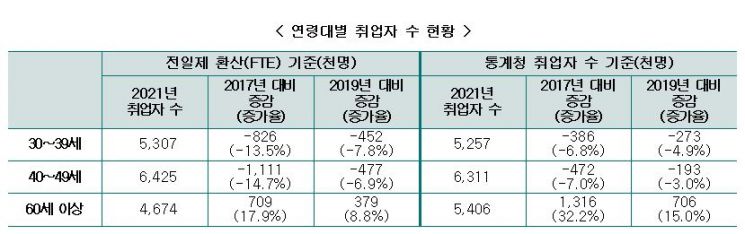
The employment shock for the 30s and 40s age group was also evident in the full-time equivalent employment rate. For those in their 40s, the full-time equivalent employment rate in 2021 was 78.7%, a sharp drop of 9.5 percentage points compared to 2017, the largest decline among all age groups. For those in their 30s, it was 76.0% in 2021, down 5.9 percentage points from 2017.
In contrast, according to Statistics Korea’s method, the employment rate decline for those in their 40s was only 2.1 percentage points during the same period, and there was no decline in the 30s employment rate.
There was also a discrepancy for the elderly, who were the focus of the government’s public job provision policies before and after COVID-19. According to Statistics Korea, the number of employed persons aged 60 and over was 5.406 million in 2021, a significant increase of 32.2% (1.316 million) compared to 2017. However, based on the full-time equivalent standard, the number of employed persons in 2021 was 4.674 million, an increase of only 17.9% (709,000) compared to 2017.
Professor Park explained, "The reduction in total employment volume for the 30s and 40s age group, which was not reflected in the statistics, has been confirmed, and for the elderly, the number of employed persons reported by Statistics Korea is inflated by about twice the actual labor volume. This is because most public jobs provided to the elderly are part-time work under 20 hours per week."
Employment in Wholesale/Retail and Accommodation/Food Services Each Decreased by 20%
By industry, the decrease in full-time equivalent employed persons was particularly notable in wholesale/retail and accommodation/food services. In 2021, the full-time equivalent employed persons in wholesale/retail were 3.47 million, a 20.0% (867,000) decrease compared to 2017. This far exceeds the decrease in employed persons based on Statistics Korea’s figures (-442,000, -11.6%). Accommodation and food services also saw a 19.0% (518,000) decrease in full-time equivalent employed persons compared to 2017, while Statistics Korea reported an 8.3% (190,000) decrease.
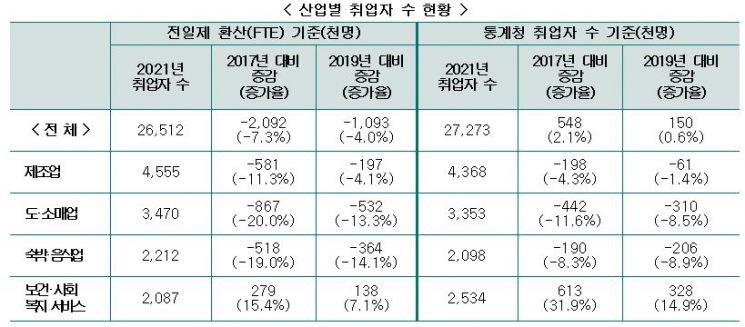
These industries were analyzed to have suffered significant damage to wage worker employment due to the sharp increase in the minimum wage before 2019. The minimum wage increased by 29.1% over three years from 2017. After 2019, the spread of non-face-to-face culture due to COVID-19 caused the largest decrease in full-time equivalent employed persons over four years.
Employment stagnation was also severe in the manufacturing sector, a pillar of the Korean economy. The full-time equivalent employed persons in manufacturing were 4.555 million in 2021, an 11.3% (581,000) decrease compared to 2017. In contrast, Statistics Korea reported a 4.3% decrease in employed persons during the same period, indicating that the actual impact on the manufacturing employment market was about three times more severe than the statistics suggested.
The research team diagnosed that this was due to a 'statistical bubble' caused by manufacturing workers taking on second jobs such as substitute driving around the time of the domestic COVID-19 outbreak, which made employment statistics appear better than reality.
On the other hand, in the health and social welfare services sector, where government public job policies were concentrated, the number of employed persons increased by 31.9% according to Statistics Korea, but only by 15.4% based on the full-time equivalent standard.
Especially vulnerable groups such as temporary and daily workers were the most severely affected by employment shocks. From 2017 to 2021, the number of employed persons based on full-time equivalent decreased significantly in the order of daily workers (-26.5%), temporary workers (-25.8%), and self-employed with employees (-23.6%). The number of self-employed without employees increased by 3.2% according to Statistics Korea but actually decreased by 5.8% based on the full-time equivalent standard.
Professor Park explained, "Due to the sharp increase in the minimum wage and the impact of COVID-19, more self-employed individuals are directly operating their stores, but even in these cases, the amount of work has decreased compared to before, resulting in more idle time."
© The Asia Business Daily(www.asiae.co.kr). All rights reserved.



















