Korea Construction Industry Research Institute Proposes 'Next Government Housing Policy'

There have been criticisms that excessive real estate and loan regulations are preventing the actual demand group in their 30s from purchasing homes, and calls for the next government to introduce more market-friendly policies.
On the 12th, Huh Yoon-kyung, Head of the Economic and Financial Research Office at the Korea Construction Industry Research Institute, stated at a seminar on "Construction and Housing Policies of the Next Government" held the previous day at the Construction Hall in Gangnam-gu, Seoul, that "the failure of the current government's real estate policy is due to extensive and frequent market interventions."
Huh said, "The current housing market is facing serious issues such as increased housing cost burdens, widening asset gaps, and supply-demand mismatches," adding, "The root cause is policy failure due to an asset bubble environment caused by low interest rates and a lack of understanding of market mechanisms."
He pointed out, "The government has announced comprehensive measures two to three times a year without considering market mechanisms, but the price increase trend has continued and balloon effects have occurred, expanding the side effects of the policies," and added, "Rather than market principles, the focus on regulation and public-centered policy operations has only increased side effects and market resistance."
Huh cited the implementation of the two lease laws (contract renewal request right and rent ceiling system) as a representative side effect, which caused a sharp rise in monthly rent prices, and noted that both landlords and tenants have faced increased housing cost burdens due to rising official property prices and strengthened property taxes.
He also pointed out that the preference for apartments has become stronger, especially among the MZ generation (born early 1980s to early 2000s), while apartment supply in Seoul has sharply decreased to about half of past levels due to government regulations.
He emphasized, "To restore policy trust, it is necessary to normalize the policy system rather than implement rapidly changing short-term policies," and proposed "▲housing stability, ▲support for asset formation" as policy alternatives for the new government.
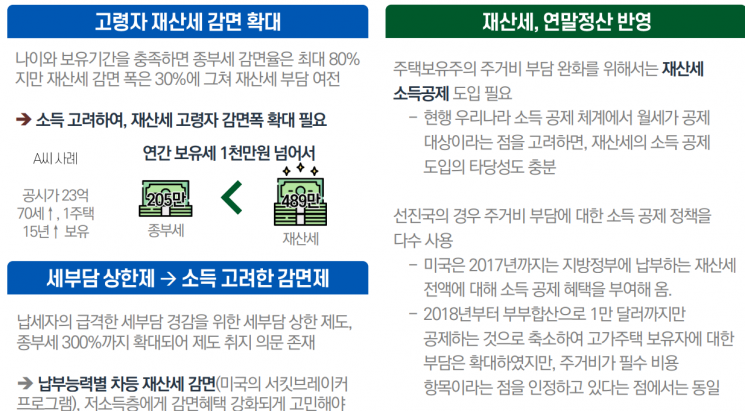
First, as measures for housing stability, the postponement of the two lease laws and the abolition of the capital gains tax surcharge were suggested.
Researcher Huh argued, "The two lease laws should be postponed for 4 to 5 years until clear information about the lease market can be obtained and the stability of the metropolitan housing market can be guaranteed with the move-in of the 3rd new towns."
For tax system normalization, he proposed improvement tasks such as lowering the official property price target realization rate from the current 90% to 80%, abolishing the capital gains tax surcharge, normalizing the special deduction for long-term holdings, strengthening property tax reductions for the elderly, and introducing income deduction linkage for property tax.
The research institute pointed out that the government should actively support asset formation through homeownership, as it is difficult for young people to purchase homes under the current actual demand requirements and financial regulations.
Huh stated, "It is necessary to relax the loan-to-value ratio (LTV) up to 70% and reset the income eligibility criteria," adding, "We should propose housing acquisition plans for low-asset, high-income earners who are currently in the blind spot of financial regulations by separating assets and monthly income."
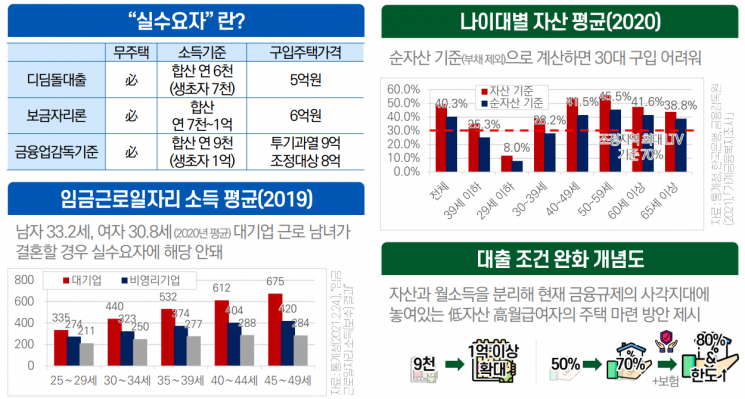
The research institute argued, "Through reforming the subscription system, social conflicts should be minimized, and restrictions on resale linked to low birth rates should be eased."
They explained that the seniority-based subscription point system and the priority allocation of special supply quotas for people in their 20s and 30s are causing conflicts between and within generations.
Huh explained, "The supply volume overly concentrated on newlyweds can be dispersed so that various social classes can receive supplies evenly by adjusting the proportion of special supply."
© The Asia Business Daily(www.asiae.co.kr). All rights reserved.
![Clutching a Stolen Dior Bag, Saying "I Hate Being Poor but Real"... The Grotesque Con of a "Human Knockoff" [Slate]](https://cwcontent.asiae.co.kr/asiaresize/183/2026021902243444107_1771435474.jpg)












