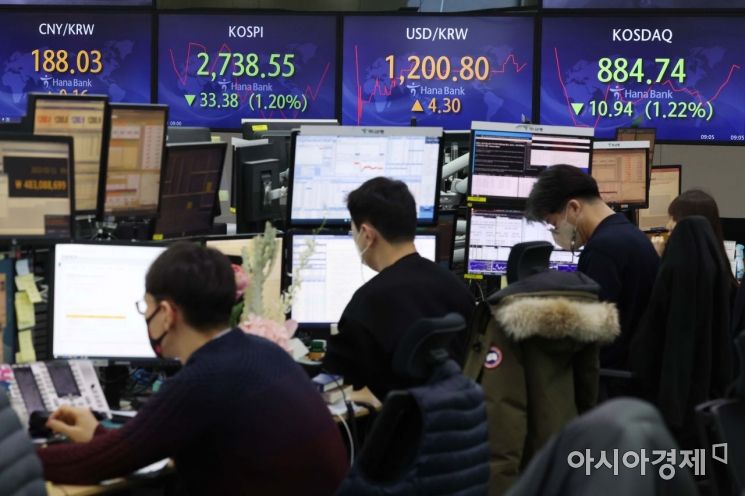
[Asia Economy Reporter Ji Yeon-jin] U.S. inflation was stronger than expected. Ahead of last month's U.S. inflation data, the domestic stock market maintained a wait-and-see stance, but on the 10th (local time), the market sharply froze as inflation figures exceeded market expectations. Foreign investors, who had been the pillar of the domestic stock market this month, showed strong buying pressure early in the session on the 11th, and individual investors' chase buying is preventing further declines.
According to the Korea Exchange on the 11th, as of 10 a.m., the KOSPI index was at 2,747.52, down 24.41 points (0.88%) from the previous day. The index, which started with a decline of over 1%, fell to the 2,730 level during the session, but individual investors turned to net buying after confirming foreign investors' buying momentum early in the session, recovering some of the losses. At the same time, individuals were net buyers of 172.3 billion KRW, and foreigners bought 42.9 billion KRW worth of shares. Meanwhile, the KOSDAQ, where foreigners are net sellers, showed a 1.52% decline to 882.07, with the downward trend more pronounced than early in the session.
Foreign investors have defended the KOSPI index by net buying 1.2612 trillion KRW in the securities market through the previous day this month. During this period, the KOSPI index rose 2.88%, escaping the fear of the sharp sell-off in January. Last month, foreigners led the market decline by net selling 3.5599 trillion KRW across the domestic stock market. In particular, they dealt a blow to the KOSDAQ by net selling over 2 trillion KRW, breaking the "Cheonsdak" (1,000-point) level in one go. Although selling pressure continued in the KOSDAQ this month, foreigners have established themselves as a support in the KOSPI market. This is thanks to their concentrated purchases of the semiconductor sector, which has a large market capitalization weight in the KOSPI, amid expectations of a significant improvement in the global semiconductor industry this year. Foreigners have bought over 1 trillion KRW worth of SK Hynix shares since the beginning of the year through the previous day and have been net buyers for seven consecutive trading days this month. Although the KOSPI index continued to decline on this day, SK Hynix, which foreigners are focusing on buying, showed a rise of more than 2% during the session.
The U.S. January Consumer Price Index (CPI) rose 7.5% year-on-year, marking the largest increase since February 1982, dragging down the U.S. stock market. However, semiconductor company Micron rose more than 3% as positive news about production disruptions caused by contamination at its Japanese semiconductor plant acted as a catalyst. Samsung Electronics also held up with a slight decline of 0.4% on the day.
LG Energy Solution succeeded in rebounding after four days, and Kakao, which announced a shareholder return policy, also showed a slight upward trend. However, Samsung SDI is down more than 4%, and NAVER, Samsung Biologics, and Hyundai Motor recorded declines of over 2%. Krafton is also experiencing a drop of more than 12%.
In the KOSDAQ market, among the top market capitalization stocks, only Kakao Games (1.00%) rose, while the rest were all weak. CJ ENM, which surged on news of halting a physical division, is falling sharply by 7% again on the day due to poor earnings. Wemade, which plunged near the lower limit on the previous day due to last year's earnings shock, is also falling nearly 7% on the day, and L&F recorded a decline of 4.9%.
The market still considers the record-high inflation a burdensome factor as it could dampen investor sentiment by fueling concerns about a sharp rate hike by the U.S. Federal Reserve (Fed) next month. SK Securities researcher Ahn Young-jin said, "Since the high U.S. inflation was already reflected in market consensus, I thought the impact would be minimal, but the key point of this result is that it was stronger than expected," adding, "It stimulated the Fed's rate hikes, causing stock prices to fall and bond yields to rise." He also said, "Even after the U.S. CPI peaks, inflation above 3% should be prepared for until the end of the year." Eugene Investment & Securities researcher Kim Yeon-jin said, "The market's primary focus is whether the Fed will raise rates at the March Federal Open Market Committee (FOMC) meeting, but it seems difficult for the February U.S. consumer prices to show a significant slowdown in inflation due to higher energy prices and rising labor costs," and forecasted, "A rate hike is inevitable at the March FOMC, and debates over the size of the hike will continue until the meeting."
© The Asia Business Daily(www.asiae.co.kr). All rights reserved.

















