Seoul Mayor Oh Se-hoon, New Year Press Conference
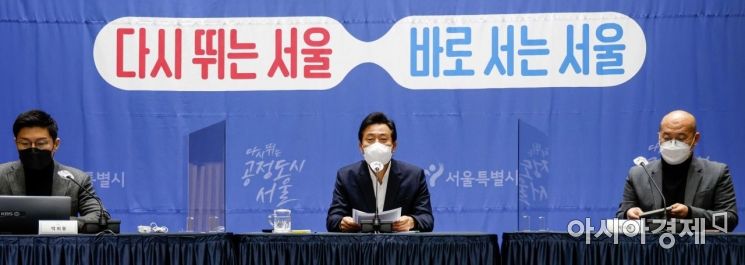 Seoul Mayor Oh Se-hoon is holding a New Year's press conference at Seoul City Hall on the 7th. Photo by Jin-Hyung Kang aymsdream@
[Asia Economy Reporter Kim Hye-min] Seoul Mayor Oh Se-hoon said on the 7th, "Since all candidates have pledged to ease reconstruction regulations, I expect significant changes once the new government takes office," adding, "Citizens will be able to feel the changes in government policies right after the presidential election."
At a New Year's press briefing held at Seoul City Hall on the same day, Mayor Oh said, "It would not be wrong to say that Seoul City has done almost everything it can regarding easing reconstruction regulations."
He added, "Now, only the central government's role remains. Issues such as easing overly strict safety inspections, the reconstruction excess profit recovery system, and the price ceiling system for pre-sale apartments are matters for the central government." He continued, "We predict significant changes under the new government, and the city will make every preparation to adapt to the field as quickly as possible."
Regarding the development of the Yongsan Maintenance Depot in Yongsan-gu, he said, "There is no place as meaningful as this, which is the last remaining space necessary to lead Seoul's economic revitalization," and added, "The 2040 Seoul Urban Master Plan will be finalized soon and announced within the first half of the year. The contents, including height and floor regulations, will greatly influence the development plan for the Yongsan Maintenance Depot."
On the utilization plan for the Yongsan U.S. military base, he stated, "The fundamental principles must be upheld. Since a law was enacted to preserve the naturalness of the space as it is, it should be utilized according to the original intent." Mayor Oh drew a clear line, saying, "I understand that some ruling party members have proposed a revision to the Yongsan Park Act to include a certain number of housing units, but I cannot agree with proposals or legal amendments that turn the entire area into an apartment complex due to the recent surge in real estate prices."
Regarding the slow progress in land return, he said, "There has been no progress even on the cleanup plan for some oil-contaminated sites. It seems impossible to receive the entire base back at once at this point," adding, "I think it is right to create a master plan and adjust it so that the space can be enjoyed as soon as it is returned, and I plan to convey this to the central government as well."
On the Yeouido reconstruction, he expressed the view that integrated development is practically difficult and said he would leave it to market order. Mayor Oh said, "It would be a more desirable and future-oriented development to gather several apartment complexes and establish and promote a comprehensive plan considering the placement of essential facilities," but he noted, "Currently, each complex is deeply immersed in its own interests."
He added, "Nevertheless, since it involves exercising individual property rights, I believe Seoul City should not force or induce joint development that it desires until the end. We have done as much as we can," and said, "Regarding the vision for Yeouido, I think we have no choice but to leave much of it to market order."
Regarding the conflict between the central government and Seoul City over supplying 3,000 housing units on the northern site of the former Seoul Medical Center in Gangnam-gu, he expressed hope that the government's stance would change after the new administration takes office. Mayor Oh said, "I think the central government's announcement of 3,000 units was an overreach to convey its intention to expand supply," adding, "We need to see how the government's direction changes after the presidential election. Seoul City's position remains unchanged."
He announced that he would present a development plan for downtown Seoul, including the Seun District in Jongno-gu, within the first half of the year. Mayor Oh said, "Not only the Seun District but also Gwanghwamun to Jongno 6-ga and Jongno to Toegye-ro are downtown areas of Seoul but have been neglected for 10 years," adding, "Seoul City's task is to build a consensus on how to harmonize this core area into a space for industrial vitality, a green space preserving naturalness, and a space that also preserves historical value."
He criticized, "I retired after proposing a method to enhance urban competitiveness by dividing the entire area into eight parts, but over 10 years, that vision has been completely disrupted. Now, it is divided into 171 parts, and when told to develop each individually, about 140 have been neglected, becoming low-rise dense areas unusable for business or residential purposes," adding, "To prevent further indiscriminate development, we will gather citizens' consensus to identify the direction and establish a development plan within the first half of the year."
© The Asia Business Daily(www.asiae.co.kr). All rights reserved.

![Clutching a Stolen Dior Bag, Saying "I Hate Being Poor but Real"... The Grotesque Con of a "Human Knockoff" [Slate]](https://cwcontent.asiae.co.kr/asiaresize/183/2026021902243444107_1771435474.jpg)














