Preference for Chinese LFP Batteries Including Tesla Amid Rising Raw Material Costs
Investment in Mining Companies and Risk Management
[Asia Economy Reporter Moon Chaeseok] As prices of key materials for electric vehicle batteries surge, the battery industry is making every effort to secure cost competitiveness. Judging that survival is difficult under the existing management method that links raw material prices to battery unit costs, companies are actively managing risks by signing supply contracts and making equity investments with mining companies. In particular, major automaker clients such as Tesla and Volkswagen prefer Chinese-made lithium iron phosphate (LFP) batteries, making it even more urgent for domestic battery companies, which mainly produce ternary batteries such as nickel-cobalt-manganese (NCM) and nickel-cobalt-aluminum (NCA), to secure cost competitiveness.
According to the Korea Resource Information Service on the 7th, the price of nickel reached $23,475 per ton as of the 4th, soaring 33.9% compared to the same period last year. This is the highest level since 2011. During the same period, cobalt rose 56.5% to $70,720 per ton, and manganese increased 20.8% to $1,685 per ton. Aluminum (LME 3-month spot) was $3,065, up 54.5%, and lithium carbonate jumped 429.2% to 362.5 yuan per kilogram.
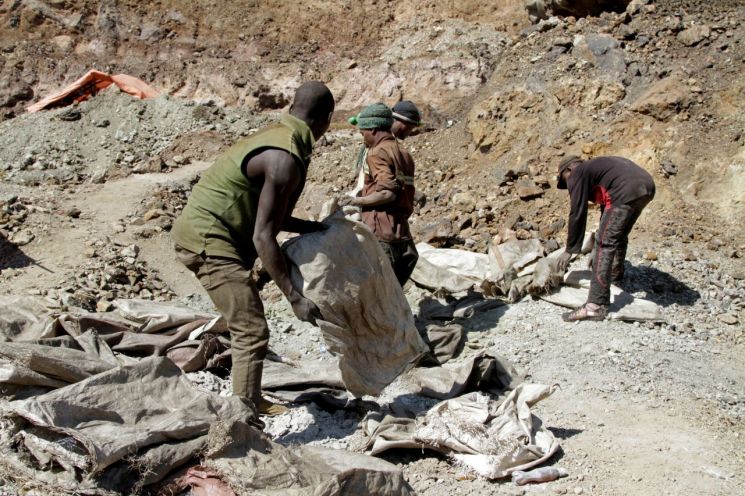
Notably, cobalt prices are soaring. They are higher than nickel, manganese, and aluminum, and supply risks are significant. Since cobalt is extracted as a byproduct when mining nickel and copper, its supply is relatively unstable and prices are high. South Korea imports 87% of its cobalt from China. Half of the world's cobalt reserves are located in the Democratic Republic of Congo (DR Congo), and China owns 15 out of 19 cobalt mines there, which is also problematic. South Korea's cobalt imports from China account for 87% of the total. Chinese companies are the biggest competitors to domestic battery manufacturers.
The fact that Chinese companies are the biggest competitors to domestic battery manufacturers is also a burden. Companies such as LG Energy Solution, SK On (parent company SK Innovation), and Samsung SDI, which supply mainly NCM and NCA batteries to automakers, inevitably face pressure. The unit cost of NCM and NCA batteries is higher than that of LFP batteries. LFP batteries use iron for cathode materials, resulting in lower production costs compared to NCM and NCA batteries. In fact, the price of batteries from China's CATL, which produces LFP batteries, is about $120?130 per kWh based on battery packs, while domestic battery prices are approximately 40% higher. For this reason, global automakers such as Tesla, Volkswagen, and Ford prefer LFP batteries. This is why the industry is as focused on reducing manufacturing costs as it is on increasing energy density (performance).
Accordingly, the domestic battery industry is directly engaging in supply contracts and equity investments with mining companies. Unlike in the past, when companies absorbed losses by delivering batteries at contract prices despite rising raw material costs, the approach has changed. Last month, LG Energy Solution signed a five-year supply contract starting in 2024 with Australian mining company Liontown for 700,000 tons of lithium concentrate (ore), a raw material for lithium hydroxide used to increase battery capacity. On the 31st of last month, LG Energy Solution also signed a five-year supply contract from 2025 to 2029 with Germany's Vulcan Energy for 45,000 tons of lithium hydroxide, which is expected to create synergy with the Liontown contract.
SK On plans to overcome the crisis by leveraging its affiliate supply chains, while Samsung SDI aims to develop affordable next-generation battery technologies. An industry insider said, "For items expected to face supply difficulties, we are closely monitoring the situation and responding by making efforts to secure inventory in advance."
© The Asia Business Daily(www.asiae.co.kr). All rights reserved.
!["The Woman Who Threw Herself into the Water Clutching a Stolen Dior Bag"...A Grotesque Success Story That Shakes the Korean Psyche [Slate]](https://cwcontent.asiae.co.kr/asiaresize/183/2026021902243444107_1771435474.jpg)
















