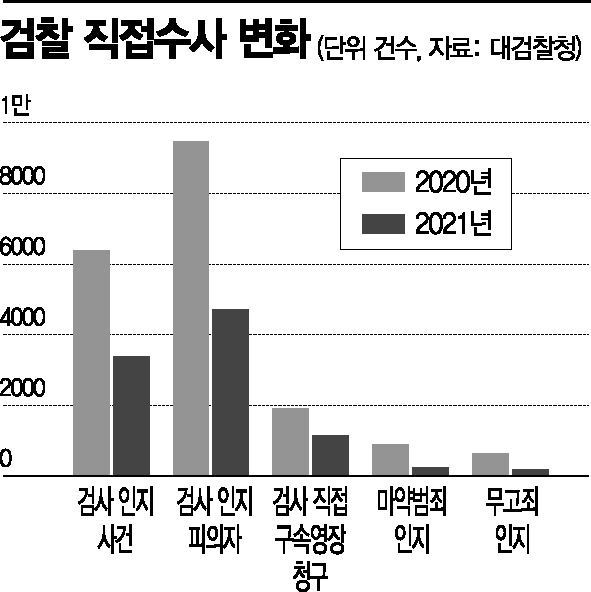
[Asia Economy Reporter Choi Seok-jin, Legal Affairs Specialist] Following the enforcement of the revised Prosecutors' Office Act and Criminal Procedure Act, which adjusted investigative authority between the prosecution and police, the total volume of direct investigations conducted by prosecutors last year decreased to about half compared to the previous year.
The number of cases sent by the police with prosecution opinions but dismissed by the prosecution, as well as cases that the police decided not to send but were later transferred to the prosecution upon objection by related parties, all increased.
It was revealed that clear definitions of the scope of "directly related crimes," which allow prosecutors to initiate investigations on related cases during police-transferred investigations, and the issue of investigative gaps in false accusation (mugo) cases need to be addressed.
According to the "One Year Analysis of Prosecutorial Work Following the Implementation of the Revised Criminal System" released by the Supreme Prosecutors' Office on the 7th, the number of prosecutor-initiated cases last year was 3,385, a 47.1% decrease from 6,388 cases in 2020. The number of suspects booked in prosecutor-initiated cases also dropped by 50.4%, from 9,467 in 2020 to 4,700 last year. The number of direct arrest warrant requests by prosecutors decreased from 1,807 in 2020 to 1,217.
By crime type, prosecutor-initiated cases for violations of the Narcotics Control Act (psychotropic substances and marijuana), false accusation, and fraud significantly declined. Due to the adjustment of investigative authority, only narcotics import/export-related crimes remain within the scope of direct investigation, excluding drug use and sales crimes. As a result, prosecutor-initiated cases for narcotics dropped by 73%, from 880 cases (1,026 suspects) in 2020 to 236 cases (291 suspects) last year.
Under current laws, when prosecutors investigate cases transferred from the police and discover additional crimes, they can only initiate direct investigations on "crimes of the same kind as the transferred crime." Therefore, even if prosecutors investigating a methamphetamine use case involving A identify B who sold methamphetamine to A or C who is a supplier, they cannot immediately start investigations on B or C. Instead, they must request supplementary investigations from the police or transfer the case back to the police. This has raised concerns about procedural delays and overlapping investigations.
Regarding false accusation (mugo), the revised law does not include it within the prosecution's direct investigative scope, so investigations are only possible for cases transferred by the police. However, many false accusation cases are dismissed by the police, making it impossible for the prosecution to initiate investigations. Consequently, the number of false accusation cases recognized and processed by prosecutors fell by 71%, from 625 cases (650 suspects) in 2020 to 179 cases (185 suspects) last year. While local prosecutors' offices request police to transfer cases requiring false accusation reviews, a more fundamental solution is needed.
Following the adjustment of investigative authority, the number of complaints and accusations directly received by the prosecution decreased by 75.9%, from 103,948 cases in 2020 to 25,005 last year. Additionally, 70.6% of these received complaints and accusations fell outside the prosecutor's investigative scope and were transferred to the police.
Last year, the number of cases transferred or sent by the special police (Sagyung) totaled 1,242,344 (692,606 general special police transfers + 74,185 special special police transfers + 475,553 general special police non-transfer records), reaching 95% of the 1,309,659 cases in 2020.
The number of special police transfers and submissions, which was only 60.5% in January last year compared to the previous year, continued to increase, recovering to previous levels. This suggests that the new system for receiving cases from the police has somewhat stabilized.
Moreover, prosecutions of cases transferred by the special police last year numbered 415,614, a decrease of about 36,000 from 451,913 in 2020. Among cases transferred with prosecution opinions by the special police, the number of cases dismissed by the prosecution increased by nearly 4,700, from 24,877 in 2020 to 29,573 last year.
Meanwhile, judicial oversight by the prosecution over cases dismissed by the police appears to be taking root.
Last year, prosecutors requested supplementary investigations for 85,325 cases (12.3%) out of 692,606 cases transferred by the general special police, and requested reinvestigations or supplementary investigations for about 22,000 cases (5.8%) out of 389,132 cases dismissed by the police. Additionally, corrective measures were requested for about 2,600 cases.
Specifically, among 389,132 records of police dismissal submissions, prosecutors requested reinvestigation for 14,494 cases, received 1,830 cases back (1,754 police decision changes + 76 transfer requests), and prosecuted 846 of these.
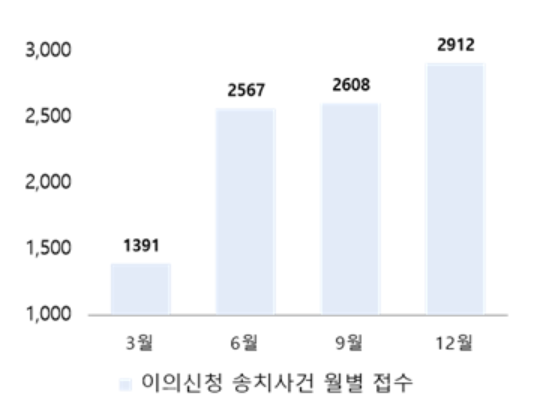
The number of cases transferred to the prosecution following objections by related parties to police dismissal decisions showed a continuous increase last year: 1,391 cases in March, 2,567 in June, 2,608 in September, and 2,912 in December. The monthly number of objection transfers, which was in the 1,000s early last year, approached 3,000 by the end of the year. Prosecutors received 25,048 cases through objections and prosecuted 528 of them.
Last year, the prosecution received a total of 1,390 cases transferred from the High-ranking Officials' Crime Investigation Office (Gongu Office) and forwarded them to local prosecutors' offices. Among cases transferred from the Gongu Office, the only case prosecuted by the prosecution was the case involving Seoul Metropolitan Office of Education Superintendent Cho Hee-yeon. The prosecution transferred or sent five cases to the Gongu Office, including the "Kim Hak-ui illegal deportation and investigation pressure" case, Prosecutor Lee Gyu-won's "Yoon Joong-chun false interview report" case, and the "accusation manipulation suspicion" case.
In July last year, the prosecution established Human Rights Protection Departments in eight district prosecutor's offices nationwide, requiring them to review and process 70% (70,579 cases) of warrants requested by the special police and over 60% (34,222 cases) of police dismissal records. Additionally, 34 prosecutors' offices at or above the level of deputy chief prosecutors were staffed with prosecutors having 18 to 21 years of practical experience as human rights protection officers, who conducted interviews with detained suspects on the day of transfer (a total of 5,750 cases) and performed specialized public relations duties.
Choi Ji-seok, head of the Criminal Policy Division at the Supreme Prosecutors' Office, which released this analysis, said, "The system is somewhat settling in, and we are trying to operate it according to its purpose." He added, "I hope improvements can be made to parts of the changed system, such as interpretations of 'direct relevance' and investigations of false accusations, which have brought unexpected difficulties."
© The Asia Business Daily(www.asiae.co.kr). All rights reserved.


















