Calls for Cement Grading System in Waste-Based Manufacturing Process
Industry "Safety Already Proven, Effective in Solving Environmental Issues" Opposes
Known as 'Green Cement' Overseas
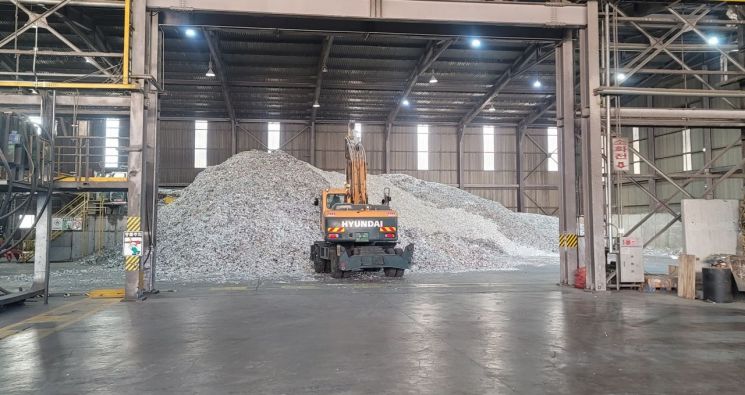 Waste plastics and other circular resources scheduled to be used in the manufacturing process at a cement plant are being transported. [Photo by Korea Cement Association]
[Asia Economy Reporter Kim Jong-hwa] "Cement contains fewer heavy metals than playground sand. Overseas, it is called ‘Green Cement,’ but uniquely in Korea, it is suspected as ‘Waste Cement.’"
This is the lament of a cement industry insider regarding the recent controversy over the introduction of a ‘Cement Grading System’ that requires the components and grades of waste (recycled resources) used in the cement manufacturing process to be disclosed. While Europe has been using waste as alternative raw materials and fuels (recycled resources) since the 1970s without any toxicity issues, Korea uniquely faces ongoing toxicity controversies.
Is waste-recycled cement actually harmful? Cement is made by mixing calcareous, clayey, siliceous materials, and iron oxide. These materials are crushed and mixed, then heated at high temperatures to produce an intermediate product called ‘Clinker.’ When gypsum is mixed in a certain ratio, cement is produced. Waste is used as fuel or recycled as raw materials in the cement manufacturing process. Coal ash, sludge (sewage treatment sediment), and discarded metal casting molds are recycled as raw materials. Waste used as raw materials accounts for about 6% of the total cement raw materials.
Some civic groups, including Democratic Party lawmaker Roh Woong-rae, recently pointed out problems with cement produced by recycling waste as raw materials at the ‘Waste Cement Component Labeling and Grading System Forum’ and argued for the necessity of a grading system. On the other hand, the cement industry strongly opposes this, saying, "The safety of recycled resource cement has already been proven, and it even helps solve environmental problems, yet it is being slandered as ‘Waste Cement.’"
Those advocating for the introduction of the cement grading system said, "Since cement made by inputting various wastes, even human feces, is being pointed out as a cause of sick house syndrome and atopy, management standards must be urgently established and strictly enforced."
However, the cement industry responded, "This is completely untrue." The industry argues that even when alternative raw materials are used in the cement process, the heavy metal content is no different from when natural raw materials are used; alkaline concrete hardens without leaching heavy metals; and stabilized sludge is recycled, but human feces are not used.
What about the Ministry of Environment’s investigation? The Ministry’s investigation found no difference in heavy metal content even when waste raw materials were used. The Ministry recently purchased cement products sold over the past 13 years and analyzed six heavy metal items, confirming that all heavy metal contents were within standard limits.
The Korea Cement Association quoted Eric Weinberger, Head of Environmental Health at Geocycle, saying, "All cement plants across Europe have used waste as recycled resources for over 50 years, but since concrete, which is alkaline, hardens and solidifies heavy metals internally to prevent leaching, no toxicity issues arise." Geocycle is Europe’s largest recycled resource recycling company.
Professor Kim Jin-man of Kongju National University explained, "Cement concrete has the characteristic of trapping heavy metals, and it has already been scientifically confirmed that heavy metals contained in concrete do not affect the human body."
Nevertheless, the controversy over ‘Waste Cement’ continues. The cement industry’s use of recycled resources has nearly tripled from 3.037 million tons in 2008 to 8.902 million tons in 2020 and continues to increase.
© The Asia Business Daily(www.asiae.co.kr). All rights reserved.

















