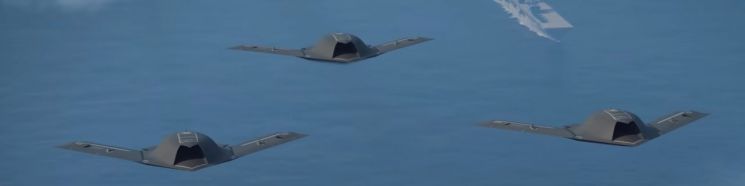
[Asia Economy Yang Nak-gyu, Military Specialist Reporter] Last year, the Defense Acquisition Program Administration released a 1 minute and 12 seconds video showing the Korean fighter jet KF-21 flying alongside three domestically produced stealth unmanned combat vehicles. The video appeared as if the unmanned combat vehicles were escorting the KF-21. However, these unmanned combat vehicles are not escorting the KF-21 but are the 'Gaori-X2,' designed to carry out independent attack missions. To observe the technological capabilities of various unmanned combat vehicles, I visited the Korean Air Tech Center located in Daejeo-dong, Gangseo-gu, Busan on the 24th of last month.
Upon entering the briefing room entrance at the center, models of various military aircraft including Korean Air commercial planes were lined up. There were no models of unmanned combat vehicles. A Korean Air official explained, "Unmanned combat vehicles are classified projects, so separate models were not made." As the briefing began, the veil over the unmanned combat vehicles started to be lifted one by one.
Korean Air developed the unmanned combat vehicle Gaori-X1 in 2014. The Gaori-X1 is a large unmanned combat vehicle measuring 10.4 meters in length, 14.8 meters in wingspan, and weighing 10 tons. The Gaori-X1 flew 50 km over 1 hour and 30 minutes, opening the possibility for unmanned combat vehicle development. Korean Air plans to develop the Gaori-X2 starting this year. The Gaori-X2 is an attack-type unmanned combat vehicle capable of independent bombing missions. It can stay airborne for more than 10 hours at a speed of Mach 0.8. For this reason, it is called a 'mini B-2 bomber.' The B-2 bomber is one of the three major strategic weapons of the United States and has a manta ray shape. The existing strategic bomber has stealth capabilities added, making it appear as small as a bird on radar, making identification impossible. Its greatest strength is the ability to conduct solo operations without escort fighters.
A company official led the reporter to Assembly Plant 2, saying they would show the materials of the Gaori-X2 with added stealth capabilities. Inside the plant were wings of the Airbus 320 commercial aircraft. The wing tips rise sharply like shark fins and are called Sharklets. The Sharklets, co-developed by Korean Air and Airbus, reduce fuel consumption by about 3.5%, extending the flight range by approximately 270 km.
Kim Jin-woo, Production Team Leader of Korean Air's Commercial Aircraft Business Division, said, "We will apply the technology co-developed with major airlines to unmanned combat vehicles to enhance operational capabilities," adding, "With Korean Air's composite material production capabilities, producing next-generation unmanned combat vehicles is not a problem."
Korean Air can supply parts to major aircraft manufacturers such as Boeing and Airbus because it uses composite materials. In the past, aircraft were made of aluminum. However, Korean Air developed and uses carbon fiber, which is strong and lightweight.
Separately from the unmanned bomber Gaori-X2, Korean Air plans to develop a manned-unmanned combined unmanned combat vehicle that will perform missions alongside Air Force fighter jets. The Gaori-X2 has no tail wing to reduce radar reflection area and enhance stealth performance. However, the manned-unmanned combined unmanned combat vehicle will be equipped with a tail wing because it needs to perform rapid maneuvers and stable flight together with fighter jets.
Boeing and the Australian Air Force are jointly developing an unmanned combat vehicle called the 'Loyal Wingman.' The Loyal Wingman means a loyal escort aircraft that performs dangerous missions in place of pilots. This unmanned combat vehicle is controlled by artificial intelligence (AI) and can operate as a team with other aircraft. Since it performs missions in high-threat areas, it is being developed in a form that is cheaper and mass-producible compared to manned fighter jets due to the higher risk of loss.
In December 2020, the U.S. Air Force flew the low-cost unmanned combat vehicle XQ-58A 'Valkyrie' alongside stealth fighters F-22 'Raptor' and F-35 'Lightning II' at the Yuma Test Range in Arizona. The test was to check whether the XQ-58 could properly relay communications between the F-22 and F-35. In the future, the Valkyrie is expected to take the lead ahead of the F-22 and F-35 to enter enemy territory for reconnaissance or attack missions.
© The Asia Business Daily(www.asiae.co.kr). All rights reserved.

















