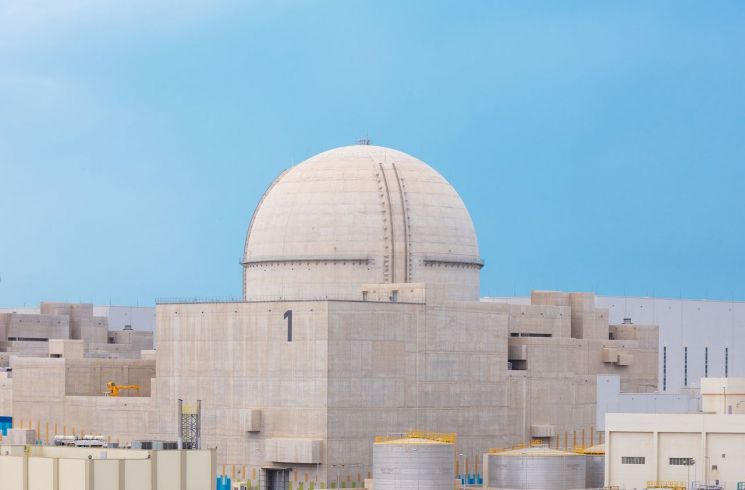
[Asia Economy Sejong=Reporter Dongwoo Lee] As the European Union (EU) has proposed a regulation classifying nuclear power investments as part of an environmentally and climate-friendly sustainable green taxonomy, voices are emerging in South Korea, which has taken a contrasting stance, calling for nuclear power generation to be included as eco-friendly energy. This comes as a global consensus is forming among major countries that the use of nuclear power and natural gas is essential to achieve carbon reduction targets.
According to the energy industry on the 5th, the EU recently finalized and proposed regulations to include nuclear power and natural gas development in the 'taxonomy' starting January next year. Taxonomy is a standard to determine whether a specific technology or industrial activity is 'eco-friendly.' Through this proposal, the EU has effectively recognized nuclear power and natural gas as green energy.
The regulation requires that investments in new nuclear power plants must receive construction permits before 2045 to be recognized as green economic activities, and countries planning to build nuclear plants must establish plans for radioactive waste management and funds for decommissioning nuclear plants. They must also have phased plans for operating radioactive waste disposal facilities until 2050.
However, this proposal can be rejected if 20 out of the 27 EU member states oppose it or if more than 353 members of the EU Parliament vote against it. Nevertheless, global energy experts generally agree that the likelihood of the EU proposal being rejected is slim, given the shift in the US and China toward supporting nuclear power development. Previously, the US government issued an executive order at the end of last year including nuclear power as zero-emission electricity, and China also announced at the end of last year plans to build 150 nuclear reactors by 2035, entering the nuclear development competition.
In contrast, the South Korean government, which maintains a nuclear phase-out policy, excluded nuclear power from the 'Korean Green Taxonomy (K-Taxonomy)' in December last year. Instead, it set a plan to conditionally include liquefied natural gas (LNG) development. The government argued that even if nuclear power is ultimately excluded from the K-Taxonomy, it would not affect actual exports. Moon Seung-wook, Minister of Trade, Industry and Energy, stated, "Judgments on nuclear power exports will be made according to the OECD's Export Credit Agency (ECA) guidelines rather than the K-Taxonomy," adding, "We do not expect direct issues with nuclear power exports."
Despite the government's explanation, the domestic business community emphasized the need to include nuclear power development in the K-Taxonomy. There are concerns that excluding nuclear power development from the K-Taxonomy could lead to the loss of next-generation technology investments and growth engines. The Federation of Korean Industries said, "The EU Commission's final proposal acknowledged that the use of nuclear power and natural gas is essential to achieve carbon reduction targets," and added, "The next government should review the K-Taxonomy and include nuclear power as green technology."
The government explained that it will first pilot the green taxonomy for one year while closely monitoring the results of the EU's green taxonomy proposal. An official from the Ministry of Environment said, "The exclusion of nuclear power from the K-Taxonomy is not yet finalized," and added, "We plan to review its inclusion through a social consensus process."
© The Asia Business Daily(www.asiae.co.kr). All rights reserved.
![Clutching a Stolen Dior Bag, Saying "I Hate Being Poor but Real"... The Grotesque Con of a "Human Knockoff" [Slate]](https://cwcontent.asiae.co.kr/asiaresize/183/2026021902243444107_1771435474.jpg)
















